Opinion
UNN, Science and Tech Minister and Enugu Politics
The more I investigate the controversy surrounding the allegation that the Minister of Science and Technology, Geoffrey Uchechukwu Nnaji didn’t graduate from UNN in July 1985, the more convinced I am that UNN Vice Chancellor, Prof. Simon Ortuanya acted very unprofessionally. I graduated from Unilorin and very well know that it is not the duty of a Vice Chancellor to keep academic records. It is the Registrar’s. Even when Premium Times contacted the VC, who, by the way, had barely been in office for two months, the least Prof. Ortuanya should have done was to have minuted the PT letter to the Registrar.
Secondly, the Premium Times’ letter was dated Monday September 29, 2025. By Thursday, October 2, 2025, the VC’s response was ready! Even if Premium Times had sent the letter by DHL on Monday September 29, the earliest it would have arrived in Nsukka, and then the VC’s table, would have been on Wednesday October 1, which was a public holiday! Now, assuming Prof. Ortuanya arrived in his office early on Thursday, October 2, it means the VC read the PT letter, investigated a matter that happened in 1985 (40 years ago) the same day, and replied Premium Times the same day! Prof. Ortuanya deserves a place in the Guinness book of world records for the most efficient public servant in history!
Thirdly, let us scrutinize the VC’s response to PT.
“From every available records and information from the University of Nigeria, Nsukka, we are unable to confirm that Mr Geoffrey Uchechukwu Nnaji, the current Minister of Science and Technology, graduated from the University of Nigeria in July 1985, as there are no records of his completion of study in the University of Nigeria, Nsukka.”
Now, but for vested interests, the VC could simply have said, “From every available records and information from the University of Nigeria, Nsukka, we are unable to confirm that Mr Geoffrey Uchechukwu Nnaji graduated from the University of Nigeria in July 1985, as there are no records of his completion of study in the University of Nigeria, Nsukka.” The fact that he added “the current Minister of Science and Technology” to his response smacks of a hatchet job.
If the foregoing smacked of a hatchet job, consider the VC’s follow up paragraph:
“Flowing from above, the University of Nigeria, Nsukka DID NOT and consequently, COULD NOT have issued the purported certificate, or at all, in July 1985 to Mr Geoffrey Uchechukwu Nnaji, the current Minister of Science and Technology.”
Let’s consider the preceeding paragraph. Aside the fact that the VC kept emphasising “current Minister of Science and Technology,” he also used the words “DID NOT” and “COULD NOT” in capital letters. We all understand what that means, don’t we?
Not convinced his delivery was sufficient, the VC, apparently for good measure, added: “This conclusion is also in consonance with an earlier letter dated May 13, 2025, ref. No, RUN/SR/R/V, issued by the University to the Public Complaints Commission in respect of the same subject matter (copy attached).” He offered Premium Times a letter they didn’t request!
Trying to make sense of what’s happening between the Minister of Science and Technology, Geoffrey Uchechukwu Nnaji, and his alma mater, University of Nigeria, Nsukka, will be futile if we fail to understand the politics of Enugu State, the trajectory of Mr. Peter Mbah’s emergence as governor, and the shape of things to expect in 2027.
The media has been awash with reports that Gov. Mbah is planning on defecting to the APC. The reports have come in fits and starts. Mbah’s people have neither denied nor confirmed the rumours. Whether true or imagined, one thing is certain. Should Mbah decide to move to APC, he’ll have to, first, bulldoze his way through Nnaji. To my mind, the current roforofo between UNN and Minister Nnaji is a mere smokescreen. Prof. Simon Ortuanya, who from all indications, Gov. Mbah helped become UNN VC, may have offered to pay back his master by whatever means necessary, including denting Nnaji with a certificate scandal. The end may be to use the media to blackmail President Tinubu into dropping Nnaji as Minister.
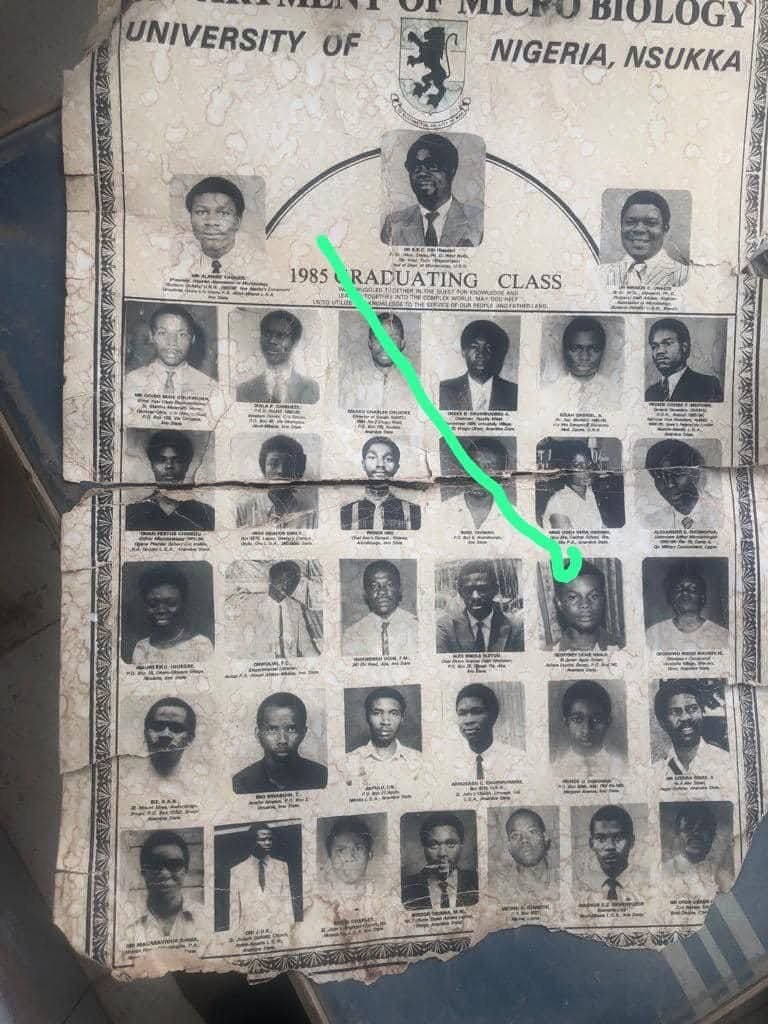
Whatever it is, Nnaji and his supporters are fighting back. They have released documents which appear to contradict the position of the VC. And the documents, including the one I posted here, appear to reinforce the argument that the VC may not have told the entire story.
I welcome your comments.
Department of Microbiology, University of Nigeria Nsukka
1985 Graduating Class
Academic Leadership
• Dr. E.E.C. Okafor – Head of Department
• Dr. N.N. Nwobu – Senior Lecturer
• Dr. S.O. Okafor – Lecturer
Graduating Students
- Okoro Godson N.
- Udeh Anthony C.
- Ijeoma Charles O.
- Obiekwe C.C.
- Nnaji Uchenna G. ✅ (highlighted in the image)
- Ezeaku F.C.
- Akaneme P.C.
- Okonkwo Fidelis N.
- Chukwuma E.E.
- Nwankwo R.
- Onyekwelu P.A.
- Ogbonna A.
- Umeora F.N.
- Eze A.N.
- Nwankwo B.C.
- Anyaegbunam C.
- Onah Francis
- Onwukwe E.
- Eze A.I.
- Okafor J.C.
- Obi S.O.
- Ogbuagu L.C.
- Nwankwo C.C.
- Okeke E.N.
- Ike E.C.
- Okeke J.C.
- Eze R.A.
- Ogbonna C.C.
- Ogbu E. N
- Oji A.E
- Okafor B. C
(bottom right edge)
️ Historical Note:
This 1985 class produced some of the department’s finest scientists and public figures, including Nnaji Uchenna G., later to become a key national figure and innovator. Their academic jo

Cover
Free Speech and the Principle of Defamation: Why Anyone Can Sue and be Sued
By Tony Asuquo
Seeking redress for reputational damage typically involves civil litigation for defamation (libel or slander), seeking damages for harm to reputation and the attendant emotional distress. In certain instances, financial losses are involved. Victims can pursue legal remedies, including monetary compensation and injunctions to stop further publication. In seeking redress, there is one key ingredient that tend to be glossed over: the assumption that the right to seek redress for reputational damage is exclusive to a particular individual or group of persons. The truth is that this right belongs to all- plebians and aristocrats; the poor and the rich. The weak and the powerful. A private citizen can sue a newspaper. A security officer can sue an individual , a group, or a Non Governmental Organisation (NGO). A government official can sue a newspaper or a media house.
The fact that the defendant is a rights organisation, a media outlet, or a civil society group does not automatically make the person seeking redress (plaintiff) wrong neither does it make the defendant right.
When those perceived as powerful in the society seek redress for reputational damage, such action should not and cannot be conceived as an act of intimidation. Victim psychology has no place here.
This principle has, time and again, been tested in courtrooms across the world. The outcomes have been constant. No one, no matter how highly or lowly placed, is above the law. This is what the general public should understand.
New York Times Co. v. Sullivan (1964)
To understand modern defamation law, one must begin in Montgomery, Alabama, United States. In 1964, a full-page advertisement placed in The New York Times by civil rights supporters contained several errors about the conduct of local police during protests.
L.B. Sullivan, the city’s police commissioner, sued the Times for libel, arguing that the errors damaged his reputation as a public official. An Alabama jury awarded him $500,000 in damages. The case reached the United States Supreme Court, which unanimously reversed the verdict in a ruling that fundamentally reshaped the relationship between free speech and defamation law.
Justice William J. Brennan Jr., writing for the Court, held that for a public official to succeed in a defamation claim, they must prove that the statement was made with “actual malice” meaning the publisher either knew the statement was false, or published it with reckless disregard for whether it was true or false. The Court reasoned that robust debate about public officials was essential to democracy, and that the fear of ruinous lawsuits would threaten that debate if the standard were lowered.
Regardless of the Supreme Court ruling, the fact remains that Sullivan was not denied his day in court because he held public office. Although he was held to a higher standard of proof, the ruling did not eliminate the right to seek redress; it calibrated it. The principle that emerged was not “public officials cannot sue” but rather “public officials must prove more.”
FBI Director Kash Patel Vs Atlantic Magazine
More than six decades after Sullivan, a strikingly parallel case emerged in Washington D.C. In April 2026, FBI Director Kash Patel filed a $250 million defamation lawsuit against The Atlantic magazine and reporter Sarah Fitzpatrick, following the publication of an article alleging that he had alarmed colleagues with episodes of excessive drinking and unexplained absences. And that his personal behaviour had become a threat to public safety.
Patel’s lawsuit argues that The Atlantic published the article with actual malice. Crucially, the same legal standard established in Sullivan’s case, having been warned before publication that the central allegations were categorically false, yet published it.
Patel is a public official who believes his reputation was dented by false reporting. Whether he succeeds or not is for the courts to determine. That he has the right to try is not in question.
Nasiru Dani Vs Sahara Reporters
Nigeria already has a settled judicial precedent that speaks directly to this principle, and it deserves far more attention in this conversation than it has received. In October 2024, the Federal Capital Territory High Court in Abuja ruled in favour of businessman and All Progressives Congress (APC) chieftain, Nasiru Danu, in a defamation suit he filed against Sahara Reporters.
The case arose from articles published by Sahara Reporters on 5 and 9 March 2021. The reports alleged that Danu and top officials of the Nigeria Customs Service defrauded the Nigerian government of ₦51 billion meant for the Customs Service. Justice Mohammed Zubairu found that the publication was false, that it referred to the claimant; and that it contained disparaging assertions against him. Above all, that it was communicated to the world via the internet.
The court awarded ₦20 million in damages and an additional ₦15 million in aggravated and exemplary damages and ordered Sahara Reporters to retract the articles and publish an unreserved apology on its website.
The court was pointed in its reasoning, finding that the failure of Sahara Reporters to justify the publication or retract it further proved that malicious intent behind it. It was not merely ruling on whether the publication was false, it was also ruling on the conduct of a media organisation that, confronted with the possibility that its reporting was wrong, chose to maintain it without justification.
The underlying principle the court affirmed is now part of Nigeria’s judicial record: an individual has the right to seek and obtain damages from a media organisation, however prominent, that publishes false and damaging allegations. That right applies regardless of how well-regarded the publication is, and regardless of how consequential its journalism may otherwise be.
DSS Officers vs. SERAP (2024)
In October 2024, two DSS operatives, Sarah John and Gabriel Ogundele filed a ₦5.5 billion defamation suit against the Socio-Economic Rights and Accountability Project (SERAP) after the organisation posted on X that DSS officers were “unlawfully occupying” its Abuja office. SERAP described the visit as harassment and intimidation and called on President Tinubu to intervene.
The officers who said they were on a routine familiarisation visit, signed a visitor’s register, and left before the post was made. The post went viral, attracted international condemnation, and resulted in both officers being suspended, investigated, and brought before a DSS disciplinary panel.
SERAP has characterised the lawsuit as a Strategic Lawsuit Against Public Participation (SLAPP), and Amnesty International called on Nigerian authorities to drop what it described as a “bogus defamation lawsuit.” The FCT High Court has since reserved judgment after both sides adopted their final written addresses on February 19.
Like Sullivan, the case turns on whether a publication that did not name individuals by name can still constitute actionable defamation when the individuals can be identified from the description. And like the Patel case, it asks whether those who work within powerful government structures retain the same fundamental right to protect their reputations as any other citizen.
SERAP’s Deputy Director, Kolawole Oluwadare admitted in court that he was not physically present during the visit and that the officers did not brandish weapons, damage property, assault staff, or force entry.
These cases; Sullivan, in 1960, Patel, in 2026, and DSS-SERAP in 2024, illustrate a principle that democratic societies have, for decades, been working to articulate the right to seek legal redress for reputational harm as universal. However, it is not unconditional, and it must be exercised with proportionality and genuine intent.
The freedom to speak comes with the responsibility to speak truthfully. And where that responsibility is breached and real harm results, courts exist to address it.
What distinguishes a legitimate defamation suit from a SLAPP is not who files it or who is sued. It is the question of purpose and proportionality: is the lawsuit genuinely aimed at obtaining justice for documented harm or otherwise? That question must be answered in every case, whether the plaintiff is a police commissioner in Alabama, an FBI director in Washington, or two security officers in Abuja.
Civil society organisations, human rights groups, and the media play an indispensable role in democratic life. They hold power accountable. They amplify voices that would otherwise go unheard. They expose abuses that institutions would prefer to bury. The credibility that makes this work powerful is built on accuracy, fairness, and a willingness to be held to the same standards demanded of others.
When a rights organisation publishes a statement that is factually wrong and causes real harm to identifiable individuals, those individuals do not forfeit their right to seek redress because their accuser carries a virtuous reputation. The law does not and should not create a privileged class of accusers who are immune from challenge. A government official, a security officer, a corporate executive, and a private citizen all carry the same fundamental right: the right to protect their reputation from destroyed by falsehoods. And the right to seek justice when it occurs.
The courts are not just deciding individual cases. They are drawing the lines of a conversation that every democratic society must have: where does the freedom to speak end, and where does the obligation to speak truthfully begin? The answer, as history has repeatedly shown, is not a line that protects only the powerful or only the seemingly marginalised. Since no one is believed to be above the law, this should be a line that protects everyone equally and holds everyone equally accountable.
Asuquo lives in Uyo
Cover
Peaceful Collaboration Over Chaos: Why Responsible Engagement Must Guide Edo’s Future And The Continued Leadership Of Dr. Osamwonyi Atu
By Aaron Mike Odeh
Recent developments in Edo State, where a group of youths disrupted a political engagement with chants of “no more promises,” have sparked intense reactions across the state. While such incidents may initially appear as expressions of civic frustration, a closer and more objective analysis suggests a more calculated undertone—one that reflects the handiwork of political adversaries determined to undermine credible leadership and obstruct continuity.
At the center of this unfolding discourse is the Deputy Speaker of the Edo State House of Assembly, Dr. Osamwonyi Atu, a leader whose track record in human capacity building and community development continues to resonate strongly with his constituents. His growing influence, rooted in tangible achievements, has understandably unsettled those who struggle to match his performance and grassroots connection.
It is important to acknowledge that Nigerian youths are not without legitimate concerns. Across the country, economic hardship, unemployment, and limited opportunities have fueled a sense of impatience and disillusionment. However, the recent disruption in Edo State does not convincingly reflect a spontaneous or organic protest. Rather, it bears the imprint of a sponsored jamboree—an orchestrated display designed to create a false narrative of widespread dissatisfaction.
Dr. Atu’s leadership has been defined by action rather than rhetoric. Over the years, he has championed initiatives aimed at empowering young people through skills acquisition programs, vocational training, and community-based development projects. These interventions have provided many with the tools to become self-reliant, thereby reducing dependence and fostering economic resilience at the grassroots level.
Beyond human capacity development, his contributions to community growth are both visible and impactful. From facilitating infrastructural improvements to supporting educational initiatives and social welfare programs, Dr. Atu has demonstrated a consistent commitment to improving the quality of life for his constituents. His approach to governance reflects a deep understanding of the needs of the people and a willingness to address them in practical and sustainable ways.
It is precisely these achievements that have made him a target of political opposition. Unable to counter his record with superior performance, his detractors have resorted to tactics aimed at discrediting his leadership. The so-called protest, therefore, should not be mistaken for genuine civic resistance; it is, in essence, an infatuation driven by envy and sustained by misinformation.
History offers clear lessons on the consequences of such theatrics. When politics is reduced to disruption and propaganda, governance suffers, and development is slowed. Edo State cannot afford to be distracted by such regressive tendencies at a time when continuity and stability are crucial for sustained progress.
Equally important is the need to emphasize the value of peaceful and constructive civic engagement. True democracy thrives on dialogue, accountability, and collaboration—not on orchestrated chaos. Citizens have the right to demand better governance, but that demand must be expressed in ways that strengthen, rather than weaken, democratic institutions.
Dr. Atu has consistently shown openness to engagement, maintaining accessibility to his constituents and demonstrating a willingness to listen and respond. This level of responsiveness is a hallmark of effective leadership and should be encouraged. It creates a foundation for trust and fosters a sense of shared responsibility between leaders and the people.
For the youth of Edo State, the path forward must be guided by discernment. Their voices are powerful, but their impact depends on how they are deployed. Allowing themselves to be used as instruments of political manipulation ultimately undermines their credibility and dilutes the legitimacy of their concerns. Instead, they must channel their energy into constructive participation—engaging in policy discussions, community development efforts, and the democratic process.
Political actors, on their part, must also rise above the temptation of short-term gains achieved through destabilizing tactics. The future of Edo State depends on issue-based politics that prioritizes development, unity, and the collective good over personal ambition and rivalry.
The recent incident should therefore be viewed not as a reflection of failure, but as a reminder of the challenges that accompany impactful leadership. It underscores the need for vigilance against attempts to distort reality and mislead the public.
In truth, the disruption represents little more than a fleeting spectacle—a jamboree lacking substance and authenticity. It cannot overshadow the concrete achievements and positive impact that Dr. Osamwonyi Atu has delivered over time. Edo people are discerning enough to recognize the difference between genuine leadership and politically engineered distractions.
As the state looks to the future, the emphasis must remain on consolidating gains and supporting leaders who have demonstrated capacity, integrity, and commitment. Continuity in leadership, particularly one that has proven effective, is essential for sustaining development and ensuring that progress is not reversed.
In conclusion, peaceful collaboration remains far more powerful than chaos in shaping a just and progressive society. Edo State stands to gain more from unity, dialogue, and strategic engagement than from disruption and division. Dr. Osamwonyi Atu exemplifies the kind of leadership that drives meaningful change—leadership rooted in service, impact, and a genuine commitment to the people.
Aaron Mike Odeh
A Public Affairs Analyst, Media Consultant, and Community Development Advocate wrote from Post Army Housing Estate, Kurudu, Abuja
Opinion
Beyond Partisanship To People Centred Policies And Programs: The Peter Mbah Paradigm
In a political environment often shaped by sharp divisions and party loyalty, leadership that rises above partisanship is both rare and compelling.
Peter Mbah represents a tiny class of Nigerian leaders whose governance philosophy is anchored less on political alignment and more on measurable service delivery. His emergence on the public stage reflects not just a transition from private enterprise to public office, but a deliberate effort to redefine leadership through results, inclusivity, and long-term vision.
Mbah’s administrative style is deeply influenced by his background in business and strategic management. Before assuming public office, he built a reputation in the private sector where efficiency, timelines, and outcomes are non-negotiable. This experience has translated into a governance approach that treats public service with a similar sense of urgency and accountability. Rather than relying on political rhetoric, his leadership emphasizes structured planning, clear targets, and performance-driven execution.
One of the most relatable and visible aspects of Mbah’s leadership is his commitment to infrastructure development. Across urban and rural communities, road construction and rehabilitation projects have aimed to improve connectivity, ease transportation, and stimulate local economies. For many residents, this translates into shorter travel times, reduced transportation costs, and improved access to markets, schools, and healthcare facilities. In areas that were once difficult to access, new or rehabilitated roads have begun to change daily realities, farmers can move produce more efficiently, traders can expand their reach, and families can commute with greater ease.
Beyond roads, Mbah’s focus on economic revitalization has been evident in efforts to attract investment and create an enabling environment for businesses. By promoting policies that support enterprise growth, he has sought to generate employment opportunities, particularly for young people. Initiatives aimed at boosting small and medium-sized enterprises (SMEs) have helped local entrepreneurs access resources, expand operations, and contribute to economic activity within their communities. This focus on job creation is especially significant in a country where youth unemployment remains a pressing challenge.
Education stands out as another cornerstone of his developmental agenda. Mbah has consistently advocated for improved learning environments, teacher capacity development, and the integration of technology into classrooms. Efforts to upgrade school infrastructure and introduce digital learning tools are designed to prepare students for a modern, knowledge-driven economy. For parents and students alike, these interventions represent hope for a more competitive and empowered future.
Healthcare delivery has also featured in his governance priorities. Investments in primary healthcare centers, alongside efforts to improve staffing and medical supplies, are aimed at bringing quality healthcare closer to the people. In practical terms, this reduces the burden on families who previously had to travel long distances for basic medical attention, while also improving response times in emergencies.
Another defining feature of Mbah’s leadership is his emphasis on security and social stability. Recognizing that development cannot thrive in an environment of insecurity, his administration has supported measures to strengthen local security frameworks and foster collaboration between communities and law enforcement agencies. The goal is to create a safe environment where businesses can operate confidently and residents can go about their daily lives without fear.
Importantly, Mbah’s governance style reflects an awareness that development must be inclusive. His policies and projects are often framed in ways that cut across political, ethnic, and social divides. By focusing on common needs, roads, schools, jobs, and healthcare, he has been able to build a broader base of support that extends beyond party lines. This ability to connect with diverse groups reinforces the idea that effective leadership is rooted in shared progress rather than partisan victory.
Transparency and accountability also form part of his governing ethos. By setting clear goals and communicating progress, his administration seeks to build public trust and ensure that governance remains people-centered.
Some have argued that Governor Peter Ndubuisi Mbah is obsessively Partisan and Pro Tinubu BUT understanding that independent candidacy is not known to our Laws, and conscious of the fact that even the best of leaders need a Political Party platform, we can connect with Mbah’s politics which without an ounce of equivocation is centred on better life for Ndi’Enugu, better integration for the people of the South East and in making good governance the summum bonum.
What makes Governor Peter Mbah the shining light of this Republic is the noticeable effort of his government to maintain a reform-oriented posture and respond to evolving needs. Peter Mbah’s leadership offers a practical example of what governance beyond partisanship can look like. His focus on tangible improvements, better roads, stronger schools, expanded economic opportunities, and improved healthcare, makes his impact relatable to everyday citizens.
The other day the Peter Mbah led government in Partnership with the French Government ably represented by the Ambassador of France in Nigeria flagged off Pipe-borne water projects for the benefit of the good people of Enugu State.
Conscious of the creed of his government which is service, and better life for the People, he has since embarked on eradicating all avenues and channels of double and multiple taxation in Enugu State ranging from the Civil Service, to the Local Government and the Markets, indeed when Mbah says the FUTURE IS HERE, he is MADly (MAKING A DIFFERENCE) committed to it.
The legacy projects of Governor Peter Mbah are lucid, they are beyond Partisanship and wistful propaganda, and are not abstract achievements; they are changes that affect how people live, work, and aspire.
As Nigeria continues to navigate complex political and developmental challenges, leaders who prioritize service over sentiment will remain critical to progress. Mbah’s trajectory suggests that while politics may define the pathway to power, it is performance that ultimately defines legacy.
His story serves as a reminder that the true essence of leadership lies not in political identity, but in the ability to deliver meaningful and lasting change.
Okechukwu Nwafor
Concerned Professionals For Good Governance (A Good Leadership Advocacy Group).
-
Cover8 months agoNRC to reposition train services nationwide.. Kayode Opeifa
-
Fashion9 years agoThese ’90s fashion trends are making a comeback in 2017
-
Entertainment9 years agoThe final 6 ‘Game of Thrones’ episodes might feel like a full season
-
Opinion1 year agoBureaucratic Soldier, Kana Ibrahim heads Ministry of Aviation and Aerospace After Transformative Tenure at Defence
-
Politics4 weeks agoNNPP Diaspora Stakeholder and Key Kwankwaso Ally, Dr. Usman Tijjani Shehu, Rejoins APC
-
Opinion1 year agoHon. Daniel Amos Shatters Records, Surpasses Predecessor’s Achievements in Just Two Years
-
Opinion5 months agoBarrister Somayina Chigbue, Esq: A rising legal leader shaping institutioal excellence in Nigeria
-
News9 months agoNigerian Nafisa defeats 69 Countries at UK Global Final English Competition