Cover
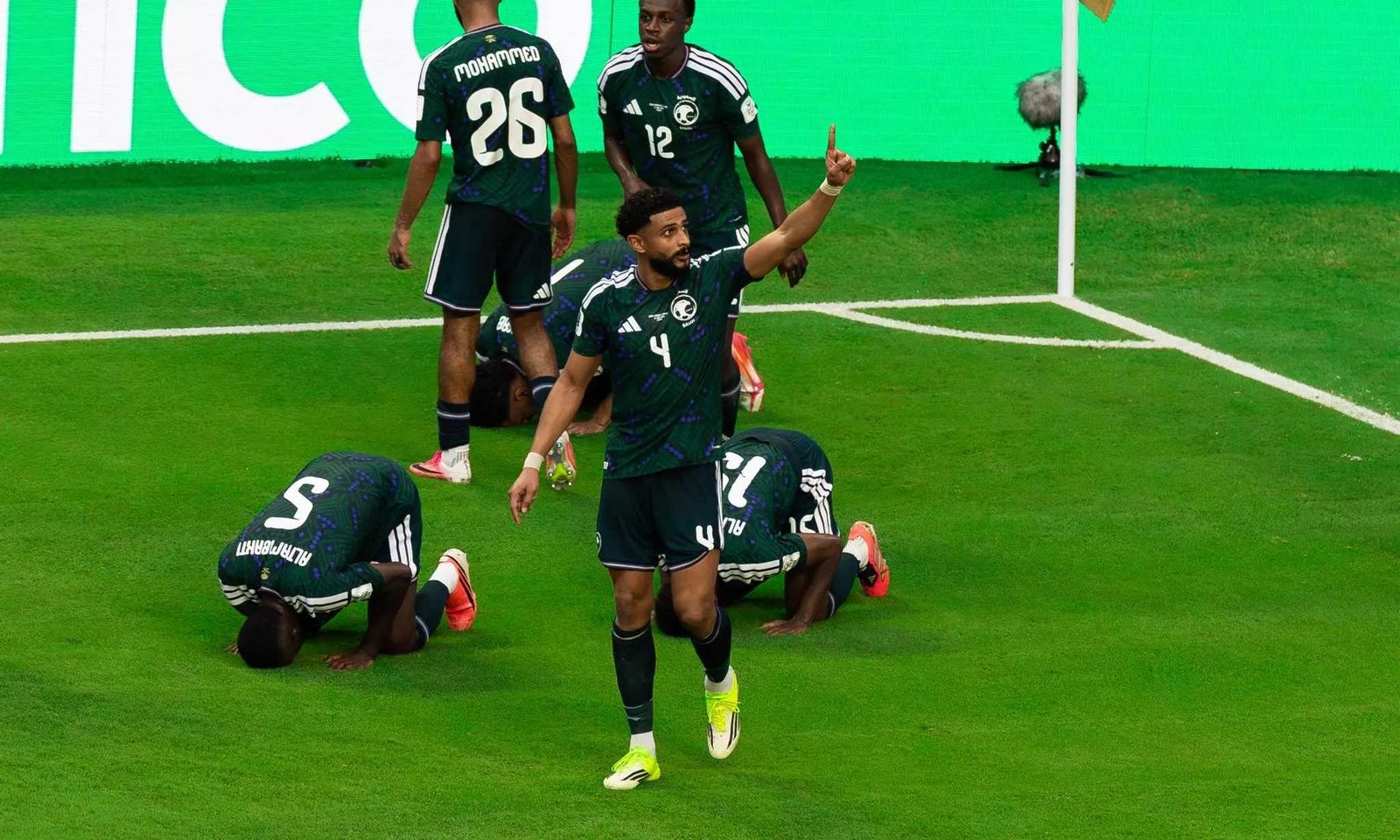
Saudi Arabia Holds Uruguay in Hard-Fought Draw
Saudi Arabia produced a disciplined performance to frustrate Uruguay in a tense World Cup encounter that ended 1-1 yesterday. The match, played before a packed stadium, showcased grit, tactical awareness, and moments of brilliance from both sides.
Uruguay entered the contest as favorites, boasting attacking stars and a reputation for physical dominance. Yet Saudi Arabia matched them stride for stride, refusing to be overwhelmed. The Saudis pressed intelligently, closed spaces, and countered with pace, forcing Uruguay to rethink their approach.
The breakthrough came midway through the first half when Uruguay capitalized on a defensive lapse. A sharp cross from the right found its way to their striker, who finished clinically to put his side ahead. The goal seemed to confirm expectations of a Uruguayan victory, but Saudi Arabia responded with resilience.
Minutes before halftime, Saudi Arabia equalized. A well-worked move down the left flank ended with a precise cutback, and the forward calmly slotted home. The equalizer ignited the Saudi fans, who roared their team on with renewed belief.
The second half was a battle of endurance and tactical adjustments. Uruguay pushed forward, seeking to reclaim the lead, but Saudi Arabia’s defense held firm. Their goalkeeper produced crucial saves, including a fingertip stop from a curling free-kick that looked destined for the top corner.
Saudi Arabia, meanwhile, threatened on the break. Their wingers exploited gaps left by Uruguay’s advancing full-backs, creating nervy moments. One counterattack nearly produced a winner, but the shot flew narrowly wide.
As the final whistle blew, both teams had reasons for mixed emotions. Uruguay rued missed chances and their inability to break down a determined opponent. Saudi Arabia celebrated a point earned through discipline and courage, proving they could stand toe-to-toe with one of football’s traditional powers.
The draw leaves Group standings finely balanced. Uruguay must sharpen their finishing if they hope to progress comfortably, while Saudi Arabia’s spirited display boosts their confidence heading into the next fixture. For neutral fans, the match was a reminder of the unpredictability of the World Cup, where determination can rival pedigree.

Cover
Appeal Court’s Rebuke of Judicial Overreach Electoral Stakes
The Court of Appeal in Abuja has suspended the enforcement of a judgment that ordered the deregistration of five political parties, including the African Democratic Congress (ADC). The ruling not only preserves the parties’ legal standing for now but also underscores a deeper issue: judicial discipline and the protection of Nigeria’s electoral framework.
Court of Appeal’s Firm Stand
In a unanimous decision, the three-member panel led by Justice A. B. Mohammed criticized Justice Peter Lifu of the Federal High Court for ignoring its earlier directive to halt proceedings. The appellate court described the lower court’s action as “judicial impertinence” and warned that such defiance undermines the hierarchy of courts.
By granting a stay of execution, the Court of Appeal reaffirmed its supervisory authority and signaled that judicial orders must be respected to safeguard the integrity of the legal system.
Political Parties in Limbo
The affected parties—ADC, Action Peoples Party (APP), Action Alliance (AA), Accord Party (AP), and Zenith Labour Party (ZLP)—remain recognized pending further hearings. Justice Lifu had earlier ruled that the parties failed to meet constitutional thresholds for continued existence, citing poor performance in the 2023 general elections and subsequent by-elections.
The suspension of that judgment means the parties can still participate in political activities, at least until the appeal is resolved. For smaller parties, the ruling offers temporary relief and a chance to fight for survival in Nigeria’s crowded political space.
ALSO ROAD
ADC’s Atiku-Amaechi Signals Bold Realignment Ahead of 2027
Reps Aspirant Drags NDC to Court Over N5bn Claim
Constitutional Benchmarks at Issue
At the heart of the dispute is Section 225A of the 1999 Constitution, which requires parties to secure at least 25 percent of votes in a state during a presidential election or win an elective seat at any level of government. The National Forum of Former Legislators (NFFL), which filed the suit, argued that the five parties consistently failed to meet these benchmarks.
Their position reflects a broader debate: should Nigeria streamline its political system to strengthen viable parties, or should it preserve space for smaller groups that represent diverse voices?
Electoral Implications
The timing of the appellate court’s intervention is critical. INEC is preparing for by-elections across six states, and deregistration of parties could have disrupted candidate nominations and voter expectations. Analysts warn that sudden changes in party status risk confusing the electorate and weakening confidence in democratic processes.
By staying the judgment, the Court of Appeal has provided stability ahead of these polls, ensuring that voters and candidates are not caught in legal uncertainty.
Judicial Integrity in Focus
Beyond electoral concerns, the case highlights the importance of judicial accountability. The appellate court’s rebuke of Justice Lifu sends a strong message that disregard for superior orders will not be tolerated. Legal experts argue that decisive action is necessary to maintain public trust in the judiciary.
The ruling also raises questions about how courts balance constitutional requirements with political realities. While performance thresholds are designed to ensure relevance, enforcement must follow due process and respect judicial hierarchy.
The appeal will determine whether the five parties remain registered or face deregistration before the 2027 general elections. For now, the suspension preserves their political identity and gives them room to contest the allegations of irrelevance.
The case is more than a battle over party registration. It is a test of Nigeria’s judicial discipline, electoral integrity, and the resilience of its democratic institutions.
Cover
INEC’s Legal Battle Over Deregistration Sparks Debate
The Independent National Electoral Commission (INEC) has moved to the Court of Appeal in Abuja, seeking a stay of execution on the judgment that ordered the deregistration of five political parties, including the African Democratic Congress (ADC).
The case has quickly evolved beyond a dispute over party registration. It now raises broader questions about judicial hierarchy, respect for appellate authority, and the credibility of Nigeria’s electoral process.
INEC’s Position
INEC told the appellate court it was blindsided by the ruling of Justice Peter Lifu of the Federal High Court, who delivered judgment despite an earlier order halting him. The Commission’s lawyers argued they only learned of the decision through media reports, not official notification.
By supporting the appeal lodged by the affected parties, INEC signaled its concern that the judgment could disrupt upcoming by-elections and undermine electoral stability. The Commission stressed that it does not oppose the request to suspend the ruling until the appeal is determined.
ADC’s Pushback
Counsel for the ADC, Shuaibu Aruwa (SAN), accused Justice Lifu of defying the appellate court’s authority. He revealed that the party was informed of the judgment via WhatsApp, a method he described as irregular and disrespectful to judicial procedure.
ALSO READ
Alex Ekubo: Daddy Freeze Mocks Nathaniel Bassey Over ‘Failure’ To Perform Miracle
Omo-Agege Endorses Obi For 2027, Maintains Support For Tinubu’s Economic Policies
Aruwa urged the Court of Appeal to sanction the trial judge, warning that such defiance invites anarchy. He argued that the judiciary must protect its integrity by ensuring lower courts comply with superior orders.
Wider Implications
The controversy comes at a sensitive time. INEC is preparing by-elections across six states, and the deregistration order could complicate candidate nominations and voter expectations. Political analysts warn that uncertainty over party status risks confusing the electorate and weakening confidence in democratic institutions.
The case also highlights the constitutional thresholds for party survival. Section 225A of the 1999 Constitution requires parties to win at least 25 percent of votes in a state during a presidential election or secure an elective seat at any level of government. The ADC and four others—Action Peoples Party (APP), Action Alliance (AA), Accord Party (AP), and Zenith Labour Party (ZLP)—were found to have failed these benchmarks.
Former Legislators’ Role
The suit was filed by the National Forum of Former Legislators (NFFL), who argued that the continued existence of underperforming parties undermines Nigeria’s electoral system. They pointed to poor showings in the 2023 general elections and subsequent by-elections as evidence of irrelevance.
Their position reflects a growing debate about whether Nigeria’s political landscape should be streamlined to strengthen viable parties or remain open to smaller groups that represent diverse interests.
Judicial Integrity at Stake
Beyond party politics, the case underscores the importance of judicial discipline. The Court of Appeal now faces pressure to assert its authority and prevent lower courts from disregarding its orders. Legal experts note that failure to act decisively could erode public trust in the judiciary.
As proceedings continue, the spotlight remains on whether the appellate court will suspend the judgment and address the conduct of the trial judge. The outcome will shape not only the fate of the five parties but also the perception of Nigeria’s judicial and electoral institutions.
Cover
Four Goals, No Winner As Iran And New Zealand Draw
Iran and New Zealand delivered a thrilling spectacle in today’s World Cup clash, ending in a 2-2 draw that kept fans on edge until the final whistle. The match was a showcase of attacking intent, defensive lapses, and sheer determination from both sides.
Iran started brightly, pressing high and forcing New Zealand into early mistakes. Their reward came in the 12th minute when a quick exchange of passes split the defense, allowing the striker to finish with composure. The early goal lifted Iranian supporters, who sensed their team could dominate.
New Zealand responded with resilience. They grew into the game, using their physical presence and aerial strength to unsettle Iran’s backline. Their equalizer arrived midway through the first half, courtesy of a towering header from a corner. The goal shifted momentum, and New Zealand began to dictate play.
Iran regained the lead just before halftime. A swift counterattack caught New Zealand off guard, and a low drive from the edge of the box found the bottom corner. The 2-1 scoreline reflected Iran’s sharpness in transition and their ability to punish defensive gaps.
The second half was a battle of nerves. New Zealand pressed forward, determined not to leave empty-handed. Their persistence paid off in the 68th minute when a well-placed shot from distance beat the Iranian goalkeeper. The equalizer set up a tense finale, with both teams chasing a decisive strike.
Iran nearly snatched victory late on. A curling effort from their captain rattled the crossbar, leaving fans gasping. New Zealand also had chances, with one close-range effort blocked heroically by Iran’s defense. In the end, neither side could find the breakthrough.
The draw leaves both teams with mixed emotions. Iran will regret missed opportunities to secure all three points, while New Zealand will take pride in their fightback. For the group standings, the result keeps qualification hopes alive but adds pressure ahead of the next fixtures.
This match highlighted the unpredictability of the World Cup. Iran showed flair and speed, while New Zealand demonstrated grit and determination. Four goals, shared spoils, and a reminder that football often defies expectations.
-
Cover10 months agoNRC to reposition train services nationwide.. Kayode Opeifa
-
Fashion9 years agoThese ’90s fashion trends are making a comeback in 2017
-
Entertainment9 years agoThe final 6 ‘Game of Thrones’ episodes might feel like a full season
-
Politics2 months agoNNPP Diaspora Stakeholder and Key Kwankwaso Ally, Dr. Usman Tijjani Shehu, Rejoins APC
-
Opinion1 year agoBureaucratic Soldier, Kana Ibrahim heads Ministry of Aviation and Aerospace After Transformative Tenure at Defence
-
Opinion1 year agoHon. Daniel Amos Shatters Records, Surpasses Predecessor’s Achievements in Just Two Years
-
Opinion6 months agoBarrister Somayina Chigbue, Esq: A rising legal leader shaping institutioal excellence in Nigeria
-
News11 months agoNigerian Nafisa defeats 69 Countries at UK Global Final English Competition