Cover
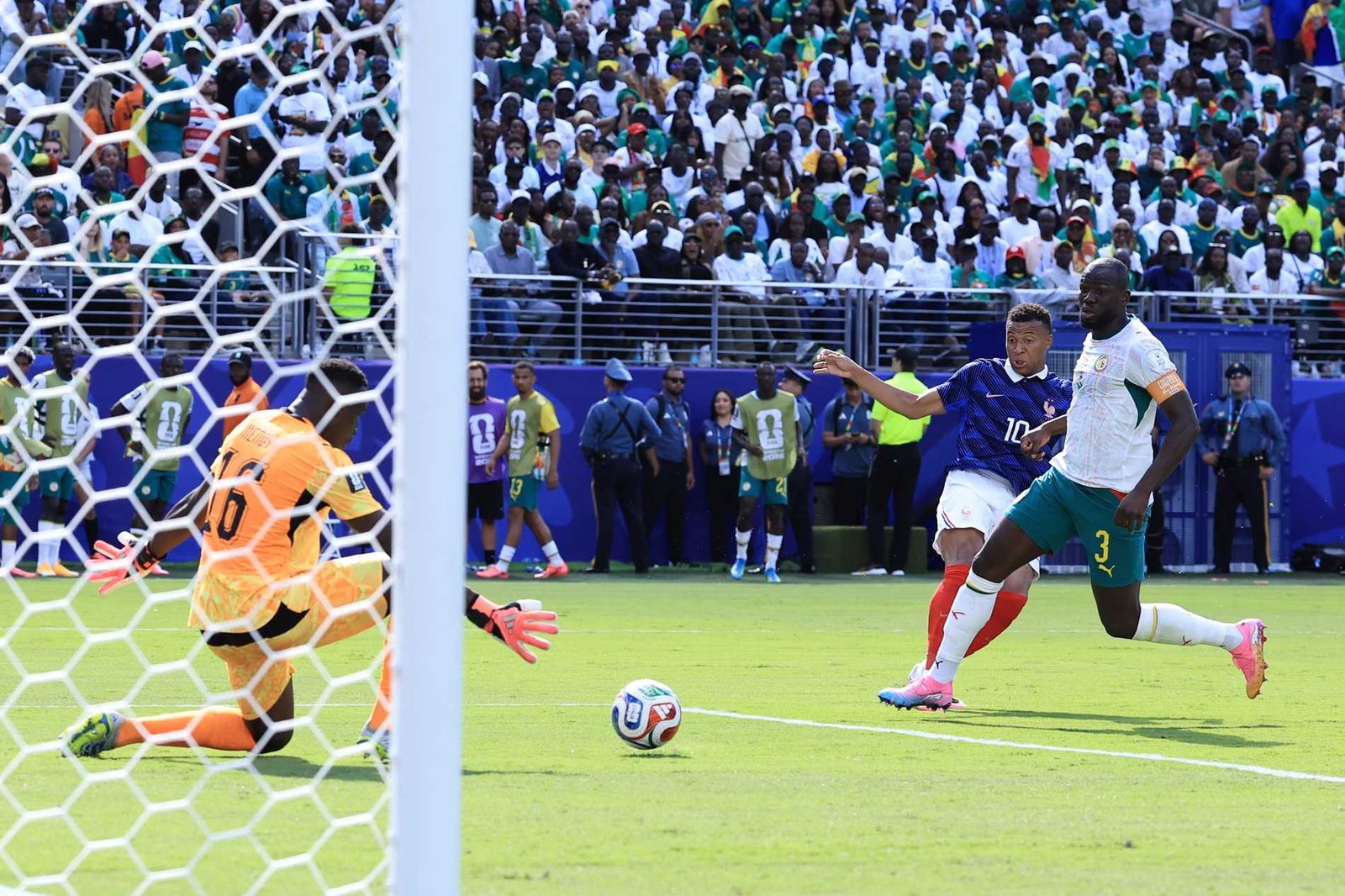
France Show Class In Victory Over Senegal
Mbappe scores twice as Les Bleus brush aside a spirited Senegal side 3-1 at MetLife Stadium to open their 2026 World Cup campaign in commanding fashion
France arrived at MetLife Stadium in East Rutherford, New Jersey, carrying the memory of 2002 — the last time these two nations met at a World Cup, the night Senegal stunned the reigning world champions and sent shockwaves through global football.
On Tuesday night, Les Bleus made sure there would be no repeat. A dominant 3-1 victory, built on two Kylian Mbappe goals and a Bradley Barcola strike, confirmed France’s class and intent — and sent a clear message to every other team in Group I and beyond.
A Disciplined First Half, Then France Took Control
The opening 45 minutes belonged to neither side in the most decisive terms, but France controlled the ball — finishing the first half with 58 per cent possession — without finding a way through a compact, well-drilled Senegalese defensive shape.
Kalidou Koulibaly marshalled his backline with the authority of an experienced leader, limiting France to patient, probing build-up play that lacked a final incisive moment. Senegal absorbed the pressure without panic, staying organised and dangerous on the counter.
At half-time, the scoreline read 0-0 — and Senegal’s disciplined performance gave their supporters genuine reason for optimism.
Mbappé Ends the Deadlock
France emerged from the interval with far greater urgency. The shift in tempo was immediate and decisive.
Kylian Mbappé broke the deadlock in the 66th minute, finishing with the composure that defines his game at the very highest level. The goal was the product of France’s sustained second-half pressure — and once it arrived, the contest began to open in ways that suited Les Bleus perfectly.
The world’s most dangerous forward had announced himself on the 2026 World Cup stage. It would not be his last contribution of the evening.
Barcola Adds the Second
Bradley Barcola extended France’s lead in the 82nd minute, adding a third goal to the tally and removing any remaining doubt about the outcome.
The Paris Saint-Germain winger — Champions League winner and a player in the form of his career — converted to make it 2-0 and give France the cushion their performance deserved. Barcola’s energy and directness throughout the second half created problems that Senegal’s defence simply could not contain.
Senegal Pull One Back — Then Mbappé Has the Last Word
Senegal refused to surrender quietly. Ibrahim Mbaye pulled one back in the 90th minute, injecting brief drama into the closing moments and giving the Lions of Teranga a consolation their second-half resilience merited.
But Mbappe had the final say. In the sixth minute of added time, he added his second goal of the match to complete a 3-1 scoreline that accurately reflected France’s overall superiority — and delivered the Golden Boot contender a two-goal return from his first World Cup appearance of 2026.
Mbappe now has eight goals in seven World Cup games across his career — a staggering return for a player still only 27 years old and very much in his prime.
Senegal’s 2002 Ghost Remains Unmatched
For Senegal, the defeat ends any immediate comparison with the class of 2002 that arrived in the pre-match build-up. That famous victory — achieved when Senegal were debutants and France were defending champions — remains one of the World Cup’s greatest upsets. Tuesday’s fixture produced a different result but no shortage of effort from Aliou Cisse’s side.
The Lions of Teranga showed sufficient defensive organisation and tactical intelligence in the first half to suggest they remain a competitive side at this level. Nicolas Jackson worked tirelessly up front before being replaced by Bamba Dieng. Iliman Ndiaye came on to inject creativity in the second half.
But France’s quality — and specifically Mbape’s — proved the difference in a match where the margin between the teams was narrower than the scoreline suggests for at least 65 minutes.
France’s Attacking Depth on Full Display
What this performance confirmed for France — and for any nation monitoring Group I — is the depth and quality behind Mbappe in Didier Deschamps’ attacking structure.
Barcola scored and impressed throughout. The supporting cast of Ousmane Dembele, Michael Olise, Rayan Cherki, and Desire Doue provides Deschamps with attacking options that few other international managers can match.
France do not merely have one world-class forward. They have a system that creates multiple threats simultaneously — and Mbappe, operating with that kind of support around him, is arguably at his most dangerous when the opposition are forced to decide who to prioritise.
Group I Outlook
France top Group I after the opening round. Their next fixtures — against Norway’s Erling Haaland and one other group opponent — will provide the sternest tests of their tournament credentials.
Senegal must now regroup quickly. Three points dropped to the group’s strongest side in the opening match means there is no margin for error. The Lions of Teranga are capable of advancing — but Tuesday’s loss demands an immediate and convincing response.
For Nigerian fans watching from home — and across West Africa, where both France and Senegal command enormous followings — Tuesday evening at MetLife Stadium delivered exactly the spectacle the tournament promised.
Mbappe is here. France are here. And based on this opening night, both look capable of being present all the way to the final.

Cover
Eyes On Judiciary: Court Halts Deregistration of 5 Parties
A Judiciary Under Scrutiny
Nigeria’s judiciary is once again at the center of political controversy. The Court of Appeal’s decision to halt the deregistration of five opposition parties—ADC, Action Alliance, Action Peoples Party, Accord Party, and Zenith Labour Party—was not just a legal correction. It was a rebuke of judicial overreach and a reminder of the fragile balance between law and politics.
The appellate court’s sharp criticism of Justice Peter Lifu’s ruling highlights a deeper issue: the credibility of Nigeria’s judicial system. By ignoring a superior court’s directive, the lower court risked undermining the very foundation of judicial hierarchy.
INEC’s Position and the Shock Factor
The Independent National Electoral Commission (INEC) supported the stay of execution, admitting it only learned of the lower court’s judgment through media reports. This revelation raises questions about transparency in judicial processes. How could the nation’s electoral umpire be sidelined in a matter that directly affects its mandate?
INEC’s stance suggests that even institutions central to Nigeria’s democracy are vulnerable to sudden judicial maneuvers.
Opposition Parties and the Fear of Shrinking Space
For the affected parties, the ruling was more than a technical legal battle. It was a fight for survival. Political actors like Gbenga Olawepo-Hashim and Prince Adewole Adebayo warned that deregistration would weaken opposition politics and pave the way for a one-party state.
Their concerns echo a broader fear: that Nigeria’s democratic space is shrinking under coordinated political and judicial pressures.
The Constitutional Debate
Supporters of the lower court ruling, such as Ondo State Attorney-General Kayode Ajulo, argue that the judgment was a faithful interpretation of Section 225A of the 1999 Constitution. This provision empowers INEC to deregister parties that fail to meet electoral performance thresholds.
But critics counter that democracy is not merely about thresholds. It is about choice, pluralism, and the right of citizens to associate freely. The clash between constitutional enforcement and democratic ideals is at the heart of this controversy.
Political Fallout Ahead of 2027
The timing of the deregistration battle is crucial. With the 2027 elections looming, opposition parties see the ruling as part of a broader strategy to consolidate power around the ruling APC. Allegations of political intimidation, defections, and judicial manipulation fuel suspicions of a deliberate plan to weaken rivals before the polls.
Timi Frank’s warning of a potential national crisis underscores the stakes. If opposition parties are deregistered, Nigeria risks sliding into political instability.
Judicial Discipline and Integrity
The appellate court’s language was unusually strong, describing Justice Lifu’s conduct as “judicial impertinence” and “rascality.” Such terms reflect frustration within the judiciary itself. The call for disciplinary measures against errant judges is not just about this case—it is about restoring public confidence in the courts.
Without judicial integrity, democracy cannot thrive.
Civil Society and Democratic Resistance
Civil society groups and political coalitions like the Conference of Nigeria Political Parties (CNPP) and the Inter-Party Advisory Council (IPAC) have framed the deregistration attempt as a direct assault on Nigeria’s democratic system. Their statements highlight a growing resistance to what they describe as “executive rascality” and “state capture.”
This resistance is vital. Democracy survives not only through institutions but also through active citizen engagement.
The Bigger Picture: Democracy at a Crossroads
Nigeria’s democracy is at a crossroads. The deregistration saga is more than a legal dispute—it is a test of whether the country can maintain a multiparty system in the face of political consolidation.
The Court of Appeal’s intervention offers temporary relief, but the underlying tensions remain. As the 2027 elections approach, the battle over party survival will shape the future of Nigeria’s political landscape.
The Court of Appeal’s decision to halt the deregistration of five opposition parties is a victory for judicial hierarchy and democratic pluralism. Yet, it also exposes the fragility of Nigeria’s institutions and the risks of political manipulation.
Whether Nigeria can safeguard its democracy depends on the integrity of its judiciary, the vigilance of its citizens, and the resilience of its political parties. The coming months will reveal whether this ruling was a turning point—or merely a pause in a larger struggle for democratic survival.
Cover
2027: NDC mandates governorship, National and State Assembly candidates to sign anti-defection forms
The Nigeria Democratic Congress (NDC) has introduced a new measure to discourage defections among its members after elections.
The measure requires all the governorship and National Assembly candidates to sign an indemnity form committing them to vacating their seats if they leave the party after winning elections on its platform.
The move was unveiled by the party’s national chairman, Moses Cleopas, during the signing ceremony at the party’s national secretariat in Abuja on Tuesday.
The occasion was attended by aspirants and candidates, ahead of the 2027 general elections.
Mr Cleopas explained that the development was not a witch-hunt but aimed at protecting the sanctity of electoral mandates and curbing what he described as “post-election political migration.”
He said the party would not tolerate situations in which elected officials abandon the platform that brought them to office while seeking to retain the mandate.
“The mandate belongs to the party and the people who voted through that platform. If you leave the party after winning, you cannot continue to hold the seat,” he said.
The national chairman explained that the policy was intended to ensure that candidates clearly accept the condition before contesting elections on the NDC platform.
“We are putting this in black and white. Once you take the ticket, you are bound by it. If you leave, you leave with the seat,” he said.
Referencing political realignments across parties, including the Labour Party, he said such cases underscored the need for stricter internal safeguards.
“In the Labour Party, we have seen situations where people won elections on the platform and later moved elsewhere. That is the kind of thing we are trying to stop,” he said.
On the legal basis of the policy, Mr Cleopas cited provisions from both international and domestic legal frameworks, arguing that while freedom of association is guaranteed, it does not automatically extend to retaining elective office after defection.
He specifically referenced Section 14 and Article 11 of the African Charter on Human and Peoples’ Rights.
“It guarantees political participation and freedom of association, including the right to join or leave political parties,” he said.
Mr Cleopas also cited provisions of the 1999 Constitution (as amended), arguing that democratic rights must be balanced with party-based electoral mandates.
According to him, elected officeholders are products of party nomination systems and therefore cannot separate their mandates from the platform that sponsored their election.
The Nigeria Democratic Congress (NDC), further stated that the new anti-decamping initiative is a constitutional and moral safeguard against political prostitution and opportunistic defections.
The party clarified that the measure does not bar any elected official from leaving the party but insists they must relinquish the mandate obtained on the party’s platform.
“It’s an NDC-backed innovation to stop decamping and political prostitution,” the party said. “Anyone who wants to leave, they are free to leave, but you will have to vacate the seat. And that is even what the Constitution says. So our position aligns with the Constitution.”
The party drew a clear distinction between genuine party divisions and self-serving defections. “If there is a division in the party as defined by the Constitution, there’s no problem, you can go! The Constitution covers you in that case. But where you just feel on your own that you have won and you wish to leave to get a better deal with another party, you can go, but you will vacate the seat.”
The party emphasized that elected officials retain the right to exit but cannot take the mandate with them. “The elected official still reserves the right to leave the party, but what we are saying is that you can’t go with the mandate. Go and contest on a new platform. There will be a by-election for you to contest. This was the case in the First and Second Republics,” the party added.
Citing historical precedent, the party referenced former Jigawa State Governor Sule Lamido’s resignation from the Peoples Redemption Party (PRP). “Sule Lamido, when he left PRP, he resigned. It’s an honourable thing to do and that’s what people were doing — you resign and go to a new party and contest. Even in the UK, that’s the way it is.”
The NDC explained that the requirement for an affidavit under the new policy merely reinforces existing constitutional provisions. “The affidavit is not adding anything to the Constitution; it only reinforces the Constitution. This increases the moral standing of the party and authorises the party to pursue your declaration to ensure that the seat is declared vacant — in black and white, signed by you on oath.”
Addressing concerns about the party’s nascent stage, the NDC acknowledged teething problems but urged patience. The NDC, which is barely four months old, has faced challenges with primaries and other internal processes, issues he noted are common even among established parties in government.
“NDC is working towards becoming an inclusive and attractive platform for anybody to want to stay, and we want everybody to stay and build the party with us,” the statement said. “If things are not right, stay and make it right. Don’t destroy it and leave. If things are good, stay and make it better.”
The party leadership appealed to stakeholders to bear with the party’s “baby steps,” pointing to ongoing reforms such as the digitalisation of primaries and the anti-decamping initiative. The leadership described these moves as evidence that the NDC is building a genuine political institution rather than a one-man show or special purpose vehicle (SPV).
“We have always talked about building a party like the ANC, the Democratic Party, Republican Party, Conservative Party, and the Labour Party in the UK. This is the direction the NDC seems to be going, and aspirants, leaders and supporters need to key in,” the party leadership stated.
Explaining further, the party’s national legal adviser, Reuben Egwuaba, expanded on the constitutional argument, saying the NDC constitution itself contains enforceable clauses on defection.
Mr Egwaba cited Articles 1, 2 and 3 of the NDC constitution, which, according to him, establish that elected officials remain bound by the party platform through which they were elected.
“These provisions make it clear that once you are elected under the NDC, your mandate is tied to the party. If you resign from the party, you cannot retain the office,” he said.
Cover
After Owo, Katsina Death Sentences, Kogi Court Imposes Maximum Penalty On Man Arrested By DSS For Kidnapping, Murdering Neighbour
Barely 24 hours after a Katsina State High Court sentenced to death a female arms courier arrested by the Department of State Services (DSS), a High Court of Kogi State has also imposed the death penalty on a man the DSS successfully prosecuted for kidnapping and murdering his neighbour, who ran a hotel in Obajana.
The Katsina and Kogi sentences came less than two weeks after a Federal High Court sitting in Abuja, imposed the death penalty on four men arrested by the DSS for carrying out the June 5, 2022 terrorist attack on St. Francis Catholic Church in Owo, Ondo State.
The Kogi court, presided over by Justice Abdul Nicodemus Awulu, on Tuesday, found Jibrin Halilu guilty on the charges of conspiracy and kidnapping, in contravention of Sections 12, 6 (1), and 4 (3)(a) of the Kogi State Kidnapping and Other Related Offences Prohibition Law, 2023. The court subsequently sentenced Halilu to death.
According to the prosecution, on March 23, 2023, Halilu and other members of his armed gang stormed Ever Ready hotel, Angwa-Tiv, in Obajana town,
abducting the proprietor, Uche Andrew Offo. Even though Offo’s family handed his abductors the N2.5 million ransom they demanded, they, nonetheless, killed him.
The DSS prosecutor told the court that operatives of the Service arrested Halilu on December 4, 2025.
“DSS investigations revealed that, while with his abductors, Offo was able to identify Halilu, who happened to be his neighbour, as being part of those who kidnapped him. That was when Halilu, despite the N2.5 million ransom he collected from Offo’s family, still killed him.
“Further investigations by the DSS also linked Halilu and his gang to the April 2, 2023 kidnapping of one Ibrahim Abdullahi, a resident of Oshokoshoko Community in Lokoja, from whom the gang collected a N5 million ransom,” a source also revealed.
The Kogi and Katsina convictions and sentencings come on the heels of a June 3, 2026, landmark verdict by a Federal High Court in Abuja sentencing four men to death for their roles in the June 5, 2022 terrorist attack on St. Francis Catholic Church in Owo, Ondo State.
The court sentenced the quartet of Idris Abdulmalik Omeiza, Al Qasim Idris, Jamiu Abdulmalik, and Abdulhaleem Idris to death by hanging for the attack which resulted in the death of over 40 worshippers and left over 100 persons injured.
“These convictions mark a significant run of courtroom victories for the DSS, reinforcing the message that those who engage in terrorism, kidnapping, and armed violence will not only be caught, but will be prosecuted and made to face the full consequences of their actions,” the source declared.
-
Cover10 months agoNRC to reposition train services nationwide.. Kayode Opeifa
-
Fashion9 years agoThese ’90s fashion trends are making a comeback in 2017
-
Entertainment9 years agoThe final 6 ‘Game of Thrones’ episodes might feel like a full season
-
Politics2 months agoNNPP Diaspora Stakeholder and Key Kwankwaso Ally, Dr. Usman Tijjani Shehu, Rejoins APC
-
Opinion1 year agoBureaucratic Soldier, Kana Ibrahim heads Ministry of Aviation and Aerospace After Transformative Tenure at Defence
-
Opinion1 year agoHon. Daniel Amos Shatters Records, Surpasses Predecessor’s Achievements in Just Two Years
-
Opinion6 months agoBarrister Somayina Chigbue, Esq: A rising legal leader shaping institutioal excellence in Nigeria
-
News11 months agoNigerian Nafisa defeats 69 Countries at UK Global Final English Competition