
Opinion
Kano’s Mass Wedding Bonanza and the Politics of Numbers

By Oluwafemi Popoola
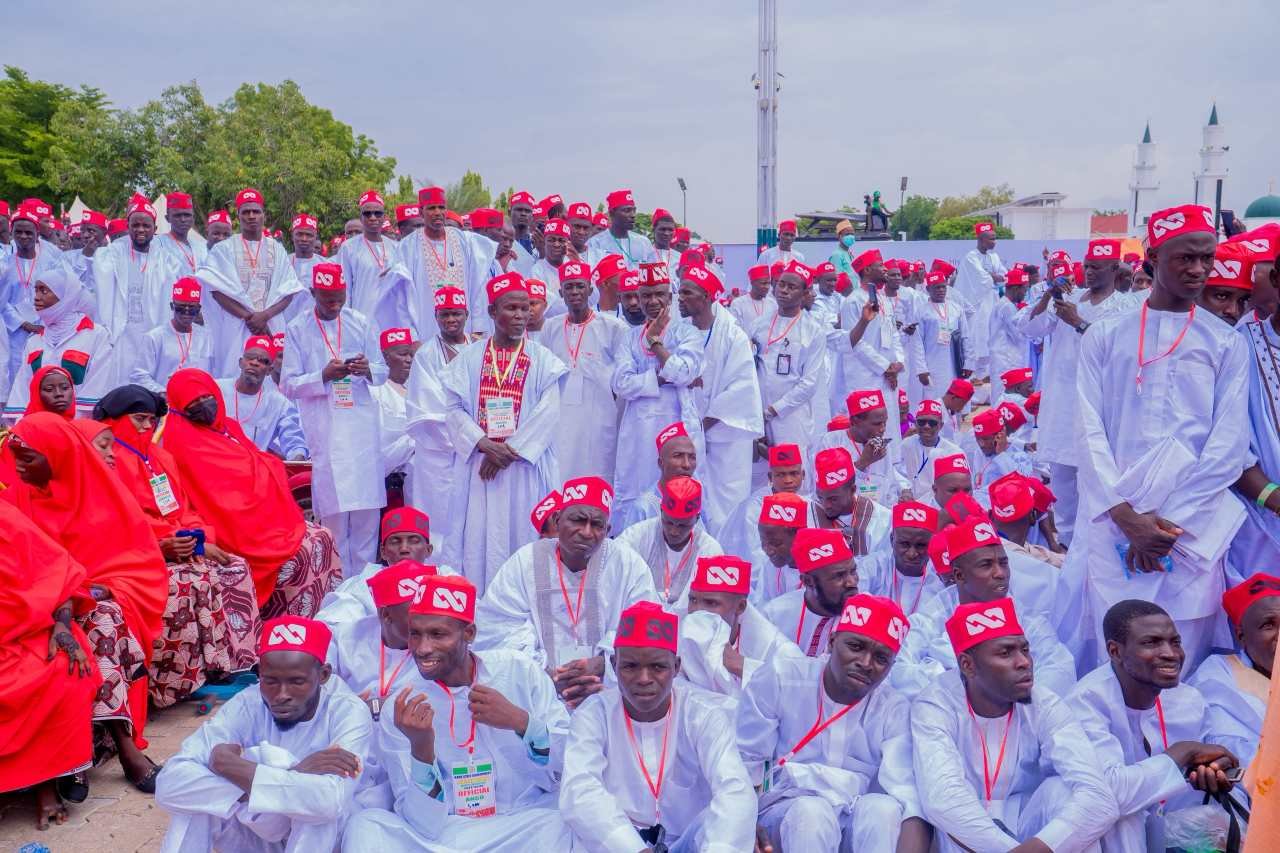
They arrived in pairs, a procession of brides and grooms dressed almost like members of the same grand production. Each pair carrying the quiet theatre of people about to begin a shared life. White flowed through the gathering like a common uniform, broken by deliberate touches of red. Their red caps bore the same striking insignia seen on Governor Abba Yusuf’s cap, the symbol of President Bola Ahmed Tinubu. Whatever political poetry the caps were meant to communicate, only the people wearing them are perhaps best positioned to explain it.
The mood, for the most part, was one of celebration. There were smiles, excitement and the unmistakable glow of people caught in the optimism of a new beginning. The videos from the ceremony painted an even more curious picture. The spectacle was so carefully arranged, so large and synchronised, that it occasionally bordered on comedy. Not comedy at the expense of the newlyweds, but comedy born from the strange visual marriage of three worlds: the pageantry of politics, the solemnity of religion and the festivity of matrimony, all occupying the same stage, as if they had agreed that, for one day, there was room for everyone.
The Kano state government under the leadership of Governor Yusuf Abba on Saturday, August 8, 2026 brought 1,500 couples together in what has become popularly known as Auren Gata, a state-sponsored mass wedding programme. The event was coordinated by the Kano State Hisbah Board and targets people from low-income backgrounds, including widows, widowers, divorcees, spinsters and bachelors.
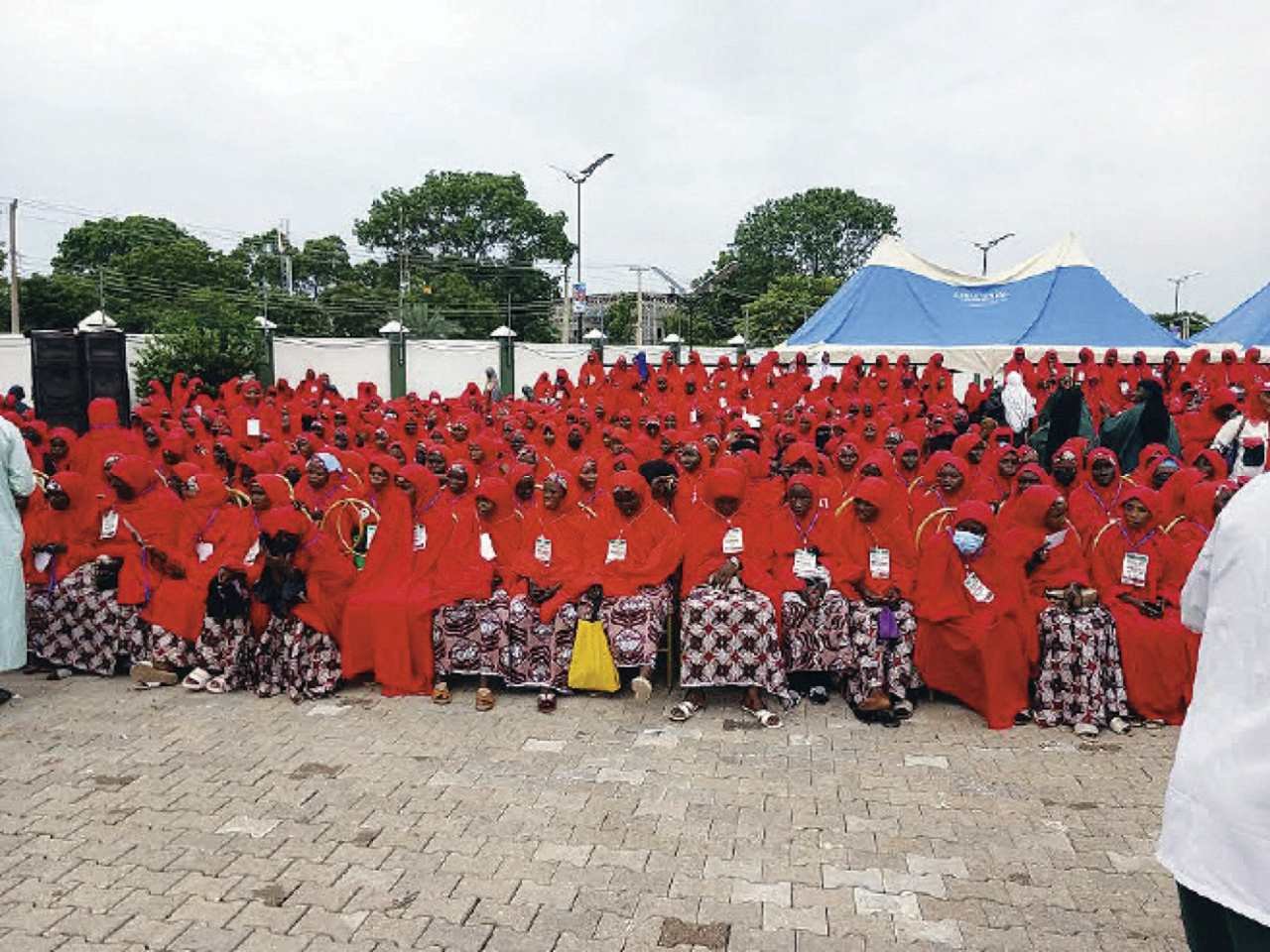
For many of the couples, however, this was the fulfilment of a long-awaited dream. Getting married in Nigeria has become an expensive ambition, and for people already struggling financially, the cost of a wedding can be enough to postpone marriage indefinitely. Governor Abba Yusuf said the programme fulfilled a promise he made during the 2023 election campaign. Under the initiative, the government supported 1,500 couples with household items, financial assistance and dowry support. The state said ₦100,000 was provided as dowry for each bride, alongside other support. The government also says the entire intervention cost about ₦1.5 billion. A whopping ₦1.5 billion! That figure deserves to be allowed to sit on the table for a moment.
The programme, popularly known as Auren Gata, is hardly new. Kano introduced it in 2012 under former Governor Rabiu Musa Kwankwaso, initially targeting widows and divorcees who faced social and economic barriers to remarriage. That first experiment eventually expanded, with successive administrations continuing the programme and increasing the number of beneficiaries. In 2012, Kano was already describing mass weddings as a response to divorce, poverty and the economic difficulties surrounding marriage. The 2026 edition also included beneficiaries in polygamous marriages, reflecting the Islamic framework within which the programme operates.
And this is where my questions begin.
There is something deeply troubling about spending ₦1.5 billion to help people enter marriage when the bigger question is whether the economic ecosystem around them is strong enough to sustain those marriages. Marriage is not the difficult part. Feeding a family is. Paying rent is. Keeping children in school is. Healthcare is. Employment is. Building a future is.
If a man cannot afford the basic cost of getting married, helping him cross that first financial hurdle may be compassionate. But what happens on Monday morning? The government cannot permanently provide food, school fees, rent, medicine and jobs for every household created by the programme.
And this is where the debate about northern Nigeria’s education crisis becomes unavoidable. UNICEF says the North has significantly lower school attendance than the national picture, with female attendance particularly poor in the North-East and North-West. It also notes that some children receiving Qur’anic education do not receive basic literacy and numeracy skills.
If 1,500 couples eventually have four children each, that is 6,000 children. If they have three, that is 4,500. Suddenly, what looked like 1,500 weddings becomes a demographic question. And if those children grow up without quality education, healthcare, employable skills and economic opportunities, we have not solved poverty. We have simply given poverty new surnames.
That is what I mean when I talk about systemic illiteracy. A child who is born into poverty, leaves school early, marries young, has several children and then raises those children without adequate education is not necessarily making an individual bad choice. Sometimes the system has made the better choice almost impossible.
Some Nigerians now argue that the mass wedding is strategic: that political actors want larger families because “their power is in their numbers,” and that more children eventually translate into more voters. That is a serious allegation. Whoever has the evidence should take it to court. Perhaps the courtroom will reveal the grand population strategy. Perhaps the answer is much less dramatic: politicians simply love anything that produces immediate gratitude and photographs.
But the politics hovering around the ceremony made the argument considerably hotter. Sheikh Sani Yahaya Jingir, leader of the Izala Scholars Council, used the occasion to defend the Muslim-Muslim ticket and called on Muslims to vote in a manner that would demonstrate their numerical strength. When criticised, he did not retreat. Instead, he reaffirmed his support for the arrangement.
Suddenly, the language of marriage acquired another meaning. Marriage produces numbers; numbers produce population; and in Nigeria, population is never entirely innocent of politics. The statement therefore opened an uncomfortable window into the arithmetic by which communities are sometimes encouraged to think of themselves less as citizens demanding good governance and more as voting blocs whose numerical weight must be displayed.
That is the more disturbing possibility: that a population can be celebrated for its size while being denied the tools to transform that size into genuine power. Critics have argued that the North’s political elite has benefited from a cycle in which mass poverty and inadequate education remain unresolved because an educated, economically independent population would be far more difficult to control.
Then came the videos.
From the short clips circulating online, I saw reports of an older man celebrating his marriage to a 17-year-old girl. Another man, aged 54 according to reports, proudly announced that he had married a third wife. In a NewsCentralTV clip that went viral, he reportedly said: “I just married another wife, and I am happy that I have married another one. My wives are now three.”
Naturally, somebody will ask: why is a man who already has two wives receiving government-supported assistance to marry a third when the economic capacity to sustain the household is itself questionable? And, like Bob Dylan would say, the answer is blowing in the wind.
The important point is that Kano’s mass wedding is not inherently a bad idea. Governments can legitimately help vulnerable people marry. Similar mass-wedding traditions exist elsewhere. South Korea’s Unification Church, for example, became famous for ceremonies involving thousands of couples, sometimes matched by the church itself. In 2013, about 3,500 couples from 70 countries participated in one such ceremony. Mass weddings have also appeared in Bangladesh and Indonesia for reasons ranging from challenging expensive marriage customs to helping poor couples reduce costs. The difference is what happens after the photographs.
If Kano can spend ₦1.5 billion helping 1,500 couples begin married life, imagine what ₦1.5 billion deliberately invested in girls’ education, vocational training, schools, maternal healthcare, reproductive-health education and employment programmes could do over ten or twenty years. That is the question I would rather ask. Not whether these people deserve marriage. They do. Not whether they deserve happiness. They certainly do. But whether a society can keep making marriage cheaper while leaving education, employment and human capital expensive.
Because population is not automatically power. An educated population is power. A healthy population is power. A skilled population is power. A population trapped in poverty is simply a larger population trapped in poverty. Otherwise, ₦1.5 billion may have bought 1,500 wedding photographs while leaving the next generation to pay the bill.
And perhaps that brings me back again to Bob Dylan. In his 1963 protest song Blowin’ in the Wind, Dylan asks how long people can exist before they are allowed to be free and how many times we can look away pretending not to see. His official site preserves the song’s famous refrain: “The answer, my friend, is blowin’ in the wind.”
Oluwafemi Popoola is a Nigerian journalist, media strategist, and columnist. He can be reached via bromeo2013@gmail.com


Kano LG Finance Deputy Director, Balarabe Muhammad, Dies

Portugal: ‘It Makes It Difficult To Like You’ – Gary Neville Slams Cristiano Ronaldo

Why Super Eagles Players Didn’t Want To Go To 2026 World Cup – Onugkha

Now Hiring: Academic and Technical Staff at a Leading Private University in Gombe State

LAUTECH 18th Convocation: EEE Class ’05 Alumni Celebrate as Electronic and Electrical Engineering Department Produced the School’s Overall Best Graduating Student


