
Cover
Centre Commends Nigerian Military’s Intensified Operations in North Central, Charges Armed Forces to Deepen Gains and Ensure Peaceful Easter Across The Country


The Civic Centre for National Security and Civic Responsibility (CCNSCR) has commended the Chief of Defence Staff, General Olufemi Oluyede, and the Armed Forces of Nigeria for what it described as “notable and encouraging improvements” in security operations across Nigeria’s North Central region.
In a statement issued on Thursday and signed by its Executive Director, Dr Johnson Audu, the group said recent military gains in the region reflect a renewed operational drive and stronger coordination under the current leadership of the Armed Forces.
The group noted that communities across several North Central states, previously plagued by banditry, violent attacks, and persistent security disruptions, are beginning to witness a gradual restoration of order, improved troop presence, and more responsive military interventions.
According to the statement, these developments point to a more proactive and intelligence-driven approach by the military, resulting in the disruption of criminal networks and the containment of threats that had long destabilised parts of the region.
“The Civic Centre for National Security and Civic Responsibility commends the Chief of Defence Staff, General Olufemi Oluyede, for the renewed sense of direction and operational coordination within the Armed Forces. The emerging security improvements across the North Central region are both significant and reassuring,” the statement reads.
The group observed that sustained offensives targeting criminal enclaves, alongside increased surveillance and rapid deployment capabilities, have contributed to weakening the operational capacity of armed groups.
It added that the military’s growing ability to secure key transport routes and respond swiftly to distress situations has helped restore public confidence in affected communities.
Dr Audu said the Armed Forces deserve recognition for maintaining pressure on criminal elements despite the complex and evolving nature of security challenges in the region.
“The men and women of our Armed Forces continue to demonstrate resilience, discipline, and commitment in the face of difficult operational realities. Their efforts in safeguarding lives and stabilising communities across the North Central deserve national commendation,” he said.
While applauding the progress made, the group emphasised that the current gains must be consolidated and sustained to prevent any relapse into widespread insecurity.
It urged the military to intensify ongoing operations and maintain strategic momentum in order to ensure that recent improvements translate into lasting peace across the region.
“These gains, while commendable, remain fragile. It is imperative that the Armed Forces sustain the current operational tempo and continue to apply pressure on criminal elements to ensure that stability is not only achieved but preserved,” the statement added.
The group specifically charged the military leadership to replicate emerging pockets of stability across other troubled areas, stressing that consistent presence and sustained engagement are critical to long-term success.
Looking ahead to the Easter period, the CCNSCR called on the Armed Forces to ensure heightened vigilance and robust deployment to guarantee a peaceful and secure celebration across the country.
“We urge the military to sustain and intensify its efforts to ensure that Nigerians across all regions can observe the forthcoming Easter season in peace and safety. The goal must be to replicate and expand current security improvements nationwide,” the statement said.
The group also underscored the importance of citizen cooperation in supporting the work of security agencies, noting that lasting security cannot be achieved through military action alone.
It called on residents of the North Central region and Nigerians at large to remain vigilant, share credible information with security agencies, and resist any form of collaboration with criminal groups.
“Security is a shared responsibility. Citizens must actively support the Armed Forces through vigilance, cooperation, and a collective rejection of all forms of criminality. The fight against insecurity requires a united national effort,” Dr Audu said.
The statement further encouraged community leaders, civil society groups, and local institutions to strengthen grassroots engagement and promote a culture of peace and mutual responsibility.
It stressed that trust between citizens and the military remains a critical factor in sustaining recent gains and preventing the resurgence of violence.
The CCNSCR concluded by reaffirming its support for the Armed Forces and its commitment to promoting civic participation in national security, urging all stakeholders to remain resolute in the collective effort to secure the nation.
“The progress recorded in the North Central region must serve as a foundation for broader national stability. With sustained military effort and active citizen collaboration, Nigeria can move steadily towards lasting peace and security,” the statement said.

A new political party, the Democratic Leadership Alliance (DLA), has announced its entry into Nigeria’s political space, outlining an agenda focused on economic reform, national security, and governance driven by ideology.
In a statement signed by its National Chairman, Samuel M. Memeh, and National Publicity Secretary, Chris Mustapha Nwaokobia Jnr., the party said its formation was in response to Nigeria’s “systemic failure, economic stagnation, and insecurity.”
The party said it is founded on the principles of Pan-Africanism, ethical leadership, scientific advancement, and people-centred governance, which it intends to translate into policy actions.
The DLA said it would pursue a transition from a consumption-based economy to one driven by production, innovation, and industrialisation.
It listed its priorities to include support for local manufacturing, investment in technology and research, and the promotion of youth-led enterprises.
According to the party, Nigeria’s development depends on building systems that enable citizens to create wealth and expand economic opportunities.
The party expressed concern over insecurity affecting farming communities, including the destruction of farmlands and displacement of farmers.
It proposed legislative and policy measures to address the situation, including regulation of cattle movement and the adoption of ranching systems.
The DLA said such measures are necessary to protect farmers, ensure food security, and stabilise the economy.
The party called on Nigerians to support its platform, describing its emergence as part of a broader effort to rebuild the country through collective responsibility.
It said membership is open to individuals who align with its vision and urged citizens to engage with its policies and programmes.
The announcement comes as political activities begin to gather pace ahead of the next election cycle, with new and existing parties seeking to mobilise support.
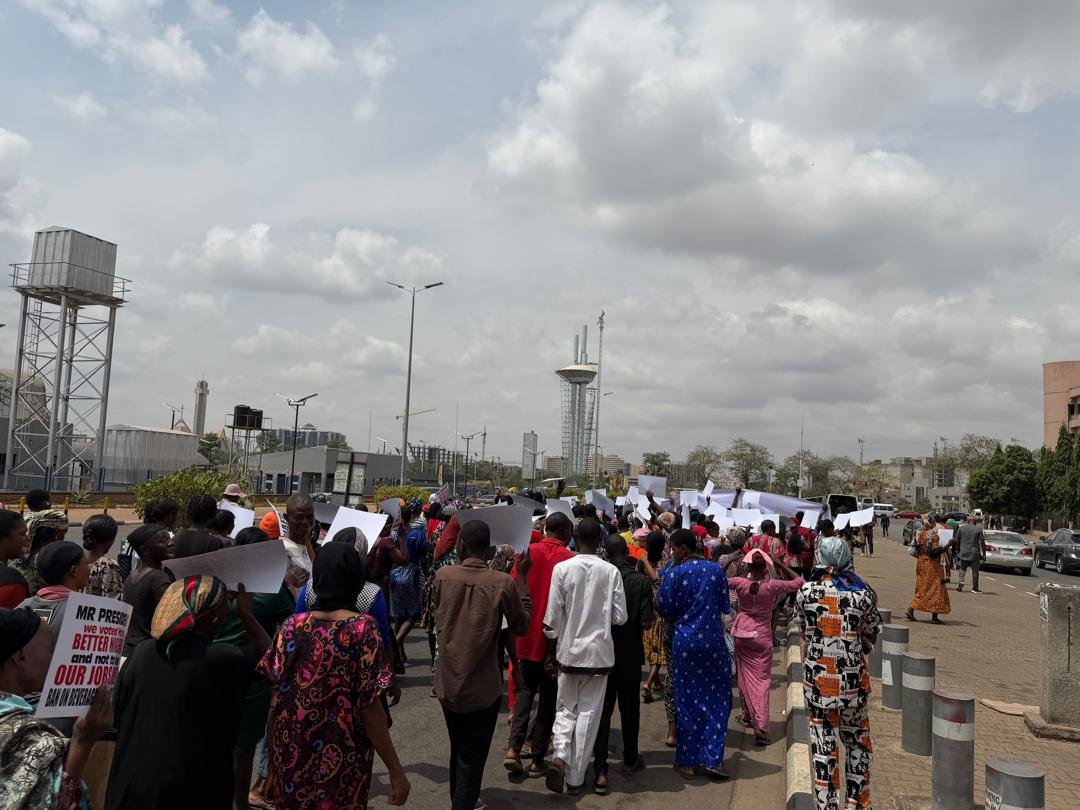
Tension heightened in Abuja on Thursday as members of Concerned Citizen for Change staged a protest at the Federal Ministry of Health, demanding the immediate removal of the Director-General of the National Agency for Food and Drug Administration and Control (NAFDAC), Mojisola Christianah Adeyeye, over what they described as gross incompetence and abuse of public office.
The protesters, who laid siege to the ministry’s headquarters, accused the NAFDAC boss of unlawfully enforcing a ban on sachet alcohol and 200ml PET bottle alcoholic products, which they claimed contravenes existing national policy and directives.
Addressing journalists during the protest, the group’s Director, Kingsley Nwanze, described the enforcement as “hasty, obscure, and illegal,” alleging that it violates the National Alcohol Policy already approved by the Federal Ministry of Health.
According to him, the action also disregards a presidential directive restraining NAFDAC from disrupting affected businesses pending the outcome of deliberations by a joint committee of stakeholders.
“The decision is capable of triggering civil unrest, especially given the current economic climate,” Nwanze said. “It undermines the Renewed Hope agenda of President Bola Ahmed Tinubu and paints the government in a negative light.”
The group further argued that the ban contradicts resolutions of the House of Representatives, which had previously advised against such enforcement following consultations with industry stakeholders.
They warned that the policy could lead to massive job losses, disrupt livelihoods across the value chain, and open the market to illicit and unregulated alcoholic products, thereby reducing government revenue.
The protesters also dismissed claims that sachet alcohol promotes abuse among minors, insisting that smaller packaging discourages excessive consumption and that producers comply with regulatory standards.
They added that industry players have invested heavily in campaigns promoting responsible alcohol consumption, particularly to curb underage drinking.
While acknowledging the need to eliminate unsafe products from the market, the group maintained that regulatory actions must be guided by empirical evidence rather than sentiment.
The protest ended with a strong call on President Tinubu to “wield the big stick” by immediately removing Adeyeye from office, insisting that her continued stay is no longer in the public interest.
Security personnel were observed monitoring the situation to ensure order, as activities at the ministry were temporarily disrupted during the demonstration.
Cover
NMDPRA’s Fresh Import Licences Will Encourage Dumping of Low-Quality Petrol, Undermine Local Refineries — Energy Transparency Group

The decision by the Nigerian Midstream and Downstream Petroleum Regulatory Authority (NMDPRA) to resume the issuance of petrol import licences has drawn sharp criticism from industry advocates, who warn that the move risks undermining domestic refining efforts and exposing the market to substandard fuel products.
In a statement issued on Wednesday, the Energy Transparency and Market Justice Initiative (ETMJI) condemned the regulator’s action, describing it as a policy reversal that could weaken recent gains in local supply while encouraging the inflow of lower-quality petroleum products.
The regulator had earlier maintained that domestic refining capacity was sufficient to meet national demand, suspending the issuance of import licences in February. However, following supply disruptions linked to the Middle East crisis, the agency granted fresh licences to six marketers to import about 180,000 metric tonnes of petrol in a bid to stabilise supply.
While the NMDPRA has framed the move as a temporary intervention, ETMJI said the decision reflects deeper inconsistencies in regulatory direction and raises concerns about quality control in Nigeria’s downstream sector.
Dr Salako Kareem, who signed the statement, said the reintroduction of petrol imports under emergency conditions risks opening the floodgates to products that may not meet required specifications.
“What we are witnessing is a deeply flawed response to a complex problem. Attempting to resolve supply shortages by reintroducing large-scale fuel imports, without watertight quality assurance, is comparable to using poison to cure a disease. It may appear to offer immediate relief, but in reality, it introduces far more dangerous consequences for consumers, the market, and the integrity of the regulatory system,” he said.
Kareem argued that rather than reverting to import dependence, the regulator should have prioritised strengthening domestic supply chains and addressing distribution inefficiencies that often create artificial scarcity.
According to him, the decision sends conflicting signals to investors in local refining, particularly at a time when Nigeria is seeking to reduce its reliance on imported petroleum products.
“This policy direction undermines the confidence of investors who have committed resources to building domestic refining capacity. When the regulator oscillates between import substitution and import expansion without a clear framework, it creates uncertainty that discourages long-term investment and planning in the sector. You cannot, on one hand, advocate self-sufficiency and, on the other, reopen the gates to imports at the slightest disruption,” Kareem said.
The group also raised concerns about the potential economic implications of renewed import activity, noting that increased reliance on imports could exert pressure on foreign exchange and contribute to higher landing costs, which are often passed on to consumers.
ETMJI insisted that external shocks should not justify what it described as a “regulatory backslide” in Nigeria’s fuel supply strategy.
Kareem said the focus should instead be on building resilience within the domestic market by improving logistics, enforcing quality standards and supporting local refiners to operate at optimal capacity.
“Short-term fixes that rely on imports may offer temporary relief, but they do not address the structural weaknesses in Nigeria’s petroleum supply chain. What is required is a disciplined commitment to strengthening local production, enhancing regulatory oversight and ensuring that every litre of fuel consumed in this country meets strict quality benchmarks,” Kareem declared.
He further warned that the reintroduction of imports without stringent monitoring mechanisms could revive long-standing issues of product adulteration and regulatory arbitrage, where market players exploit loopholes for profit.
The advocacy group called on the NMDPRA to provide full transparency on the criteria used in issuing the new licences, including safeguards put in place to prevent the entry of substandard products into the Nigerian market.
It also urged the federal government to align regulatory actions with its broader energy transition and economic diversification goals, stressing that inconsistent policies could erode public trust and delay progress in the sector.
As Nigeria continues to navigate a complex energy landscape shaped by both domestic constraints and global uncertainties, stakeholders say the balance between ensuring supply and maintaining standards will remain a critical test of regulatory credibility.


Centre Commends Nigerian Military’s Intensified Operations in North Central, Charges Armed Forces to Deepen Gains and Ensure Peaceful Easter Across The Country

New Party, DLA, Unveils Ideological Agenda, Targets Economic Reform, Security

DLA Unveiled, Vows to Rescue Nigeria from Economic, Security Crisis
-

 Cover7 months ago
NRC to reposition train services nationwide.. Kayode Opeifa
-

 Fashion9 years ago
These ’90s fashion trends are making a comeback in 2017
-
Entertainment9 years ago
The final 6 ‘Game of Thrones’ episodes might feel like a full season
-
 Opinion1 year ago
Bureaucratic Soldier, Kana Ibrahim heads Ministry of Aviation and Aerospace After Transformative Tenure at Defence
-
 Opinion1 year ago
Hon. Daniel Amos Shatters Records, Surpasses Predecessor’s Achievements in Just Two Years
-

 Opinion4 months ago
Barrister Somayina Chigbue, Esq: A rising legal leader shaping institutioal excellence in Nigeria
-

 News8 months ago
Nigerian Nafisa defeats 69 Countries at UK Global Final English Competition
-
 Special Report1 year ago
Golden Jubilee: Celebrating Tein Jack-Rich’s Life of Purpose and Impact