Connect with us

Cover

Apo-Karshi road: FCTA terminates Kakatar Ltd contract, mobilises SCC to site 

Published

on

The Federal Capital Territory Administration (FCTA) has revoked the 13-kilometre Apo to Karshi road awarded to Kakatar Engineering Ltd. Since 2011.

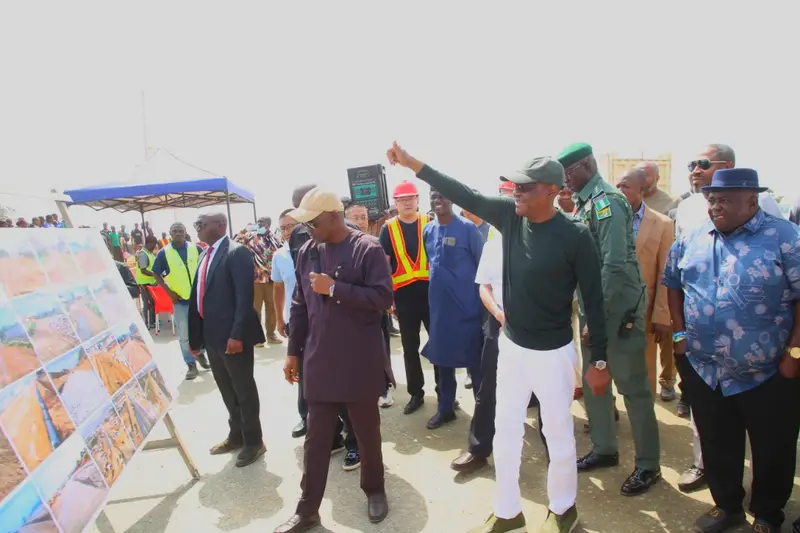
FCT Minister Nyesom Wike disclosed this after inspecting ongoing road projects in Karu, Gishiri and the dualisation of the Outer Southern Expressway in Abuja on Thursday.

Wike explained that the contract had been reawarded to SCC, adding that work was currently ongoing.

He stressed that completion of the road would provide an alternative route and decongest the current main road, easing traffic for residents of areas like Nyanya and Karu going to the city centre.

He recalled that the project was awarded since 2011 but faced so many delays due lack of funding and other challenges.

“Like I said, we cannot continue to play politics when it comes to the welfare of the people,” he said.

The minister said the construction of the road from Kubwa to Bwari, equally awarded to SCC had also commenced, adding that when completed, it would provide an alternative route to Bwari.

Speaking on the inspected projects, the minister, who could not hide his joy with the progress so far, expressed optimism that they would be completed on schedule and inaugurated in mid-2026 to celebrate President Bola Tinubu third year in office.

“You can see the happiness of everybody and that’s what shows that the Renewed Hope Agenda is really working.

“People had never seen this type of development in Abuja before, and that is why you can imagine when we were at Karu, you saw how the students were very happy.

“When we went to Girishi, look at how the pupils there were all happy and so, this makes us happy too.

“When we see that people are happy, people appreciate that they can see development, people appreciate that the government thinks about their welfare. So, that’s what it takes,” he said.

On what people should expect in 2026, Wike said that 2025 would be nothing compared to the kind of infrastructure that would be provided in the coming year

According to him, the infrastructure will be partially tailored to lift the lives of the people and improve economic activities, including interventions in health and education.

The minister said that there would likely be no new project in 2026, adding much resources would be channeled towards completing ongoing projects across the intervening sectors.

“We want to make sure that the projects we have started this year will be completed in 2026.

“Mind you, that year appears to be a political year. So, you don’t expect to start projects that you may not be able to finish within the period that you’re appointed to stay.

“So, we want to make sure all projects we have started, by the grace of God, were completed,” Wike said. 

Continue Reading
Click to comment

Leave a Reply

Your email address will not be published. Required fields are marked *

Cover

IKOH NDI ABIA 2027: The Maturity Of Time For A Calm, Experience And Winning Leadership In Abia State

Published

on

By Aaron Mike Odeh

Politics, especially in a developing democracy like ours, is beyond mere political activities and electoral contests. It is fundamentally about leadership, vision, emotional intelligence, capacity, and the ability to inspire confidence among the people. In moments when the destiny of a people stands at a defining crossroads, wisdom demands that political parties and stakeholders place competence, experience and acceptability above sentiments and unnecessary experimentation.

As someone who has actively participated in Abia politics for over twenty-six years, occupying different positions at appointment status, i believe I possess the moral standing and practical experience to speak with clarity on the political future of Abia State and the direction the All Progressives Congress (APC), should take ahead of the 2027 governorship election.

My political journey and Media Consultancy has taken me across the length and breadth of NIGERIA including Abia State. From Arochukwu to Ukwa, from Umunneochi to Ikwuano, I have interacted closely with party leaders, grassroots mobilizers, traditional institutions, youths, women groups and stakeholders across different divides. I have watched governments emerge and fade. I have seen political structures built and dismantled. I have equally studied the expectations, emotions and aspirations of Abia people over the years.

From this wealth of experience and practical evaluation of Abia politics, one fact has remained consistently clear: for APC to genuinely position itself for victory in 2027, the party must present a candidate with political maturity, administrative experience, emotional stability, credibility and the capacity to unite various interests within and outside the party.

Without hesitation, I strongly believe that Chief Henry Ikechukwu Ikoh perfectly fits into this critical expectation.

Chief Ikoh represents a rare blend of humility, experience, consistency and strategic political understanding. In a political environment often dominated by controversies, unnecessary bitterness and divisive tendencies, he has remained calm, focused, approachable and remarkably stable. These qualities may appear ordinary to some people, but in practical governance and political management, they are indispensable virtues that sustain leadership and build confidence among the electorate.

One of the strongest assets Chief Ikoh possesses is his maturity and ability to relate across political, ethnic and social lines. Politics in Abia today requires a leader who can build bridges rather than walls; a leader who understands that governance succeeds better when stakeholders are respected and united under a common vision. Chief Ikoh has demonstrated this quality over the years through his interactions with people across party affiliations and communities.

Beyond his personal qualities, Chief Henry Ikechukwu Ikoh possesses extensive experience in public service and political administration. Leadership is not learned overnight. It is developed through years of service, sacrifice, strategic engagement and practical exposure. Abia State at this moment requires a leader who understands governance, appreciates political realities and possesses the administrative competence to navigate the challenges confronting our people.

Another important factor that distinguishes Chief Ikoh is his consistency of purpose. His aspiration to govern Abia State is not a sudden ambition driven by opportunism or political convenience. Since 2003, he has remained steadfast, focused and committed to his vision for the state. Such consistency speaks volumes about conviction, preparedness and genuine passion for service.

In politics, consistency builds trust. It reassures the people that a leader is not merely pursuing personal ambition but is driven by a long-term vision and commitment to societal development. This is one quality many Abians have come to appreciate in Chief Ikoh.

Furthermore, APC as a party must begin to prioritize electability and acceptability ahead of internal sentiments. Elections are won not merely through slogans, but through strategic calculations, grassroots acceptance and broad-based support. The reality before us is that the people of Abia are yearning for a leadership that is calm, responsible, inclusive and development-oriented. They desire a leader who can listen, unite and inspire confidence across different sectors of society.

Chief Henry Ikechukwu Ikoh possesses these qualities in abundance.

His calm disposition, amiable personality and infectious ebullience naturally attract people to him. He is not known for needless controversies or divisive politics. Rather, he embodies the spirit of maturity and responsible engagement that APC needs to expand its acceptance across Abia State.

The journey toward 2027 should therefore not be approached with bitterness, selfish calculations or divisive tendencies. It should be approached with sincerity, wisdom and genuine concern for the future of Abia State and the success of our great party.

There comes a moment in the life of every people when destiny presents an opportunity that must not be ignored. I strongly believe that moment has come for APC in Abia State.

Indeed, as the Holy Scripture declares, “The time to favour Zion, yea, the set time, has come.” For Abia State, this is the maturity of time to embrace tested experience, political maturity and purposeful leadership.

With deep sense of responsibility and commitment to the progress of our state, I most respectfully appeal to APC stakeholders, leaders and delegates to rally behind Chief Henry Ikechukwu Ikoh and support the vision of IKOH NDI ABIA 2027.

This is not merely about an individual ambition; it is about giving APC the strongest opportunity to win the governorship election and provide purposeful leadership for the good people of Abia State.

The task before us is collective. The future is now. And the time is ripe for a leader with capacity, humility, experience and vision.

THE SET TIME IS NOW!

Aaron Mike Odeh, A Public Affairs Analyst, Media Consultant, Human and Community development advocate wrote from Post Army Housing Estate Kurudu Abuja

Continue Reading

Cover

Alleged Coup Trial: Cleric Says He Warned That The Plot Would Fail

Published

on

*Admits he received money for ‘prayers’

A Federal High Court in Abuja, on Monday, viewed a video- recorded statement by Sheikh Sani Abdulkadir, the sixth defendant in the ongoing trial of persons accused of conspiring to overthrow the government of President Bola Tinubu.

In the recording, the Sheikh, who admitted receiving money to pray for the success of the operation, however, claimed that he warned the alleged plotters that their plan was doomed and that they would be sabotaged from within.

The video recording was played during the continuation of trial proceedings, with the fourth prosecution witness (PW4) still in the witness box.

In the recording, Abdulkadir, an Islamic cleric, said he had known the alleged ringleader, Colonel Maaji, for less than a year and was approached through an intermediary identified as Sanda to offer spiritual support for the plot.

He told investigators that Sanda informed him that his “Oga” intended to stage a coup and needed prayers regarding its likely success. After conducting the prayers, Abdulkadir said he advised them the operation would fail and that two persons would eventually expose those involved.

A subsequent request was relayed back to him, he said, asking for further prayers to prevent those two individuals from speaking out. Money was later transferred to him for prayers and charity, and names of alleged participants were forwarded for inclusion.

Abdulkadir said he first learnt of the arrests through media reports, after Sanda had informed him that Colonel Maaji had been unreachable for four days. He maintained throughout the recording that the funds he received were strictly for prayers and not in support of any coup attempt.

He also acknowledged understanding that a coup meant a military overthrow of government but said he did not report the plot because he did not know who to report to.
The cleric said his arrest came after he visited the Economic and Financial Crimes Commission (EFCC) to resolve restrictions placed on his bank account.

Upon contacting an EFCC deputy director, he was invited to the commission’s office to explain the source of the funds. He denied making any coup-related statement while in EFCC custody and stated that he was neither assaulted nor tortured, and that all his statements were made voluntarily.

Following the playback, the prosecution sought to tender extra-judicial statements made by all six defendants before a Special Investigation Panel and military police authorities.

However, defence lawyers of all six defendants objected, arguing the statements were either involuntarily obtained or made in violation of the Administration of Criminal Justice Act (ACJA).

Their objections include failure to inform defendants of their right to legal representation; alleged discrepancies between video recordings and corresponding written statements; allegations of coercion, inducement and torture; and claims that the footage did not adequately establish the physical condition of defendants during recording.

Counsel to the fifth defendant further argued that, given the number of accused persons, the court should conduct separate trial-within-trial proceedings for each disputed statement rather than a combined exercise.

Responding, the prosecution urged the court to dismiss the objections, maintaining that the law does not mandate separate proceedings for each defendant and that the trial judge holds discretion over how evidence is received.

Justice Joyce Abdulmalik ruled in favour of a single joint trial-within-trial to determine the voluntariness and admissibility of all the disputed statements.

The case was then adjourned to May 12.

Continue Reading

Cover

2027 zoning debate: Opposition must choose strategy over sentiment — Atiku camp warns

Published

on

The media office of former Vice President Atiku Abubakar has cautioned opposition political actors against embracing what it described as a self-defeating and intellectually dishonest narrative that insists the 2027 presidential ticket must be zoned exclusively to the South.

In a statement issued on Monday in Abuja, signed by Olusola Sanni, media aide to former Vice President Atiku Abubakar, the camp said while the ruling APC may understandably retain its southern presidential configuration around incumbent President Bola Ahmed Tinubu, it would amount to political naivety for the opposition to adopt the same logic without a sober assessment of electoral realities.

The statement noted that politics must be driven by strategy, coalition-building, and hard electoral arithmetic—not emotional talking points or selective moral arguments.

“The first and most obvious question is this: how does a Southern opposition candidate realistically unseat a sitting Southern president? Nigerian political history offers no precedent for such an outcome. No incumbent president has ever been defeated by an opposition challenger from the same geopolitical bloc. To insist otherwise is to enter the contest already defeated,” the statement said.

The Atiku camp further argued that the moral argument being advanced in favour of southern zoning collapses under scrutiny.

“By 2027, the South would have held presidential power for approximately 18 years in the Fourth Republic, compared to about 10 years for the North. If the South retains power for another four years, that disparity widens even further. It therefore becomes difficult to understand the justice in an argument that seeks to deepen an already existing imbalance under the guise of equity,” the statement added.

The statement also accused some political actors of selective memory and opportunism, particularly those who abandoned the zoning principle in 2011 following the death of President Umaru Musa Yar’Adua, only to now present it as a sacred political doctrine.

“It is intellectually dishonest for those who enthusiastically supported a Southern presidency under Goodluck Jonathan in 2011, despite the North’s legitimate expectation under the informal zoning arrangement, to now suddenly posture as custodians of rotational justice. Principles do not become sacred only when they align with personal ambition.”

While affirming that the Southeast’s aspiration to produce a president remains legitimate and deserving of serious national engagement, the statement warned against reducing that aspiration to what it called “transactional political bargaining.”

“The Southeast deserves a sustainable and credible pathway to national leadership—not symbolic tokenism or bespoke arrangements tailored to satisfy one individual’s ambition,” it stated.

The statement concluded by urging the opposition to focus on building a credible national coalition capable of defeating the incumbent rather than embracing narratives that may inadvertently strengthen President Tinubu’s re-election prospects.

“Defeating an incumbent president requires realism, not romanticism; strategy, not sentiment; honesty, not selective memory. The opposition must decide whether its goal is to make an emotional statement or to actually win power.”

Continue Reading

Trending

Copyright © 2023 - 2025 DailyMirror Nigeria. Design by AspireWeb.ng, powered by WordPress.