Cover
Presidency: South must complete its 8 years – Wike
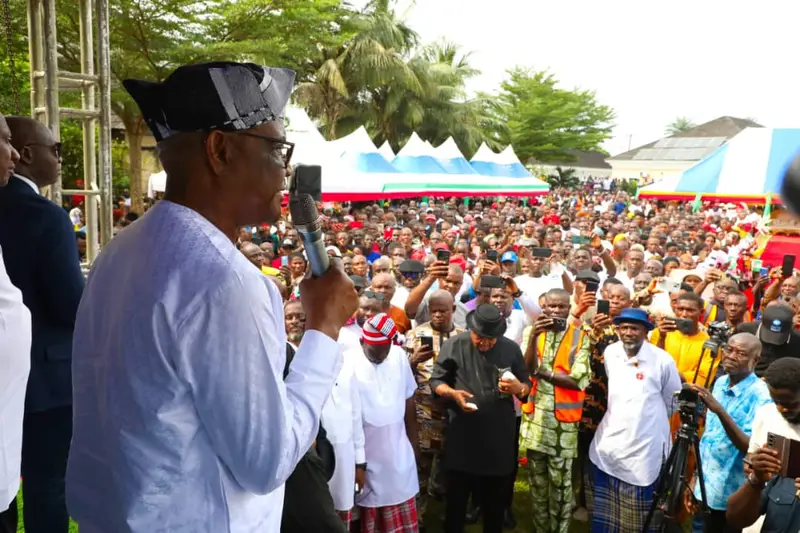
Minister of the Federal Capital Territory (FCT), Nyesom Wike, has insisted that the southern part of Nigeria must complete its two full terms of eight-year presidential slots in the spirit of fairness and equity.
Senior Special Assistant to the minister on Public Communications and Social Media, Mr Lere Olayinka said Wike stated this position on Sunday, during his special Christmas visits to Emohua and Ikwerre Local Government Areas of Rivers.
While addressing the people, Wike maintained that President Bola Tinubu, a southerner, should be supported to complete his first term and re-elected for a second term until 2031, in line with the principle of power rotation in Nigerian politics.
He said that party affiliation should not stop anyone from supporting Tinubu’s second term bid.
“The South must complete their eight years. It doesn’t matter which party we belong to give Mr President the needed support to succeed.
“In 2031, after the South must have completed its eight years through President Tinubu, we will know what to do next,” he said.
He advised politicians to honour political agreements to build the needed trust, confidence and harmony among political actors and the electorates.
He reminded Ikwerre people how they took risks to support Tinubu during the 2023 elections when others were not courageous enough to do so.
“In 2023 when it was difficult to campaign for Tinubu and when people were not sure he would emerge as President, the Ikwerre knew politics is about risk and they took the risk.
“If you look at the votes that made Tinubu win in Rivers, the votes were majorly from Ikwerre.
“So, when it mattered most, we stood on his mandate, not this people coming out now to shout on your mandate. When it was important they couldn’t shout on your mandate.
“You take stands when things are tough, not when food is ready. We took this position when things were tough, and we are still standing by it,” Wike said.

Cover
Atiku Alleged Plot to Exclude ADC from 2027 Elections
Former Vice President Atiku Abubakar has alleged a fresh plan to block the African Democratic Congress (ADC) from participating in the 2027 general elections. He warned that such a move would represent a grave assault on Nigeria’s democracy and undermine the people’s right to freely choose their leaders.
Atiku, who is the ADC’s presidential candidate, claimed he had received credible information suggesting that elements within the ruling establishment were coordinating political and legal manoeuvres to keep the party off the ballot.
According to him, the alleged plot is part of a broader campaign to weaken opposition parties and limit Nigerians’ electoral choices. “We are fully aware of their plots. While they seek to sow confusion within the opposition, we know their real target is the ADC because it represents the most credible alternative,” he said.
Atiku accused the ruling All Progressives Congress (APC) of attempting to determine which opposition parties should contest the election. He argued that if the APC was confident in its popularity, it should not fear competition from the ADC.
He described the alleged strategy as a recurring pattern where neutral institutions are drawn into partisan disputes, frivolous litigations gain momentum, and administrative powers are selectively deployed against opposition figures.
ALSO READ
Immigration Debate: Ramaphosa Warns Against Violence
“The pattern has become all too familiar. First, institutions that ought to be neutral are drawn into partisan contests. Then, frivolous litigations suddenly gain unusual momentum. Administrative powers are selectively deployed. Political pressure is mounted behind closed doors. Before long, democracy itself becomes the casualty,” he said.
Atiku criticised the ruling party for focusing more on silencing opposition voices than addressing Nigeria’s pressing challenges. He pointed to hunger, inflation, unemployment, insecurity, and declining purchasing power as issues that require urgent governance attention.
“The obsession with silencing the opposition has become so consuming that governance itself has taken a back seat,” he noted.
Insisting that the ADC’s growing popularity should be met through democratic competition, Atiku said elections must be decided by voters, not through legal or administrative suppression.
“The proper response to a popular political movement is not suppression. It is to present superior ideas before the electorate. Democracies are won at the ballot box, not in back rooms, not through manipulated court processes, and certainly not through the abuse of state institutions,” he declared.
Atiku urged the judiciary to resist political pressure and called on the Independent National Electoral Commission (INEC), security agencies, civil society organisations, and the international community to remain vigilant against actions that could undermine the credibility of the electoral process.
“No administration has the constitutional authority to determine which political party Nigerians are permitted to vote for. Sovereignty belongs to the people—not to those who temporarily wield power,” he said.
The statement comes amid heightened political realignments ahead of the 2027 elections. Atiku and former Rivers State governor Rotimi Amaechi have adopted the ADC as a platform for building a coalition aimed at challenging the APC.
Recent months have seen both the ruling party and opposition groups trade accusations over attempts to weaken rival platforms through litigation and internal crises.
As of press time, neither the Presidency, the APC, nor INEC had responded to Atiku’s allegations.
Cover
Saudi Arabia Chief Resigns After World Cup Exit
Saudi Arabia’s football leadership has been shaken following the resignation of Yasser Al-Misehal, president of the Saudi Arabian Football Federation, after the Green Falcons’ disappointing performance at the 2026 FIFA World Cup.
Saudi Arabia finished bottom of Group H with two points, drawing against Uruguay and Cape Verde but suffering a heavy 4–0 defeat to Spain. The early exit ended hopes of progressing to the knockout stages.
Al-Misehal announced his resignation on Sunday, stating he bore full responsibility for the team’s failure. “The failure of the national team to qualify for the next round of the World Cup is a result that falls short of all our ambitions, and I bear full responsibility for it,” he wrote on X. He added that stepping down was necessary to open a new chapter for Saudi football.
Al-Misehal had led the federation for seven years and played a key role in securing Saudi Arabia’s successful bid to host the 2034 World Cup. His tenure coincided with the kingdom’s massive investment in football, part of its broader economic diversification strategy.
Under his leadership, Saudi Arabia spent nearly $2 billion in recent years to elevate the domestic league, attracting global stars such as Cristiano Ronaldo, Neymar, and Karim Benzema. The Saudi Pro League has since become one of the most lucrative competitions worldwide.
The resignation follows a turbulent period for the national team’s technical bench. French coach Hervé Renard was dismissed earlier in March after poor friendly results, ending his second spell in charge. Renard had returned to replace Italian Roberto Mancini, but neither coach managed to deliver consistent success.
ALSO READ
Wimbledon Players End Prize-Money Protest After Talks
The federation now faces the task of rebuilding both leadership and technical direction ahead of future competitions, including preparations for the 2034 World Cup on home soil.
Analysts say Al-Misehal’s exit underscores the pressure on football administrators in countries investing heavily in the sport. Saudi Arabia’s ambitions extend beyond domestic success, with the 2034 World Cup seen as a global showcase of its sporting and economic transformation.
The resignation also highlights the challenges of balancing high-profile investments in star players with the performance of the national team. Despite the influx of talent into the Saudi Pro League, the Green Falcons have struggled to translate domestic growth into international success.
The federation is expected to announce interim leadership soon, while discussions continue on long-term reforms. For Saudi Arabia, the focus will be on strengthening grassroots development, stabilising coaching structures, and ensuring the national team can compete at the highest level.
Al-Misehal’s departure marks the end of a significant era in Saudi football administration, but it also opens the door for new leadership tasked with delivering results that match the country’s global ambitions.
Cover
Wimbledon Players End Prize-Money Protest After Talks
Top tennis stars, including world number ones Jannik Sinner and Aryna Sabalenka, have ended their protest over prize money at Wimbledon after holding constructive meetings with tournament organisers.
The players had initially limited their press conferences to 15 minutes during the opening week, a move aimed at drawing attention to what they described as unfair revenue distribution. They argued that players currently receive only 15 percent of Grand Slam revenues and demanded an increase to 22 percent.
In response, Wimbledon raised its prize money by 20 percent, with singles champions now set to earn £3.6 million ($4.76 million). This marks a significant increase from the £3 million awarded to winners in 2025.
The All England Club’s chief executive, Sally Bolton, expressed relief that the protest had ended, noting that discussions with players had been positive. “We’ve had fruitful conversations and agreed to continue in constructive dialogue,” she said.
ALSO READ
South Korea Exit World Cup, Coach Face Presidential Probe
Despite ending the protest, players stressed that the underlying issues remain unresolved. Their representatives confirmed that normal media duties would resume, but they will carefully evaluate Wimbledon’s proposals once presented.
Sabalenka, a three-time semi-finalist, said she hoped the matter would be settled permanently. “I really hope we can finally get to the table and come to a conclusion that everyone is happy with. Hopefully we’ll never have to do this again,” she remarked.
The protest at Wimbledon followed similar action at the French Open in May, where players restricted pre-tournament media duties. Their campaign highlights growing tension between athletes and organisers over revenue sharing at tennis’ biggest events.
Players argue that their performances drive ticket sales, broadcasting rights, and sponsorship deals, yet they receive a relatively small share of the financial returns. The demand for 22 percent of revenues reflects a push for greater equity in the sport.
While Wimbledon’s prize money increase is seen as progress, players insist that dialogue must continue with all four Grand Slam tournaments. The outcome of these negotiations could reshape financial structures in professional tennis, potentially setting new standards for athlete compensation.
For now, the focus returns to the grass courts, with players and organisers keen to ensure that the championships proceed without further disruption.
-
Branded Content4 days agoNow Hiring: Academic and Technical Staff at a Leading Private University in Gombe State
-
Cover10 months agoNRC to reposition train services nationwide.. Kayode Opeifa
-
Entertainment9 years agoThe final 6 ‘Game of Thrones’ episodes might feel like a full season
-
Fashion9 years agoThese ’90s fashion trends are making a comeback in 2017
-
Politics3 months agoNNPP Diaspora Stakeholder and Key Kwankwaso Ally, Dr. Usman Tijjani Shehu, Rejoins APC
-
Opinion2 years agoBureaucratic Soldier, Kana Ibrahim heads Ministry of Aviation and Aerospace After Transformative Tenure at Defence
-
Opinion1 year agoHon. Daniel Amos Shatters Records, Surpasses Predecessor’s Achievements in Just Two Years
-
Opinion7 months agoBarrister Somayina Chigbue, Esq: A rising legal leader shaping institutioal excellence in Nigeria