Cover
Akume, Alia relationship will be maintained- Shettima
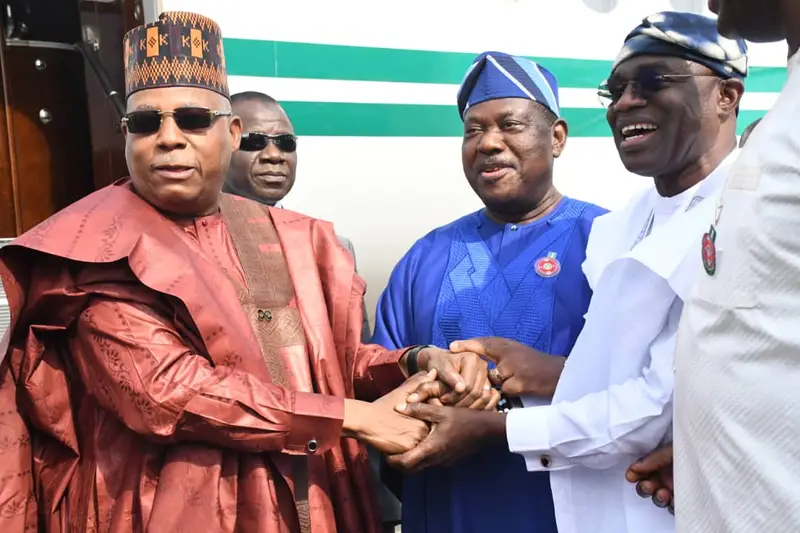
The President Bola Tinubu’s administration will maintain the good relationship between Gov. Hyacinth Alia of Benue and the Secretary to the Government of the Federation(SGF), George Akume.
Vice President Kashim Shettima gave the assurance on Sunday in Makurdi during the wedding reception of the son of Akume.
The Vice-President said he has a moral obligation as the leader of the North, to work on the relationship between Gov. Alia and SGF.
“We have that moral obligation to step in and heal the wounds. What binds us together supersedes whatever that divides us. If this relationship goes asunder is the people of Benue that will suffer.
“It is the people of the North Central that will suffer, it is the people of Nigeria that will suffer. Sen. Akume has paid his dues,” Shettima said.
He described Akume as the longest serving public servant in the contemporary history of Nigeria, after the former Chairman of the All Progressives Congress (APC), Abdullahi Ganduje, who used to hold that record.
The Vice-President commended Alia for his transformative agenda in Benue, saying “your Excellency, we are mighty proud of you, we are grateful to you for your leadership, we adored you for your transformative agenda”.
Responding, Akume paid growing tribute to Tinubu for his purposeful leadership since he assumed the mantle of leadership of Nigeria in May 2023.
“The leadership of the country is doing very well because I’m in a position to know the functioning of government, the mechanics of government and what government is since 1999,” the SGF said.
Also, Alia commended Tinubu and Shettima for their sustained efforts toward repositioning the country for the good of all Nigerians.
The governor, who congratulated the young couple, assured them of his continued support and guidance, saying “it is my hope that this young couple will add a lot of value to the growth and development of Benue state.
“We wish you well now and always. We pray that you go with God and may he be ahead of you to bless, behind you to protect you, and above you to continually shower his love and blessings upon you,” the governor said.
Dignitaries present at the event include the Ministers of Water Resources and Sanitation, Prof. Joseph Utsev; Special Duties and Intergovernmental Affairs, Zaphaniah Jisalo; and Livestock Development, Idi Mukhtar Maiha.

Cover
Wimbledon Players End Prize-Money Protest After Talks
Top tennis stars, including world number ones Jannik Sinner and Aryna Sabalenka, have ended their protest over prize money at Wimbledon after holding constructive meetings with tournament organisers.
The players had initially limited their press conferences to 15 minutes during the opening week, a move aimed at drawing attention to what they described as unfair revenue distribution. They argued that players currently receive only 15 percent of Grand Slam revenues and demanded an increase to 22 percent.
In response, Wimbledon raised its prize money by 20 percent, with singles champions now set to earn £3.6 million ($4.76 million). This marks a significant increase from the £3 million awarded to winners in 2025.
The All England Club’s chief executive, Sally Bolton, expressed relief that the protest had ended, noting that discussions with players had been positive. “We’ve had fruitful conversations and agreed to continue in constructive dialogue,” she said.
ALSO READ
South Korea Exit World Cup, Coach Face Presidential Probe
Despite ending the protest, players stressed that the underlying issues remain unresolved. Their representatives confirmed that normal media duties would resume, but they will carefully evaluate Wimbledon’s proposals once presented.
Sabalenka, a three-time semi-finalist, said she hoped the matter would be settled permanently. “I really hope we can finally get to the table and come to a conclusion that everyone is happy with. Hopefully we’ll never have to do this again,” she remarked.
The protest at Wimbledon followed similar action at the French Open in May, where players restricted pre-tournament media duties. Their campaign highlights growing tension between athletes and organisers over revenue sharing at tennis’ biggest events.
Players argue that their performances drive ticket sales, broadcasting rights, and sponsorship deals, yet they receive a relatively small share of the financial returns. The demand for 22 percent of revenues reflects a push for greater equity in the sport.
While Wimbledon’s prize money increase is seen as progress, players insist that dialogue must continue with all four Grand Slam tournaments. The outcome of these negotiations could reshape financial structures in professional tennis, potentially setting new standards for athlete compensation.
For now, the focus returns to the grass courts, with players and organisers keen to ensure that the championships proceed without further disruption.
Cover
Immigration Debate: Ramaphosa Warns Against Violence
South African President Cyril Ramaphosa has acknowledged the legitimacy of citizens’ concerns over illegal immigration but firmly warned that violence and intimidation will not be tolerated during the planned nationwide protests on June 30.
In his weekly newsletter, Ramaphosa stressed that while the right to protest is constitutionally guaranteed, it must be exercised peacefully. He cautioned that no grievance justifies unlawful conduct, adding that vigilantism has no place in a constitutional democracy.
Ramaphosa admitted that South Africans have raised genuine issues about undocumented immigration, weak border management, overstretched public services, and criminal syndicates exploiting the system. He said these concerns are valid and deserve attention.
The president assured citizens that his government is committed to reforming immigration controls. Measures include strengthening border security, improving enforcement against undocumented migration, tightening asylum and visa systems, and tackling corruption that has undermined immigration management.
While recognising the right to protest, Ramaphosa emphasised that freedom of expression does not permit threats, vandalism, or violence. He urged organisers and participants to respect the rights and dignity of others.
“Freedom comes with responsibility. The right to protest is one of the defining freedoms of our democracy, but every right carries corresponding responsibilities,” he said.
He warned against individuals taking immigration enforcement into their own hands, describing such actions as vigilantism. Only authorised law enforcement officers, he noted, have the constitutional mandate to demand identification and enforce immigration laws.
ALSO READ
INEC, Parties Clash Over Access Codes Ahead 2027 Elections
Ramaphosa disclosed that his government had consulted widely with traditional leaders, trade unions, business groups, and religious organisations to build consensus on immigration reforms. He said these engagements showed broad support for government’s stance.
He also reminded citizens that many foreign nationals legally reside in South Africa, contributing to the economy through work, education, and investment. Such individuals, he stressed, remain entitled to constitutional protection.
The president welcomed assurances from protest organisers that demonstrations would remain peaceful. However, he warned that anyone engaging in criminal acts would face prosecution.
“Where there is criminal conduct, those responsible will be held accountable and the law will take its course,” he said.
Ramaphosa urged South Africans to reject fear and division, recalling the painful history of racial profiling and humiliation under apartheid. He insisted that national security must be upheld alongside constitutional values.
South Africa has witnessed weeks of anti-immigration protests and sporadic xenophobic attacks. These incidents have prompted several African countries, including Nigeria, Ghana, Mozambique, Malawi, and Zimbabwe, to evacuate or assist in the voluntary repatriation of their citizens.
Observers say the June 30 protests will test South Africa’s ability to balance public concerns over immigration with its constitutional commitment to peaceful dissent and human rights.
Ramaphosa’s message is clear: immigration concerns are valid, but violence will not be tolerated. As South Africans prepare to take to the streets, the government faces the challenge of addressing public frustrations while safeguarding democratic freedoms.
Cover
INEC, Parties Clash Over Access Codes Ahead 2027 Elections
The Independent National Electoral Commission (INEC) and political parties are locked in a dispute over access codes required to upload candidates’ particulars for the 2027 general elections.
While INEC insists the codes have been released and training conducted, several parties maintain they are yet to receive them. The disagreement has raised concerns about compliance with the commission’s strict timetable.
INEC says it distributed the codes on Friday, June 26, 2026, and trained party representatives on Thursday and Friday to ensure smooth use of its online nomination portal. According to the commission, the deadline for uploading presidential and National Assembly candidates remains July 11, 2026.
Victoria Eta-Messi, INEC’s Director of Voter Education and Publicity, dismissed claims of delay. She argued that parties must attend the training before receiving codes. “Were they expecting to have been given codes without the training?” she asked, stressing that the process was ongoing and support staff were available to assist.
The commission’s revised timetable shows that the portal for presidential and National Assembly candidates opened on June 27 and will close on July 11. For governorship and state assembly candidates, the portal opens July 18 and closes August 8.
Despite INEC’s assurances, many parties insist they have not received the codes. The African Democratic Congress (ADC) and Peoples Redemption Party (PRP) said they were still waiting. The Labour Party (LP) also confirmed it had not been issued codes, though it had distributed nomination forms to candidates.
Factional disputes within the Peoples Democratic Party (PDP) and African Democratic Congress (ADC) further complicate matters, with rival groups seeking INEC’s recognition to upload candidates.
ALSO READ
NNPP Eyes Strategic Alliances Ahead of 2027 Elections
The Nigeria Democratic Congress (NDC) faces additional hurdles. A Federal High Court in Lokoja recently ordered INEC not to recognise the party pending resolution of legal disputes over its registration. The NDC has vowed to appeal, insisting its candidates, including presidential hopeful Peter Obi, remain on the ballot.
Among the parties, only the Because Of Our Tomorrow (BOOT) party confirmed receipt of the access code. Its chairman, Sunny Adenuga, said the party would collect the code early in the week.
The clash comes amid heavy workload for INEC, which has just concluded an off-season governorship election in Ekiti and bye-elections in six states. The commission is also preparing for the Osun governorship election, where codes for uploading polling agents have already been issued.
Political parties, meanwhile, continue to grapple with internal litigations and factional disputes, adding pressure on the electoral body.
Section 29(1) of the Electoral Act 2026 requires that candidate nominations be submitted not later than 120 days before the election. INEC’s online portal is designed to enforce this deadline, with access codes serving as the gateway for parties to upload Forms EC9 and related documents.
The EC9 form captures candidates’ personal particulars, while EC9A to EC9E list nominated candidates for various offices.
The dispute highlights persistent challenges in Nigeria’s electoral process, particularly the balance between INEC’s digital reforms and parties’ readiness. While INEC insists the system is straightforward, parties argue that delays in issuing codes could jeopardise compliance.
Observers note that the controversy underscores the need for transparency and coordination between the commission and political parties. With deadlines fast approaching, failure to resolve the disagreement could trigger legal battles and further strain Nigeria’s electoral system.
As the July 11 deadline looms, INEC and political parties must urgently reconcile their positions. The credibility of the 2027 elections depends on timely submission of candidate details, adherence to the Electoral Act, and cooperation between stakeholders.
The clash over access codes is more than a technical dispute; it is a test of Nigeria’s ability to manage electoral logistics in a digital age.
-
Branded Content4 days agoNow Hiring: Academic and Technical Staff at a Leading Private University in Gombe State
-
Cover10 months agoNRC to reposition train services nationwide.. Kayode Opeifa
-
Entertainment9 years agoThe final 6 ‘Game of Thrones’ episodes might feel like a full season
-
Fashion9 years agoThese ’90s fashion trends are making a comeback in 2017
-
Politics3 months agoNNPP Diaspora Stakeholder and Key Kwankwaso Ally, Dr. Usman Tijjani Shehu, Rejoins APC
-
Opinion2 years agoBureaucratic Soldier, Kana Ibrahim heads Ministry of Aviation and Aerospace After Transformative Tenure at Defence
-
Opinion1 year agoHon. Daniel Amos Shatters Records, Surpasses Predecessor’s Achievements in Just Two Years
-
Opinion7 months agoBarrister Somayina Chigbue, Esq: A rising legal leader shaping institutioal excellence in Nigeria