

Headlines
Atiku: Nigeria’s greatest hurdle is failure to educate, employ and empower talents

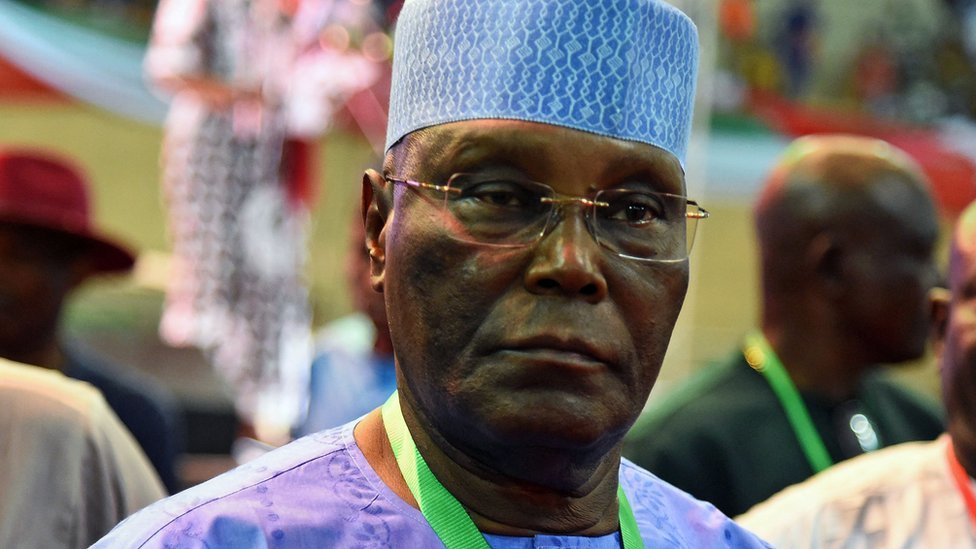
Founder of the American University of Nigeria (AUN), Yola, Atiku Abubakar, says Nigeria’s greatest national challenge is failure to consistently educate, employ, and empower talents among its youth.
Speaking at the university’s 18th Founder’s Day celebration in Yola on Saturday, the Presidential Candidate of the African Democratic Congress (ADC), represented by his vice-presidential running mate Rotimi Amaechi, urged the nation to pivot from short-term consumption toward long-term human capital development.
The university community celebrated the founder in grand style.
- Transfer: Bayer Leverkusen receive offers for Boniface
- Transfer: Fulham prepare new deal for Bassey amid interest from Man Utd, Inter Milan
While eulogising him for decades of remarkable life, vision, generosity, leadership, and service, they prayed for the joy of seeing his dreams for future generations flourish.
In his address, Atiku framed Nigeria’s surging youth population as a double-edged sword that requires immediate, strategic intervention.
According to him, Nigeria possesses immense natural wealth and cultural influence, but its most critical asset is its young demographic.
“The nation must choose between turning its citizens into a skilled workforce or allowing systemic neglect to fuel poverty, insecurity, and social frustration,” he said.
Atiku asserted that a country cannot consume its way out of poverty, emphasizing that true prosperity relies entirely on structural value creation.
The former Vice President criticized the contemporary focus on mere certificate acquisition, arguing that qualifications must be backed by tangible capabilities.
His speech also emphasised the disruptive role of emerging technologies, including Artificial Intelligence (AI), robotics, biotechnology, and digital networks, warning against Africa becoming a passive consumer of global technology.
“We need Nigerian solutions for Nigerian problems and challenges,” Atiku stated, pointing to the need for digital tools in agriculture, rural education, data systems for public health, and localized clean energy infrastructure.
He further cautioned that if access to technology remains restricted to the elite, it will widen existing inequalities. Additionally, he warned that without strong ethical institutional frameworks, advanced digital tools risk being weaponized to spread misinformation, compromise privacy, and manipulate corporate and democratic systems.
Addressing the students directly, Atiku challenged them to view themselves as independent enterprises, advising them to base their future success on problem-solving, integrity, and local relevance rather than brand names or corporate metrics.
Earlier, the AUN President, Prof. Dwayne Frazier, expressed appreciation to the founder on behalf of the university community for all the years he dedicated to the university.
He said, “But what if the university wasn’t here? I think of our students as much as our own faculty. That is my founder’s dream.”
He noted that the university awards 30% of scholarships to students in the community, adding, “Our work begins by asking our neighbors what they need and listening to what they tell us. Then we ask, what can we do together? This is how a university learns its place in the community relationship.”
The president also pointed out that the university supports children in the community through their Feed and Read programme to help reduce out-of-school children in the state, as well as offering free medical care and organizing quizzes for secondary school students in Yola and other local government areas among others.
Delivering the Founder’s Day Lecture, the Founder and Chairman of United Nigeria Airlines, Prof. Obiora Okonkwo, eulogized Atiku for a remarkable life, legacy, and contributions to national development.
Speaking on the topic, “Purposeful Education and the 21st-Century University: Leadership, Innovation and Social Responsibility,” Prof. Okonkwo said the AUN story demonstrates that a founding vision is not fulfilled at inauguration. It must be translated over time into curriculum, faculty recruitment, student support, governance, infrastructure, research culture, and community relationships.
Okonkwo, a professor of Entrepreneurship at the University of Abuja, also pointed out that entrepreneurship is an important expression of innovation, particularly where formal employment cannot absorb all graduates.
“But entrepreneurial education should not be reduced to instructing every student to become a business owner. It should cultivate opportunity recognition, resourcefulness, financial literacy, design thinking, collaboration, resilience, and value creation,” he added.
Meanwhile, the event saw the presentation of gifts to the founder, certificates to winners of the STEM quiz, recognition of staff for outstanding performance for the period under review and for long service to the university.









Atiku: Nigeria’s greatest hurdle is failure to educate, employ and empower talents

Fire Guts FRCN Studios in Kaduna

Transfer: Bayer Leverkusen receive offers for Boniface

Now Hiring: Academic and Technical Staff at a Leading Private University in Gombe State

LAUTECH 18th Convocation: EEE Class ’05 Alumni Celebrate as Electronic and Electrical Engineering Department Produced the School’s Overall Best Graduating Student

NMS 95 Reunion Ends in Tragedy as 2 Members Die, 3 Injured in Road Crash


