Cover
Centre defends due process in appointment of IST Chairman Aminu Junaidu
…says reforms boosting investor confidence in capital market
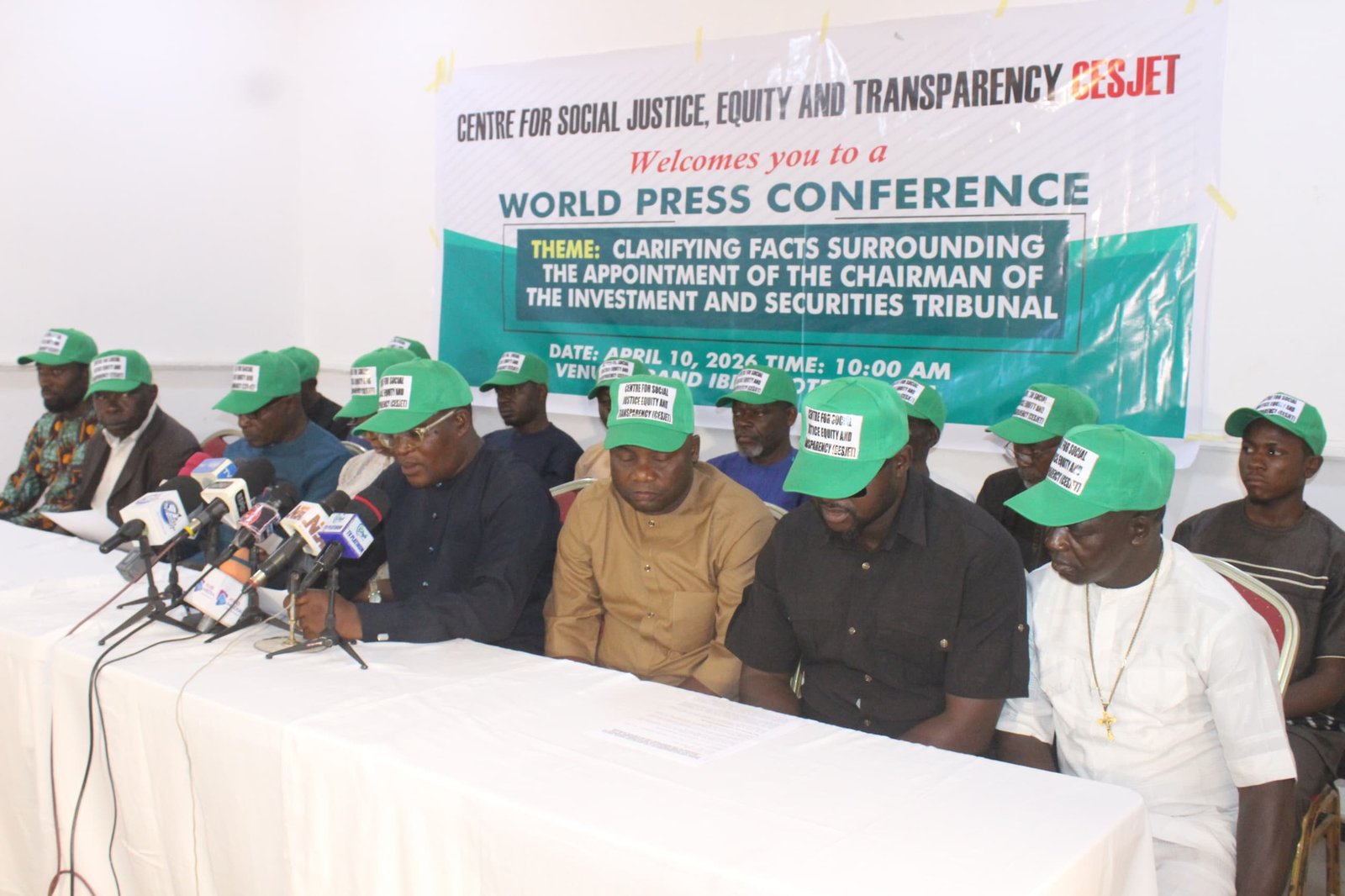
The Centre for Social Justice, Equity and Transparency (CSJET) has defended the appointment of Barrister Aminu Junaidu as Chairman of the Investment and Securities Tribunal (IST), insisting that due process was followed and rejecting claims that the appointment violated the Investment and Securities Act 2025.
Speaking at a press conference held on Friday in Abuja, Executive Director of the Centre, Pastor David D. Yakubu, said the appointment was approved by President Bola Ahmed Tinubu within his constitutional authority, and that there was no evidence of any breach of established legal or administrative frameworks.
CSJET said much of the public debate surrounding the appointment had been shaped by misinterpretation of governance processes, stressing that executive decisions must be understood within the context of institutional needs and constitutional powers.
“The appointment was duly approved by President Bola Ahmed Tinubu, acting within the constitutional powers vested in his office. In a constitutional democracy, such authority is exercised within defined legal and administrative frameworks, not arbitrarily,” Yakubu said.
The Centre also urged caution in interpreting administrative developments as illegality, warning against what it described as “selective readings” of government actions.
“The existence of differing narratives does not automatically translate into illegality. What must guide public judgment is the totality of the process, not isolated fragments of it,” he added.
CSJET further noted that appointments of heads of agencies are processed through the Office of the Secretary to the Government of the Federation, with formal letters issued through established channels.
“For clarity, appointments of Heads of Agencies are processed through the Office of the Secretary to the Government of the Federation, and formal letters of appointment are issued accordingly. This is a well-established administrative procedure,” Yakubu said.
The group also defended Junaidu’s qualifications, describing him as a seasoned legal practitioner with extensive experience in governance and public administration.
“Barrister Aminu Junaidu is a seasoned legal practitioner with extensive experience in governance and public administration. As a former Attorney-General of Zamfara State, he operated at the highest levels of legal advisory and institutional management,” CSJET stated.
The group added that his experience was relevant to the demands of the tribunal, which operates at the intersection of law and economic regulation.
“The argument that qualification must be narrowly restricted to a specific segment of capital market practice overlooks the broader competencies required for modern institutional leadership—analytical depth, legal expertise, and administrative capacity,” the Centre said.
On performance, CSJET said the tribunal had recorded improvements since Junaidu assumed office following a formal handover on October 26, 2025.
“Since assuming office, Barrister Aminu Junaidu has demonstrated a commitment to restoring order, stability, and efficiency within the Investment and Securities Tribunal,” he said.
The group added that there had been improvements in efficiency, inclusiveness, and case management, which it said had contributed to rising confidence among legal practitioners.
“More lawyers are increasingly bringing new cases before the Tribunal, encouraged by a growing reputation for timely and efficient dispute resolution,” CSJET said.
He also highlighted international engagements as evidence of growing institutional credibility, citing visits by foreign delegations.
“On March 13, 2026, the Ethiopian Ambassador to Nigeria paid an official visit to the tribunal to understudy its processes and engage with its leadership,” the group said.
“On March 27, 2026, a delegation from Ethiopia’s capital market institutions visited the tribunal to exchange ideas and learn from its evolving systems. These visits reflect increasing confidence in the tribunal’s direction,” he said.
CSJET said such engagements demonstrated that Nigeria’s capital market institutions were gaining recognition beyond the country’s borders.
“These visits reflect increasing confidence in the tribunal’s direction and the reforms being implemented. They show that Nigeria’s capital market institutions are being recognised beyond our borders,” he stated.
The organisation warned against what it described as narratives that could undermine institutional stability.
“We must be careful not to elevate disagreement into crisis, or to reinterpret administrative developments as constitutional breaches without clear and compelling evidence,” he said.
CSJET further stressed that investor confidence depended on stability and trust in regulatory institutions.
“The capital market thrives on trust, predictability, and stability. It is important that discourse around its institutions remains factual and balanced,” the group added.
The Centre reiterated that the appointment of Junaidu followed due process and was consistent with constitutional provisions.
“The appointment of Barrister Aminu Junaidu followed due process and reflects the lawful exercise of constitutional authority,” he added.

Cover
No Winners, No Losers: Canada vs Bosnia Ends Even
The World Cup clash between Canada and Bosnia and Herzegovina ended in a stalemate yesterday, with both teams unable to find a decisive breakthrough. The match, played under high tension and watched by thousands of fans worldwide, finished with no winners and no losers.
Canada entered the game with confidence after a spirited performance in their opening fixture. Bosnia and Herzegovina, equally determined, sought to assert themselves as a formidable force in the group stage. From the first whistle, both sides displayed intensity, pressing hard and contesting every ball.
The first half was marked by Canada’s aggressive approach. Their midfield controlled possession, moving the ball quickly and forcing Bosnia’s defense into constant action. Jonathan David threatened with sharp runs behind the backline, but Bosnia’s goalkeeper stood firm, denying Canada’s best chances.
Bosnia responded with counterattacks that tested Canada’s defense. Edin Džeko, the veteran striker, led the line with composure, holding up play and creating openings. His effort midway through the half forced Canada’s goalkeeper into a crucial save, keeping the score level.
The second half mirrored the first, with both teams trading opportunities but failing to convert. Canada’s Alphonso Davies surged down the left flank, using his pace to unsettle Bosnia’s defenders. His crosses, however, lacked the finishing touch. Bosnia’s midfield, led by Miralem Pjanić, slowed the tempo and dictated play, but their shots from distance failed to trouble the Canadian keeper.
As the match wore on, fatigue set in. Both sides tightened defensively, unwilling to risk conceding late. The crowd urged for a breakthrough, but neither team could deliver. The referee’s final whistle confirmed a draw that reflected the balance of play.
For Canada, the result was bittersweet. They showcased energy and determination but lacked clinical finishing. Their coach emphasized the need for sharper execution in front of goal, noting that the team must convert chances to progress further in the tournament.
Bosnia and Herzegovina, meanwhile, expressed satisfaction with the point earned. Their defensive resilience and tactical discipline kept Canada at bay. The coach praised his players for their composure under pressure, highlighting the importance of remaining unbeaten in the group stage.
The draw leaves both teams with work to do. Canada must refine their attacking edge, while Bosnia must find greater creativity in the final third. With group standings still open, every point matters, and this result ensures both sides remain in contention.
Fans in Nigeria and across the globe witnessed a contest defined by grit rather than goals. The match may not have produced a winner, but it delivered drama, tension, and a reminder of football’s unpredictability.
As the World Cup continues, Canada and Bosnia will look ahead to their next fixtures, determined to turn resilience into victory. Yesterday’s encounter proved that in football, sometimes balance is the story, and sometimes a draw is the truest reflection of two evenly matched teams.
Cover
Czechia’s Return to World Cup Ends in Defeat to South Korea
Czechia’s long-awaited return to the FIFA World Cup ended in heartbreak yesterday as South Korea fought back to secure a 2-1 victory in Guadalajara. The Group A opener delivered drama, intensity, and a reminder of how unforgiving the global stage can be.
The match began with Czechia showing intent. Their midfield pressed high, forcing South Korea into early defensive errors. The European side’s energy paid off in the 59th minute when Ladislav Krejčí rose above his marker to head home the opener. It was a moment of joy for Czechia, back in the World Cup after a 20-year absence.
But the lead did not last. South Korea, known for resilience, responded swiftly. Just eight minutes later, Hwang In-beom struck from the edge of the box, curling a precise shot past the Czech goalkeeper. The equaliser shifted momentum, silencing Czechia’s supporters and igniting the Korean contingent inside the stadium.
The decisive blow came in the 80th minute. Substitute Oh Hyeon-gyu capitalised on a defensive lapse, slotting calmly into the net to complete the turnaround. His goal sealed South Korea’s victory and underlined their reputation as a team that thrives under pressure.
Czechia tried to rally in the closing stages, but their attacks lacked sharpness. South Korea’s disciplined defence absorbed the pressure, ensuring the scoreline remained unchanged until the final whistle.
The statistics told the story of South Korea’s dominance. They controlled 61.5 percent of possession, completed more passes, and created twice as many chances. Czechia, despite their spirited start, struggled to maintain rhythm once South Korea found their stride.
For Czechia, the defeat was a bitter reminder of the challenges of competing at the highest level. Their return to the World Cup was supposed to signal a new era, but the loss leaves them with work to do if they hope to progress from Group A.
South Korea, meanwhile, celebrated a crucial win. With Mexico also victorious in their opener, the Koreans know every point matters in a tightly contested group. Their comeback showcased tactical patience and mental strength, qualities that could carry them deep into the tournament.
The atmosphere in Guadalajara was electric. Nearly 45,000 fans filled the stadium, creating a vibrant backdrop for the clash. South Korea’s supporters erupted in joy at the final whistle, while Czechia’s fans left subdued, reflecting on what might have been.
Looking ahead, Czechia face South Africa in Atlanta on June 18. It is a must-win fixture if they hope to keep their campaign alive. South Korea will meet hosts Mexico the same day in Zapopan, a match that promises fireworks given both sides’ winning starts.
This result sets the tone for Group A. South Korea have announced themselves as serious contenders, while Czechia must regroup quickly. The World Cup is unforgiving, and yesterday’s match proved that momentum can shift in an instant.
For Nigerian fans following the tournament, the lesson is clear: resilience often defines success at the World Cup. South Korea’s comeback was not just about skill but about belief, a quality every team must carry into the knockout rounds.
As the tournament unfolds, Czechia’s story will be one to watch. Will they recover from this setback, or will their return end in disappointment? For now, South Korea stand tall, their victory a statement of intent in Mexico.
Cover
Group Lauds House of Reps, Pondi Over Bill to Improve Funding for SSDC
*Calls legislation a historic moment for rapid development in the South South
The Amalgamated Coalition of Activists in Nigeria and Diaspora (ACAND) has commended the House of Representatives for passing for second reading a bill seeking to strengthen the funding framework of the South South Development Commission (SSDC).
The group also praised the sponsor of the bill, Hon. Julius Pondi representing Burutu Federal Constituency of Delta State in the House, describing the proposed legislation as a bold and timely intervention by the lawmaker that could accelerate development across the South South region.
In a statement issued on Thursday by its President Lucky Efe, ACAND said the move to provide additional funding for the SSDC represents a historic moment in the quest to address longstanding infrastructural deficits and socio-economic challenges confronting communities in the region.
According to the group, improved funding would enhance the commission’s capacity to execute critical development projects in areas such as roads, education, healthcare, youth empowerment, environmental remediation and economic growth.
“Today marks a significant milestone in the development trajectory of the South South region. The passage of this bill for second reading demonstrates the commitment of the House of Representatives to ensuring that the SSDC is adequately equipped to fulfil its mandate,” the statement said.
The coalition particularly commended Hon. Pondi for championing the amendment, noting that the lawmaker had shown foresight and dedication to the welfare and development of the people of the South South.
It said the region, despite its immense contribution to the nation’s economy, continues to grapple with infrastructure gaps and developmental challenges that require sustained intervention and adequate funding.
“By seeking to expand the funding base of the commission, Hon. Julius Pondi has taken a strategic step towards ensuring that the SSDC can deliver impactful projects that will improve the lives of millions of people across the South South,” the group added.
ACAND urged lawmakers in both chambers of the National Assembly to support the bill through subsequent legislative stages to facilitate its eventual passage and implementation for the development of the region.
The coalition expressed optimism that the proposed amendment would provide the commission with the financial strength needed to accelerate development, create jobs, improve public infrastructure and promote sustainable growth across the region.
It further called on stakeholders, traditional institutions, civil society organisations and community leaders to rally support for the initiative, describing it as a critical investment in the future of the South South.
The House of Representatives had on Wednesday passed for second reading a bill seeking to amend the South South Development Commission Act, 2025, to provide additional funding for the commission.
Leading the debate on the bill, its sponsor, Hon. Julius Pondi, said the amendment was aimed at strengthening the commission’s financial base to enable it undertake more developmental projects and effectively tackle infrastructural challenges in the South South region.
-
Cover10 months agoNRC to reposition train services nationwide.. Kayode Opeifa
-
Fashion9 years agoThese ’90s fashion trends are making a comeback in 2017
-
Entertainment9 years agoThe final 6 ‘Game of Thrones’ episodes might feel like a full season
-
Politics2 months agoNNPP Diaspora Stakeholder and Key Kwankwaso Ally, Dr. Usman Tijjani Shehu, Rejoins APC
-
Opinion1 year agoBureaucratic Soldier, Kana Ibrahim heads Ministry of Aviation and Aerospace After Transformative Tenure at Defence
-
Opinion1 year agoHon. Daniel Amos Shatters Records, Surpasses Predecessor’s Achievements in Just Two Years
-
Opinion6 months agoBarrister Somayina Chigbue, Esq: A rising legal leader shaping institutioal excellence in Nigeria
-
News10 months agoNigerian Nafisa defeats 69 Countries at UK Global Final English Competition