Branded Content
LAUTECH 18th Convocation: EEE Class ’05 Alumni Celebrate as Electronic and Electrical Engineering Department Produced the School’s Overall Best Graduating Student

By Engr. Olaniyi Olayiwola
The Electronic and Electrical Engineering (EEE) Department of Ladoke Akintola University of Technology (LAUTECH), Ogbomosho, had every reason to hold its head high at the university’s 18th Convocation Ceremony. The department not only produced distinguished graduates but claimed the most coveted academic laurel on offer; the university’s Overall Best Graduating Student. This is coming to EEE department for the first time since LAUTECH was founded 36 years ago. Adding colour and deeper meaning to the occasion, the EEE Class ’05 Alumni Association marked the milestone with a special celebration, honouring academic excellence and reaffirming its commitment to the department that shaped its members over two decades ago.
Nestled within the Faculty of Engineering and Technology, the EEE Department has long been regarded as one of LAUTECH’s most rigorous and intellectually demanding disciplines. The 2025/2026 Academic Session, however, delivered a statement that transcended departmental pride. Oladepo Caleb Olugbenga, the best graduating male student from the department, recorded a First-Class cumulative grade point average (CGPA) of 4.89, a performance of exceptional brilliance that earned him the distinction of Best Graduating Student in the Faculty of Engineering and Technology and, ultimately, the historic Overall Best Graduating Student of Ladoke Akintola University of Technology at the 18th Convocation’s conferment of First Degree awards today, 22nd April, 2026. It is the kind of achievement that sends a message across faculties, departments, and generations that precision, discipline, and intellectual rigour; the very values the EEE curriculum demands translate into the highest form of academic distinction. Equally commendable was Akinwande Salimat Oluwatobi, who graduated as the best female student in the department with an impressive First-Class CGPA of 4.51, demonstrating that excellence in the EEE Department is not a solitary phenomenon but a culture.
The celebration of these outstanding graduates was not left to chance or institutional routine. The EEE Class ’05 Alumni Association composed of members of the graduating set of 2005 in the Electronic and Electrical Engineering Department who have stepped forward with purpose and pride to honour the stars of the 2025/2026 session. The Association has since 2023/2024 Academic year instituted an annual Award of Excellence presented to the best graduating male and female students from the EEE Department. What made the 18th Convocation particularly significant is that the Association expanded its recognition framework in 2026 to include the best graduating student in the Faculty of Engineering and Technology, a widening of scope that coincided fortuitously with one of their department’s finest hours. That the recipient of this expanded faculty-level award also emerged as the university’s overall best graduate made the occasion nothing short of historic.
“We are incredibly proud,” said Dr. Rabiu Emmanuel Oluwatosin, the Executive Chairman of the EEE Class ’05 Alumni Association. “When we graduated in 2005, we made a silent promise to give back. Seeing a student from our department stand on the highest pedestal for the first time in this university is not just our department’s win. It is a validation of every late-night oil we burned studying, every push our good lecturers provided, and every sacrifice our parents made. We celebrate Caleb and Salimat because they represent what EEE students are made of.” Engr. Olaniyi Olayiwola, the General Secretary of the Association, echoed this sentiment while highlighting the institutional significance of the moment. “Our award of excellence is not a one-off gesture. It is a deliberate, sustained commitment to recognising and encouraging academic merit. We started with the department, and this year we extended to the faculty. The timing could not have been more perfect.”

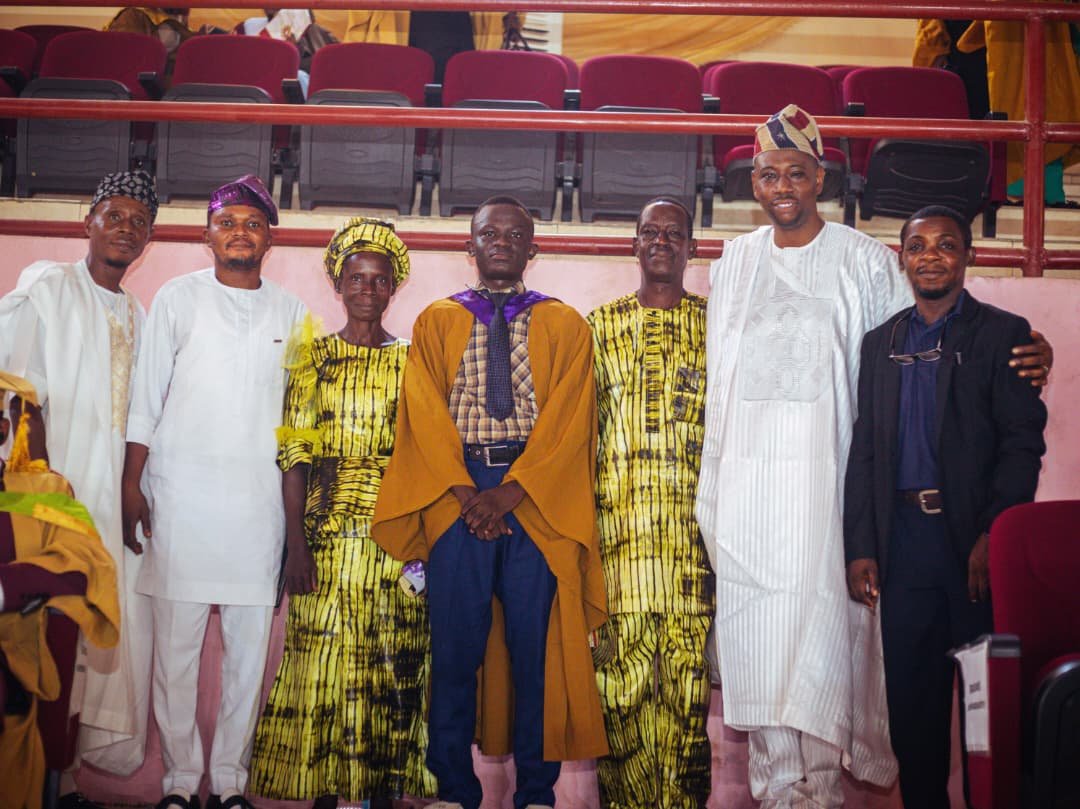
L-R: Revd. Dr. Jemiriye Oluwafemi (Member, LAUTECH EEE Class 05 Alumni Association), Engr. Adeyemo Victor (Ogbomoso Zonal Coordinator), Mrs. Oladepo (Caleb’s Mother), Oladepo Caleb Olugbenga (LAUTECH Overall Best Graduating Student), Mr. Oladepo (Caleb’s Father), Dr. Rabiu Oluwatosin (Executive Chairman), Engr. Adeagbo Monsur (Member, LAUTECH EEE Class 05 Alumni Association)
At the ceremony, the Association presented its Awards of Excellence to both outstanding students. Oladepo Caleb Olugbenga received the award as the best graduating male student in the EEE Department and, in a first for the Association’s history, as the best graduating student in the Faculty of Engineering and Technology, a recognition made all the more profound by his groundbreaking simultaneous coronation as the university’s Overall Best Graduating Student. Akinwande Salimat Oluwatobi received the award as the best graduating female student in the department, representing a level of academic commitment and intellectual consistency that deserves to be celebrated as loudly as any headline achievement. The dual recognition sends an important message about the culture the Association is working to build: that excellence is not reserved for one gender or one narrative, and that the department is producing outstanding talent across the board.
The Association’s activities, however, are not merely ceremonial. They are anchored in a broader philosophy of sustainable development that aligns closely with the United Nations Sustainable Development Goals, particularly SDG 4 (Quality Education), SDG 9 (Industry, Innovation and Infrastructure), and SDG 17 (Partnerships for the Goals). SDG 4 calls for inclusive and equitable quality education and the promotion of lifelong learning opportunities. The Association’s annual Award of Excellence is a direct intervention in this space, not simply through the act of recognition, but through the signal it sends to current and prospective students that academic excellence is seen, valued, and rewarded by those who have walked the same path. Recognition of this nature has been shown to stimulate academic aspiration, particularly in STEM disciplines where the learning curve is steep and the temptation to settle for passing grades is ever-present. SDG 9, which speaks to building resilient infrastructure, promoting sustainable industrialisation, and encouraging innovation, finds expression in the Association’s most tangible intervention to date. Following a thorough needs assessment conducted in the department, the Association identified critical gaps in laboratory infrastructure and responded with a targeted donation of an Antenna Trainer Device; a specialised laboratory system designed to teach students the fundamental principles of antenna design, radiation patterns, and wave propagation. In a rapidly evolving telecommunications and radio-frequency engineering landscape, access to this kind of hands-on equipment is an educational necessity. The donation ensures that EEE students at LAUTECH are not learning solely from textbooks while the world advances; they are gaining applied, laboratory-grounded competencies that make them industry-ready and genuinely competitive. SDG 17, which underscores the importance of multi-stakeholder partnerships in achieving sustainable development, finds its clearest embodiment in the Association itself, a self-organised alumni body that has built a sustainable bridge between a professional community and an academic institution, mobilising intellectual capital, professional networks, and financial resources in service of a shared mission.
Critically, the Association under the distinguished chairmanship of Dr. Rabiu Oluwatosin, has structured all of these activities as a sustainability initiative, not a one-time donation or a ceremonial gesture, but a recurring, institutionalised programme with annual outputs, expanding scope, and a long-term vision. The intent is deliberate: to make giving back to the department a permanent feature of what it means to be a member of the EEE Class ’05, and to inspire subsequent graduating sets to establish similar traditions of alumni engagement. The needs assessment that preceded the Antenna Trainer donation illustrates this philosophy well. Rather than acting on assumption, the Association engaged academic staff and students to identify the most impactful intervention possible. This approach of listening before acting reflects a maturity in alumni engagement that is still rare in the Nigerian university context, and it is a model worth replicating across the sector.
As LAUTECH community absorbs the remarkable achievement of Oladepo Caleb Olugbenga during this 18th Convocation and 36th Founder’s Day, the EEE Class ’05 Alumni Association stands as proof that the bonds forged in the heat of an engineering programme, the shared late nights, the gruelling laboratory sessions, and the demanding examinations can be channelled, years later, into something that outlasts any individual graduation ceremony. The message from the Electronic and Electrical Engineering Department, through its 2025/2026 graduates and through the alumni who came before them, is one of confidence that excellence is not accidental. It is cultivated, and those who were cultivated here do not forget where it began.
The current Executive Members of the LAUTECH EEE Class ’05 Alumni Association are: Dr. Rabiu Oluwatosin (Chairman), Engr. Odewale Adewumi (Vice Chairman), Engr. Olayiwola Olaniyi (General Secretary), Engr. Oyeniyi Oluwaseun (Financial Secretary), Engr. Adetiran Adesoji (PRO), Engr. Alade Temitope (Treasurer), Engr. Adeyemo Victor (Ogbomoso Zonal Coordinator), Engr. Gazali Abolade (Abuja Zonal Coordinator), Engr. Adeyemo Olusegun (Ibadan Zonal Coordinator), Engr. Ojenike Abimbola (Lagos Zonal Coordinator), Engr. Agbonyin Anthony (Osogbo Zonal Coordinator), Engr. Robert Omotooke (Port-Harcourt Zonal Coordinator), and Engr. Oladapo Kola (Diaspora Zonal Coordinator).