Politics
Osun 2026: APC Chieftain, Ojuade, drums support for Omisore
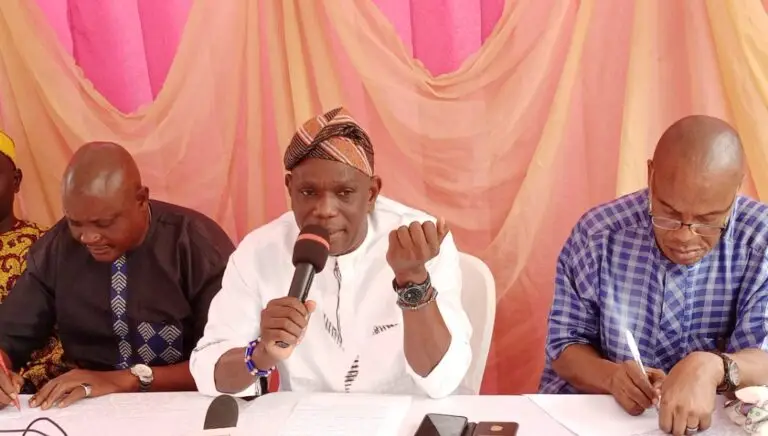
As the race to the governorship election in Osun gathers momentum, a chieftain of All Progressives Congress (APC), Hon. Bukola Ojuade has called on the leadership and members of the party to support Sen. Iyiola Omisore’s governorship ambition.
Ojuade made the call at a news conference organised by Ojuade Support Group on Sunday in Ile-Ife.
The News Agency of Nigeria NAN reports that Omisore, a former senator and one time deputy governor of Odun, has declared his interest in securing APC’s ticket for the August 2026 governorship election in the state.
Ojuade, at the News conference, appealed to members to give the party’s governorship ticket to Omisore, describing him as the most qualified among all the aspirant.
According to him, Omisore is the leader Osun needs at this critical time in its history.
“Sen. Omisore is not just a politician, he is an engineer by profession, a legislator by distinction and a strategist by instinct,” he remarked.
The APC chieftain stated that Omisore had served the country in various capacities, adding that as deputy governor, he brought infrastructural development to the fore.
“As a senator, he championed bills and projects that directly benefited the people of Osun State. Also, as the immediate past National Secretary of APC, he helped build the party’s structures across Nigeria.
“He is a bridge between the old and the young. He is widely accepted across all senatorial zones.
“And let me say it clearly today, Sen. Iyiola Omisore is more than qualified—he is prepared, capable and ready to lead Osun into the future.
“His ambition to contest in the 2026 gubernatorial election is not just his—it is the hope of thousands across the 30 local government areas of Odun State,” he said.
According to Ojuade, the people of the state are yearning for competent, compassionate and visionary leadership.
“With Sen. Omisore at the forefront, we are preparing to bring Osun into a new era of responsive and responsible leadership.
“Omisore is the most popular among the contestants around now. APC should allow him to pick the ticket to lead the party.
“He cannot be ignored when discussing leadership, development and capacity,” he said.
Ojuade described APC as the party of the present and the future, stressing: “The tide is turning, and Osun State is coming back to the APC that understands governance, listens to its people and has the track record to prove it.”
He stated further that the people of Osun had seen the difference and that they were now ready and prepared to choose the path of experience rather than experimentation.

Politics
BREAKING: Electoral Violence Erupts in Wakama Ward as APC Campaign DG, 12 Party Members Attacked
A wave of electoral violence has reportedly rocked Wakama Ward, where the Director-General of the APC campaign organisation and 12 members of the All Progressives Congress (APC) were allegedly attacked by suspected ethnic militia believed to be loyal to Labour Party candidate, Labaran Maku.
Sources from the area disclosed that the attackers, armed with machetes and axes, inflicted serious injuries on several victims during the assault. Many of those attacked sustained varying degrees of injuries, while two victims are currently receiving treatment in hospital for severe wounds.
One of the victims, Ezekiel Baba, was initially declared missing in the aftermath of the attack, raising fears about his safety. However, following a swift response by personnel of the Nigerian Security and Civil Defence Corps (NSCDC), he was rescued and taken to hospital for medical attention.
Sources further alleged that operatives of the NSCDC apprehended one of the suspected attackers, identified as Peter Assi, a former Councillor of Wakama Ward and a known political associate of Labour Party candidate, Labaran Maku. Security authorities are yet to issue an official statement on the arrest and the circumstances surrounding the incident.
The incident has heightened tensions in the area and raised serious concerns about voter safety and the conduct of the ongoing Nasarawa North Senatorial Bye-Election. Residents and political stakeholders have called on security agencies to swiftly investigate the attack, bring the perpetrators to justice, and ensure adequate security for voters and election officials.
The APC has strongly condemned the incident, describing it as a dangerous act of political violence capable of undermining the credibility of the electoral process.
Security authorities are yet to issue a comprehensive official statement on the incident, while efforts to obtain a response from the Labour Party candidate and other relevant stakeholders were ongoing at the time of filing this report.
Cover
Judicial Battle Reboots Kwara ADC’s 2027 Election Machinery
The Kwara State chapter of the African Democratic Congress (ADC) has converted a recent legal threat into a political launchpad. Following an appellate court victory that halted an attempt to deregister the party, the Kwara ADC has declared its full readiness to contest the 2027 general elections.
A Federal High Court judgment by Justice Peter Lifu originally ordered the Independent National Electoral Commission (INEC) to deregister the ADC along with four other opposition parties.
The decision was met with an outcry by opposition coalition who alleged the judicial action was another manipulative scheme to cripple opposition politics in the nation and give an unearned leap to ruling parties for the 2027 election cycle.
The “threat however, disappeared into thin air as the Court of Appeal in Abuja swung into action and delivered a strong rebuff on the lower court. A stay of execution of the deregistration order was issued by the Court of Appeal.
Experts and political leaders in opposition said the lower court’s ruling had contravened judicial hierarchy as courts above had already issued a stay of proceedings. It has returned to status quo, following the successful legal defence as the Kwara State chapter of the ADC has called an emergency State Executive Committee meeting at its State Secretariat, Ilorin.
Party stakeholders have already turned the page from the legal battle to an intensive grassroots mobilisation as party structures have been instructed to get set for the next election cycle.
“This issue, while appearing like a setback, has only united us more than before,” said the Kwara State Chairman of ADC, Babatunde Muhammed, who assured that “
The Court of Appeal intervention in our case has revived my confidence in the country’s judicial system, and that you cannot simply rubbish an existing political movement because you have access to some judges.
We remain unruffled” he added. Consequently, all ADC Candidates and ward executives in Kwara State have been tasked to commence voter outreach immediately with a unit-by-unit grassroots mobilisation plan that aims to put the current ruling party on the defensive by articulating how the ADC platform and agenda contrast with the performance of the incumbent administration.
The new approach of Kwara ADC will focus primarily on local security issues, fiscal and economic management and ensuring a free and fair electoral system in 2027 election.
Cover
Voter Apathy and Money Politics Threaten Democratic Future
Nigeria’s democracy faces mounting pressure from two persistent threats: voter apathy and the dominance of money in politics. The Institute for Peace and Conflict Resolution (IPCR), alongside Search for Common Ground, has warned that these forces are eroding citizen participation and weakening democratic institutions.
At a joint press conference in Abuja marking Democracy Day 2026, IPCR Director-General Dr. Joseph Ochogwu stressed that Nigeria’s democratic challenges stem not from the system itself but from declining civic engagement. He argued that democracy thrives only when citizens actively participate, hold leaders accountable, and reject manipulation.
Ochogwu identified several drivers of voter apathy: declining trust in institutions, fear of electoral violence, unmet governance expectations, and the widespread belief that individual votes do not matter. These factors, he said, discourage citizens from voting and weaken the legitimacy of elected governments.
When citizens withdraw from democratic processes, space opens for manipulation, misinformation, and electoral malpractice. Ochogwu warned that disengagement undermines accountability and allows narrow interests to capture democratic institutions. He urged Nigerians, especially young people, to see elections not as routine events but as the primary means of exercising sovereignty.
Beyond apathy, the monetisation of politics poses another grave danger. Ochogwu described money politics as a systemic driver of disenfranchisement. Wealthy elites dominate political participation, while ordinary citizens are excluded from meaningful influence. Within parties, financial considerations often determine outcomes, sidelining merit and ideas.
Exclusion and Inequality
The dominance of money in politics widens inequality, restricting opportunities for citizens without financial power to contest or participate. Ochogwu warned that this distortion undermines democratic fairness and entrenches a system where governance is shaped by wealth rather than public interest.
Ochogwu also highlighted terrorism, banditry, and violent extremism as enemies of democracy. These threats erode public confidence in institutions and hinder development. He stressed that insecurity compounds the challenges of apathy and money politics, creating a fragile democratic environment.
Gift Omoniwa, Director of Programmes at Search for Common Ground, raised concern about Nigerian youth being vulnerable to recruitment by extremist groups. She warned that without meaningful engagement, young people could be drawn into violence, further destabilising democracy.
Omoniwa outlined efforts to counter these risks, including a reality television programme showcasing youth resilience and alternatives to extremism. She reaffirmed her organisation’s commitment to working with government, civil society, and communities to promote peace and democratic governance.
Ochogwu closed his remarks by reminding Nigerians that democracy requires collective responsibility. He echoed President Bola Tinubu’s Democracy Day appeal, stressing that democracy is bigger than any individual and depends on shared commitment and continuous engagement.
Since 1999, Nigeria has maintained uninterrupted civilian rule, the longest stretch in its post-independence history. Yet this achievement remains shadowed by low voter turnout, political violence, and the outsized influence of money. The warnings from IPCR and Search for Common Ground underscore the urgent need for reforms that strengthen civic participation and reduce the grip of money on politics.
Nigeria’s democratic survival depends on citizens rejecting apathy and resisting money politics. Without active participation and fair competition, democracy risks becoming hollow, vulnerable to manipulation and exclusion. The call from IPCR and Search for Common Ground is clear: Nigerians must reclaim their democracy by engaging, voting, and demanding accountability.
-
Cover10 months agoNRC to reposition train services nationwide.. Kayode Opeifa
-
Fashion9 years agoThese ’90s fashion trends are making a comeback in 2017
-
Entertainment9 years agoThe final 6 ‘Game of Thrones’ episodes might feel like a full season
-
Politics3 months agoNNPP Diaspora Stakeholder and Key Kwankwaso Ally, Dr. Usman Tijjani Shehu, Rejoins APC
-
Opinion2 years agoBureaucratic Soldier, Kana Ibrahim heads Ministry of Aviation and Aerospace After Transformative Tenure at Defence
-
Opinion1 year agoHon. Daniel Amos Shatters Records, Surpasses Predecessor’s Achievements in Just Two Years
-
Opinion7 months agoBarrister Somayina Chigbue, Esq: A rising legal leader shaping institutioal excellence in Nigeria
-
News11 months agoNigerian Nafisa defeats 69 Countries at UK Global Final English Competition