Connect with us

Cover

Sack NAFDAC DG Now, Protesters Demand as CUPN Storms Abuja Over Sachet Alcohol Ban

Published

on

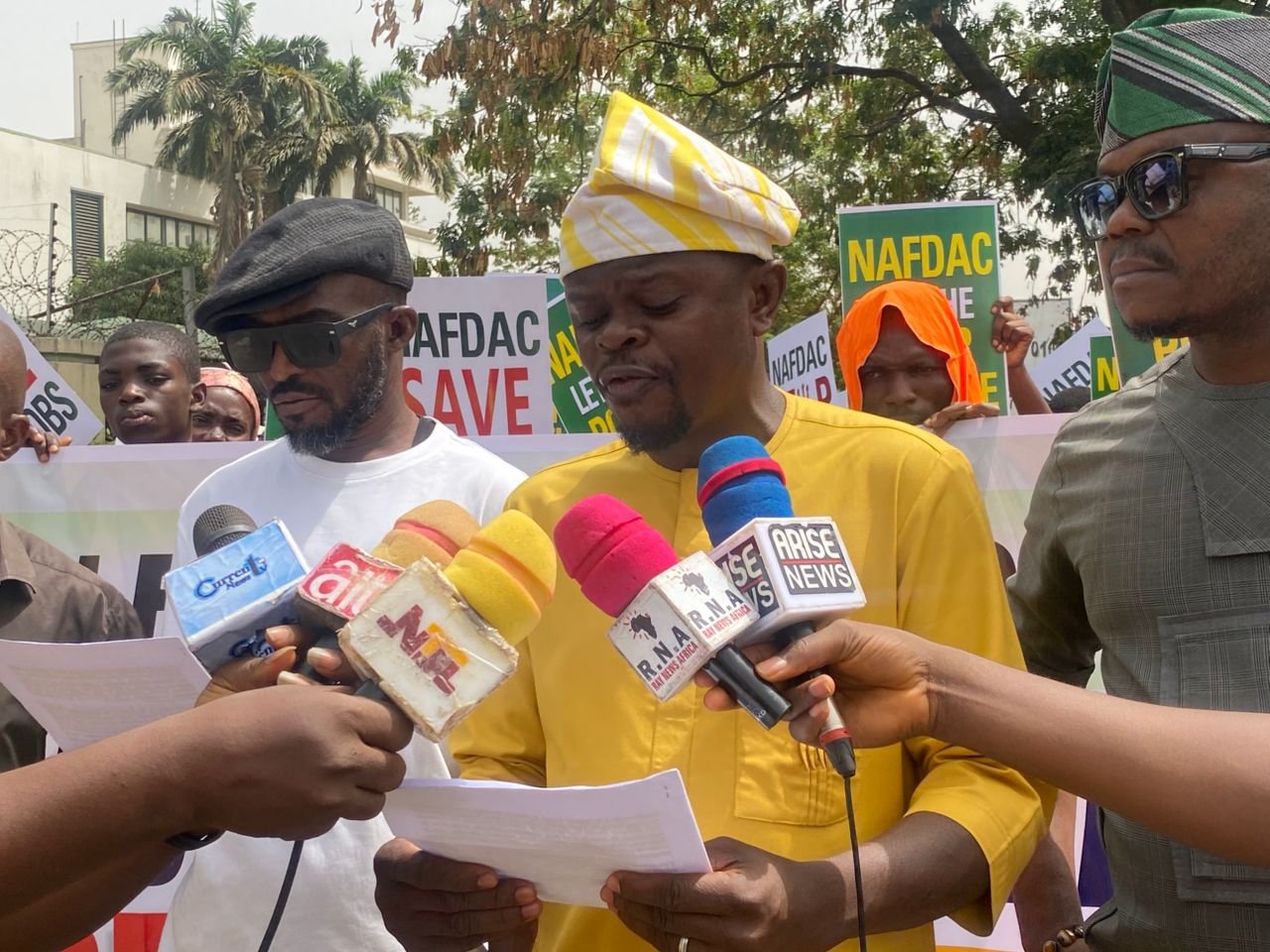
Tension flared in the nation’s capital on Tuesday as members of the Coalition for Unemployed People in Nigeria (CUPN), led by Comrade Nathaniel Isiaku Balogun, staged a protest demanding the immediate sack of the Director-General of the National Agency for Food and Drug Administration and Control (NAFDAC), Prof. Mojisola Christianah Adeyeye, over what they described as “gross incompetence and abuse of public office.”


The protesters, who converged on major streets in Abuja, accused the NAFDAC boss of illegally enforcing what they termed an arbitrary ban on sachet alcohol and 200ml PET bottle alcoholic products, allegedly in defiance of existing government directives and legislative resolutions.


Addressing journalists during the protest, Comrade Balogun said the coalition was “terribly appalled by the unwholesome activities” of the NAFDAC Director-General, insisting that the enforcement contradicts the National Alcohol Policy signed into law by the Federal Ministry of Health.


According to him, the action also disregards a presidential directive restraining the agency from further disrupting business premises of affected companies pending the outcome of a joint committee set up to review the matter.


“This hasty enforcement is counterproductive to the economic policy of the Renewed Hope Agenda and capable of stirring civil unrest, especially given its timing,” Balogun stated. “It is throwing the country into needless confusion due to conflicting directives from different government authorities.”


The coalition further argued that the move amounts to a flagrant disobedience of the resolution of the House of Representatives (Reference: NAS/10/HR/CT.33/77c of March 14, 2024), which, after a public hearing with key stakeholders, reportedly restrained NAFDAC from implementing the ban and described it as anti-people.


CUPN maintained that sachet and small PET bottle alcoholic products were introduced as affordable alternatives for low-income adult consumers and should not be criminalized. The group contended that smaller portions discourage abuse rather than promote it and emphasized that locally produced sachet alcohol is manufactured under hygienic conditions and certified by regulatory authorities, including NAFDAC.


The coalition also dismissed claims that sachet alcohol encourages underage consumption, stating that independent empirical research has allegedly contradicted such assertions. It added that industry operators have invested over a billion naira in nationwide campaigns promoting responsible drinking and discouraging underage consumption.


Balogun warned that the enforcement of the ban could lead to massive job losses across the value chain, negatively impact government revenue, and open the market to illicit and smuggled alcoholic products.


While affirming support for pragmatic measures to eliminate unsafe products from the market, CUPN insisted that regulatory decisions must be based on verified empirical evidence rather than “emotional persuasions.”


The protesters called on President Bola Ahmed Tinubu to act swiftly in the interest of his administration and relieve Prof. Adeyeye of her duties, arguing that her continued stay in office is “no longer in the public interest.”


As of the time of filing this report, NAFDAC had not issued an official response to the protest or the allegations raised by the coalition.

Continue Reading
Click to comment

Leave a Reply

Your email address will not be published. Required fields are marked *

Cover

World Cup Referees Earn Big As African Official Denied Entry

Published

on

The 2026 FIFA World Cup is set to be the biggest in history, with 48 teams competing across North America. But while referees are preparing for a record payday, controversy has already emerged after Somali referee Omar Artan was denied entry into the United States.

Artan, who travelled with a diplomatic passport, was stopped at Miami International Airport and forced to return to Istanbul. His exclusion has reduced FIFA’s pool of centre referees from 52 to 51, unless a replacement is named. The incident has raised questions about US immigration policies and their impact on international sporting events.

For referees who make it to the tournament, the financial rewards are substantial. Reports indicate that each referee will earn at least $100,000 for their involvement, with additional bonuses depending on the number of matches officiated. Those selected for the final in New Jersey on July 19 will receive the highest payout in World Cup history.

The expanded format of the tournament, spread across the United States, Mexico, and Canada, has increased the workload for officials. FIFA has selected 88 assistant referees and 30 Video Assistant Referees (VARs) to support the 51 centre referees. The list includes some of the most experienced names in world football.

Among them is Polish referee Szymon Marciniak, who officiated the dramatic 2022 final between Argentina and France. Premier League officials Michael Oliver and Anthony Taylor are also on the roster, alongside French referees François Letexier and Clément Turpin, and Slovenia’s Slavko Vincic.

Brazilian referee Wilton Sampaio will take charge of the opening match in Mexico City between the hosts and South Africa. His appointment reflects FIFA’s strategy of blending experienced officials with emerging talents to ensure consistency across the expanded competition.

African referees are represented by Tom Abongile of South Africa, Mustapha Ghorbal of Algeria, Amin Mohamed of Egypt, Pierre Atcho of Gabon, Dahane Beida of Mauritania, and Jalal Jayed of Morocco. However, Artan’s exclusion has cast a shadow over the continent’s representation.

No Kenyan referee was selected this time, a notable absence given the country’s growing football profile. The decision underscores FIFA’s emphasis on referees with consistent exposure to top-level international competitions.

The financial rewards for referees mirror FIFA’s broader investment in the tournament. Clubs will also benefit, with FIFA pledging to pay teams daily for each player involved. Payments will be backdated to qualifiers, ensuring clubs are compensated for releasing players to national duty.

For referees, the pay structure reflects both the demands of officiating at the highest level and FIFA’s ambition to attract the best officials. The final in New Jersey is expected to deliver a record-breaking payout, reinforcing the prestige of officiating the world’s most-watched football match.

Yet, Artan’s case highlights the challenges that can overshadow such opportunities. His denial of entry has sparked debate about fairness and inclusivity, particularly for officials from Africa and other regions facing stricter visa scrutiny.

As the tournament kicks off, the focus will be on the referees’ performance on the pitch. But off the pitch, questions remain about how immigration policies intersect with FIFA’s global ambitions. For now, referees who made the cut are preparing for both the responsibility and the rewards of officiating at football’s grandest stage.

Continue Reading

Cover

Matawalle Defends Tinubu’s, Dismisses Opposition Propaganda

Published

on

Minister of State for Defence, Dr. Bello Muhammad Matawalle, has dismissed claims of declining support for President Bola Ahmed Tinubu in the North-West, insisting that the region remains firmly behind the president as the 2027 elections approach.

Matawalle’s remarks came in response to recent surveys and opposition statements suggesting that economic hardship and insecurity were eroding Tinubu’s popularity. The minister argued that such narratives were driven by propaganda aimed at undermining the administration’s achievements.

He pointed to the NOI Polls survey, which gave Tinubu’s government a 30 per cent approval rating after three years in office. Opposition figures, including Mallam Bolaji Abdullahi, interpreted the result as evidence of widespread rejection. Abdullahi argued that the administration could no longer claim to have inherited Nigeria’s challenges.

Matawalle countered that critics were deliberately amplifying isolated incidents of insecurity to overshadow progress. He highlighted coordinated military operations in Sokoto, Zamfara, Katsina, Kaduna, and Kebbi states, which he said had eliminated notorious bandit leaders, dismantled criminal hideouts, and restored relative peace in affected communities.

“The opposition is uncomfortable with the visible progress being recorded in the fight against insecurity and the ongoing developmental strides across the country,” Matawalle stated.

He praised the Armed Forces and security agencies for their sacrifices, noting that many personnel had paid the ultimate price in the line of duty. He also cited improvements in the fight against insurgency in the North-East and efforts to reduce communal violence in the North-Central region.

Beyond security, Matawalle stressed that Tinubu’s Renewed Hope Agenda was delivering results in infrastructure, agriculture, social investment, and economic reforms. He listed federal interventions in Northern Nigeria, including road rehabilitation, agricultural value chain support, food security programmes, rail and energy projects, and empowerment initiatives for youth and women.

According to him, these policies are resonating with citizens and will translate into political support for Tinubu in 2027. “The people of the region understand the efforts being made to improve their security, livelihoods and overall well-being. They are witnessing the results firsthand,” he said.

Matawalle expressed confidence that no amount of political blackmail or misinformation would diminish the administration’s achievements. He insisted that Tinubu remained focused on governance, national development, and improving the welfare of Nigerians.

He urged political leaders to prioritise national interest over partisan rivalry, stressing that consolidating peace and development should be the collective goal. The minister concluded that the gains of the Renewed Hope Agenda would continue to strengthen Tinubu’s support base in the North-West and across Nigeria as the 2027 elections draw closer.

Continue Reading

Cover

US Denial Ivory Coast Fans Visa Ahead of 2026 World Cup

Published

on

The build-up to the 2026 FIFA World Cup has taken a controversial turn after the United States denied visas to hundreds of Ivory Coast supporters. The decision has forced many fans to abandon plans to travel for the tournament, raising questions about visa policies and their impact on global sporting events.

Julien Kouadio Adonis, president of the National Committee of Elephants Supporters (CNSE), confirmed the setback. He said the refusal had left fans disappointed and unable to fulfil their role of cheering the national team on the world stage.

“The supporters have cancelled the trip because the US government does not want to see supporters from certain countries, including the Ivory Coast, on its soil,” Kouadio explained. He described the situation as deeply painful, stressing that supporting the team is considered a “sacred duty” by many Ivorians.

The CNSE, operating under the Ministry of Sport, is responsible for organising travel for fans during international competitions. Earlier this year, Kouadio had expressed optimism that about 500 supporters would make the journey to North America. That hope has now been dashed, with only a handful of committee officials receiving clearance to travel.

Despite the restrictions, CNSE officials say they will focus on coordinating support from Ivorian fans already living in the United States. Kouadio noted that more than 1,000 diaspora supporters are expected to attend matches, ensuring the team will not be left without encouragement in the stands.

Ivory Coast will play two of their three group-stage matches in Philadelphia. They face Ecuador on June 15 and Curacao on June 25. Between those fixtures, the team will travel to Toronto for a clash against Germany. The absence of travelling supporters from Abidjan and other cities is expected to affect the atmosphere, but organisers hope diaspora fans will fill the gap.

The visa denials have not only affected Ivory Coast. Earlier this week, Somali referee Omar Artan was reportedly denied entry, while members of Iran’s support staff also faced rejections. These developments have sparked wider concerns about how US immigration policies intersect with international sporting events.

For Ivory Coast, the setback underscores the challenges African nations face in mobilising supporters for global tournaments. While the team prepares for tough matches against Ecuador, Germany, and Curacao, the absence of their traditional fan base could be felt both on and off the pitch.

Kouadio insisted that the CNSE remains committed to ensuring visible support for the Elephants. “A handful of our officials will be present to look after Ivorian supporters based in the United States,” he said. The committee hopes to coordinate chants, banners, and cultural displays to maintain the team’s spirit during the competition.

The issue highlights the broader tension between global sports and national immigration policies. As the World Cup expands to 48 teams for the first time, organisers face the challenge of balancing security concerns with the inclusive spirit of football.

For Ivorian fans, the disappointment is profound. Many had saved for months to make the trip, only to be stopped by visa restrictions. Yet, with diaspora supporters stepping in, the Elephants will still hear familiar voices as they chase success in the 2026 World Cup.

Continue Reading

Trending

Copyright © 2023 - 2025 DailyMirror Nigeria. Design by AspireWeb.ng, powered by WordPress.