Connect with us

Sports

Spygate: Southampton’s Coach Admits Everything, But His Owner Is Keeping Him Anyway

Published

on

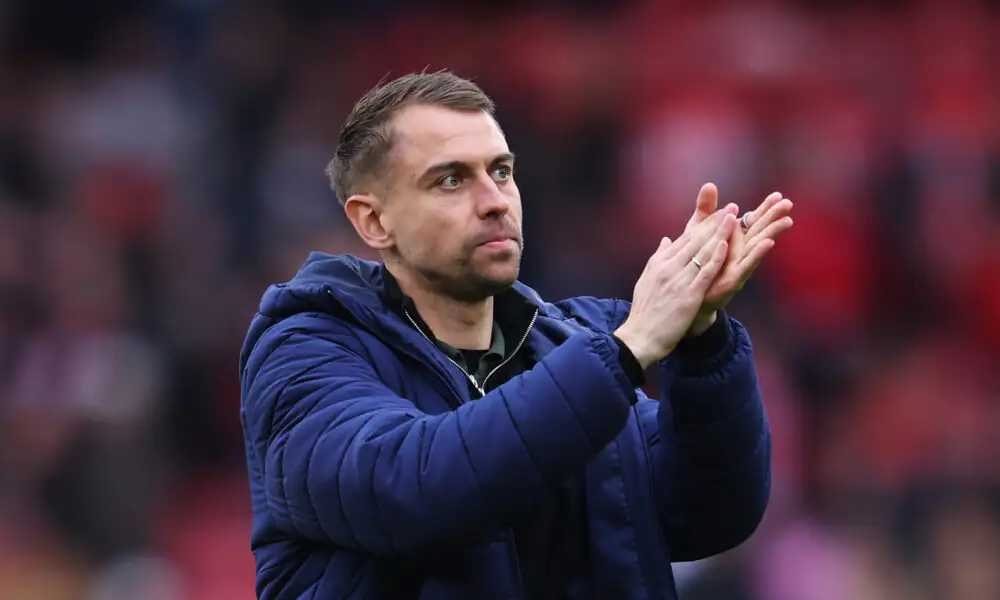
Tonda Eckert stood in front of a camera on Tuesday and said the words that were always coming. He admitted responsibility. He apologised. He held his hand up.
What he did not do was resign. And his owner has made clear he does not intend to ask him to.

The Southampton “Spygate” scandal — which resulted in the club being thrown out of the Championship play-offs last month — has produced a public reckoning that answered some questions and raised several more. Chief among them: what does it mean to be held responsible when responsibility carries no further consequence?

What Eckert Said
The 33-year-old German head coach released a lengthy video statement through the club on Tuesday, opening with a pledge to be “as honest and clear as I can be.”
He delivered on that, at least in terms of ownership.

“For everything that has happened, I do want to apologise and I hold my hand up because as head coach I am responsible,” Eckert said. “I am responsible for everything that has happened at this football club.”

The English Football League had already reached that conclusion for him. In its ruling last month, the governing body confirmed that Eckert had authorised the sending of a young intern to spy on a Middlesbrough training session — describing the act as “deplorable” and noting that the club had placed unacceptable pressure on a junior member of staff to carry out the surveillance.

That final detail carries particular weight. This was not a manager who personally drove to Middlesbrough with binoculars. This was a senior figure who sent a young, inexperienced employee to do something ethically wrong and professionally risky — and who, when the scandal broke, became the one whose career survived while the intern’s reputation was exposed.

The Owner Stands Firm
Southampton’s Serbian owner, Dragan Solak, spoke to the BBC on Tuesday and made his position unambiguous: Eckert is staying.
“I have to believe, honestly, and I believe Tonda, that he didn’t know it was the rule that he was breaking,” Solak said.

He continued: “My personal opinion, and the opinion of the board, is that he is a manager who deserves to be backed by us and to be supported by us. I think he deserves a second chance.”
Solak went further, describing the coverage and consequences of the scandal as “a witch-hunt” and arguing that Southampton had been “over-sentenced.” He also invoked the legal principle of double jeopardy — arguing that having already been punished by the EFL, Eckert should not face further sanction.

“Whatever crime you did, you can be sentenced only once,” Solak said.
That argument has a legal basis in criminal proceedings. It carries less force in football’s regulatory framework, where multiple bodies — the EFL, the FA, and individual clubs — operate independent disciplinary processes with overlapping jurisdiction. The FA has already launched its own investigation into the affair and could still charge Eckert. If found guilty, a ban remains a real possibility.

The Punishment So Far
Southampton’s expulsion from the Championship play-offs was the headline sanction — and it was severe. The club had reached the semi-finals, knocked out Middlesbrough, and were preparing for a final that could have led to Premier League promotion.

That opportunity was stripped away entirely. Middlesbrough were reinstated and played the final at Wembley on May 23 — a final they lost to Hull, who will join Coventry and Ipswich in the Premier League next season.

In addition to the play-off expulsion, Southampton will begin next season with a four-point deduction after admitting to multiple breaches of regulations related to the “unauthorised filming of other clubs’ training sessions.” The plural matters. This was not a single isolated incident.

The Intern in the Room
The moral dimension of this story that has received the least scrutiny is also the most uncomfortable one.

The EFL found that Southampton’s management pressured a junior intern to carry out the spying. That person — unnamed, presumably young, almost certainly in a precarious employment position — was placed in an impossible situation by people with significantly more institutional power than they possessed.

Eckert has apologised. Solak has called it a “mistake.” Neither has addressed directly what the club owes to the individual who was put in this position by those above them.

A full accounting of the Spygate scandal requires more than a head coach accepting responsibility in a video statement. It requires asking what Southampton did to protect — or failed to protect — the most vulnerable person in this entire episode.

Southampton enter next season in the Championship, four points already deducted, a head coach under FA investigation, and a reputation for institutional ethics that will take time to repair.

Eckert may survive the FA inquiry. He may not. Solak’s backing is firm but conditional on legal processes he cannot fully control.
For Nigerian and African football fans who follow the English game closely — including the Championship, where many African players build careers before or after Premier League stints — the Spygate story is a reminder that football’s competitive integrity depends on more than talent and tactics. It depends on the basic ethical choices made by the people in charge.

Eckert made the wrong choice. He has admitted it publicly. The question the coming months will answer is whether admission is sufficient — or whether accountability in football still means something more.

Continue Reading
Click to comment

Leave a Reply

Your email address will not be published. Required fields are marked *

Cover

Ucheibe, Ordega To Join Falcons Ahead Senegal Friendly Match

Published

on

Ucheibe,-Ordega-To Join-Falcons-Ahead-Senegal-Friendly-Match

Nigeria’s Super Falcons have received a boost as Benfica midfielder Christy Ucheibe and Al-Ittihad forward Francisca Ordega joined the team’s camp in Ikenne, Ogun State, ahead of their two-legged friendly matches against Senegal.

The duo arrived on Wednesday morning alongside Glory Ogbonna, Blessing Nkor, Comfort Erhabor, and Sikiratu Isah, expanding the squad as preparations intensify for the matches scheduled for Friday and Monday at the Remo Stars Sports Complex.

Team media officer Mary Akinsola confirmed that eight players had already reported to camp on Tuesday evening. They include Joy Omewa, Tosin Demehin, Toni Payne, Blessing Ilivieda, Folashade Ijamilusi, Anderline Mgbechi, Ngozi Okobi-Okeoghene, and Omorinsola Babajide.

These arrivals joined the early group led by six-time CAF Player of the Year Asisat Oshoala, Shukurat Oladipo, and Kafayat Shittu, bringing the total number of players in camp to 17. More players and officials are expected in the coming days as the squad builds towards full strength.

The friendly matches against Senegal are part of Nigeria’s preparations for the 2026 Women’s Africa Cup of Nations (WAFCON), which will be hosted in Morocco in July. The Falcons are aiming to extend their dominance by winning a record 11th continental title. Success at WAFCON will also secure qualification for the 2027 FIFA Women’s World Cup in Brazil.

The arrival of experienced players like Ucheibe and Ordega adds depth to the squad. Ucheibe, known for her midfield control at Benfica, and Ordega, a seasoned forward with international experience, are expected to provide leadership and balance to the team. Their presence will be crucial as Nigeria tests its readiness against Senegal, a side eager to challenge the Falcons’ supremacy.

The camp atmosphere reflects determination and focus. With a blend of established stars and emerging talents, the Falcons are shaping a squad capable of competing at the highest level. The friendlies will serve as a tactical rehearsal, allowing head coach Randy Waldrum to assess combinations and strategies before the continental showdown.

Nigeria’s women’s team has long been a powerhouse in African football, and the build-up to WAFCON is seen as an opportunity to reinforce that status. The Senegal friendlies will not only test the team’s fitness and cohesion but also provide fans with a glimpse of the squad’s potential heading into Morocco.

Continue Reading

Cover

Ali’s Guinness Boxing Dream: Reps Endorse On Private Funding

Published

on

Bash-Ali

The House of Representatives has thrown its weight behind veteran Nigerian boxer Bash Ali’s ambition to stage a Guinness World Record Boxing Championship in Nigeria. However, lawmakers made it clear that the project must be financed through private sponsorship rather than government funds.

The resolution came after the House Committee on Public Petitions, chaired by Kwamoti Bitrus, presented its findings on a petition Ali filed against the National Sports Commission. Ali alleged that officials had sabotaged his efforts and created administrative hurdles that stalled the project for years.

Ali, a former World Boxing Federation cruiserweight champion, has been campaigning for more than two decades to stage the Guinness World Record fight. At 70, he hopes to become the oldest boxer in history to compete in a professional championship bout. His dream has survived multiple administrations, but repeated disputes with sports authorities have kept the project in limbo.

Presenting the committee’s report, Bitrus explained that Ali accused the National Sports Commission of frustrating his plans through bureaucratic delays and lack of cooperation. After reviewing the petition, the committee recommended that Ali pursue the project strictly as a privately funded initiative.

The House adopted the recommendation, stressing that while government agencies should provide regulatory and logistical support, they must not assume financial responsibility. Lawmakers directed the National Sports Commission to ensure a fair and transparent process in granting approvals, providing access to facilities, and coordinating with security agencies.

According to the resolution, relevant government institutions may offer non-financial assistance such as security, protocol coordination, and international liaison when formally requested. However, such support must not create financial obligations for the government.

The House also urged the Federal Ministry of Sports and the National Sports Commission to clearly define the boundaries of government involvement in privately organised international sporting events. Lawmakers said this would prevent future disputes and ensure clarity for stakeholders.

For Ali, the decision represents both a challenge and an opportunity. While the government will not bankroll the event, the resolution provides a framework for him to seek private sponsorship with the assurance of regulatory cooperation. This could open doors for corporate investors and international partners who may be more willing to support the fight under a transparent structure.

Ali’s career dates back to the 1980s when he rose to prominence as a cruiserweight champion. His proposed Guinness World Record fight has attracted attention globally, not only for its historic significance but also for its potential to spotlight Nigeria as a host for major international sporting events.

Supporters of the veteran boxer believe the House’s decision offers renewed hope. By removing the uncertainty of government funding and clarifying the role of regulatory agencies, the resolution may finally pave the way for Ali to achieve his long-standing ambition.

The development marks a turning point in one of Nigeria’s most enduring sports controversies. For Ali, the path forward now depends on his ability to mobilise private capital and secure the trust of sponsors who share his vision of making history in the boxing ring.

Continue Reading

Cover

Serena Williams Returns To Tennis With Queen’s Doubles Wild Card

Published

on

Serena Williams is officially back on the tennis court. The 23-time Grand Slam singles champion will compete in doubles at the HSBC Championships at Queen’s Club next week, marking her first professional appearance since stepping away from the sport.

Williams, 44, had sparked speculation about a comeback late last year when she re-entered the anti-doping programme, a requirement for athletes returning to the tour. That move fueled anticipation, and now her participation in London confirms she is ready to test herself again.

Her decision to play doubles rather than singles reflects a strategic re-entry. Doubles offers a less demanding format, allowing Williams to ease back into competition while still showcasing her trademark power and precision. Fans will be eager to see how her game adapts after time away, especially against younger opponents who have dominated the circuit in her absence.

Williams’ return is more than a personal milestone. It reignites global interest in women’s tennis, where her influence has been unmatched for two decades. From her first Grand Slam victory in 1999 to her dominance across surfaces, she has set standards that continue to inspire new generations.

The Queen’s Club event, traditionally a men’s warm-up for Wimbledon, has added intrigue with Williams’ entry. Her presence will draw attention beyond the doubles draw, as the tennis world watches to see whether this signals a longer-term comeback or a brief appearance.

For Williams, the decision underscores her enduring competitive spirit. Retirement never seemed definitive, and her reappearance suggests unfinished business. Whether she pursues another Grand Slam or simply enjoys the thrill of competition, her return is a reminder of her lasting impact on the sport.

Continue Reading

Trending

Copyright © 2023 - 2025 DailyMirror Nigeria. Design by AspireWeb.ng, powered by WordPress.