Cover
UN reimposes sanctions on Iran nearly decade after nuclear deal
United Nations (UN) sanctions on Iran that were suspended nearly a decade ago as part of a landmark nuclear deal are back in force as of Sunday.
Britain, France, and Germany – the three European powers that were signatories to the 2015 accord to limit and monitor Iran’s controversial nuclear programme – triggered the so-called “snapback” sanctions mechanism in late August.
They accused Iran of committing serious breaches, including uranium enrichment far beyond levels needed for civilian nuclear purposes.
The resumption of inspections by the International Atomic Energy Agency (IAEA) was also a key demand.
Western powers fear Iran is seeking to build a nuclear bomb, a claim Iran rejects.
Despite last-minute diplomatic efforts, no breakthrough was reached with Iranian leaders.
As a result, the sanctions regime in place from 2006-10 automatically resumed at midnight GMT.
The measures include a comprehensive arms embargo, a ban on uranium enrichment and a global freeze on the assets of Iranian individuals and entities linked to nuclear or ballistic missile programmes.
While the sanctions are expected to further strain Iran’s already weakened economy, battered by extensive U.S. unilateral measures, the full impact of the UN “snapback” remains uncertain.
Germany, the United Kingdom, and France warned Iran against escalating tensions following the reimposition of the sanctions.
“We urge Iran to refrain from any escalatory action and to return to compliance with its legally binding safeguards obligations,” the three countries’ foreign ministers said in a joint statement.
“The reimposition of UN sanctions is not the end of diplomacy.”
The three European powers also emphasized a focus on the swift enforcement of the reinstated restrictions.
“We urge all UN member states to implement these sanctions,” the statement added.
U.S. Secretary of State Marco Rubio said in a statement that President Donald Trump had emphasized that diplomacy remains an option.
“A deal remains the best outcome for the Iranian people and the world,” Rubio said, adding that Iran must engage in good-faith talks without delays or obstruction.
Iran’s Supreme Leader Ayatollah Ali Khamenei recently rejected the idea of negotiations with the U.S., accusing Trump of lacking a serious commitment to dialogue.
In protest against the reinstatement of the sanctions, Iran said on Saturday it was recalling its ambassadors from Britain, France, and Germany.
The Iranian Foreign Ministry described the decision to reactivate the sanctions as “irresponsible,” and the diplomats were called back to Tehran for consultations.
Tehran has said it will terminate cooperation with the IAEA upon the resumption of sanctions, while hardliners in parliament are calling for even more drastic responses, including leaving the Nuclear Non-Proliferation Treaty.
On Friday, the UN Security Council had rejected a Russian request to extend the negotiations and further suspend the sanctions.
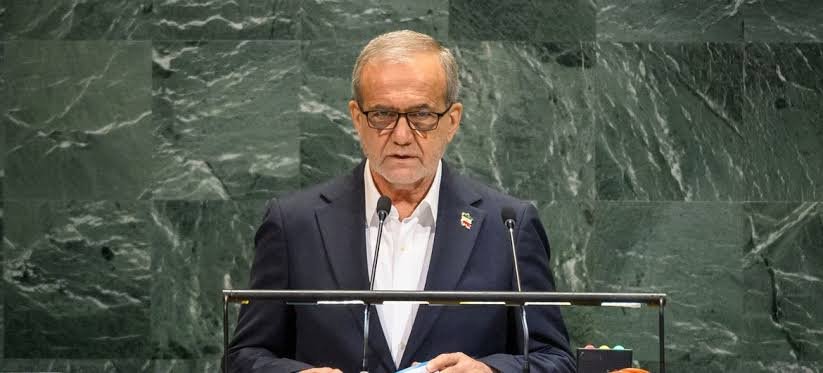
Earlier at the UN General Assembly in New York, President Masoud Pezeshkian had acknowledged that his efforts to reach an agreement on the nuclear dispute had failed, but expressed confidence that Iran could withstand the sanctions.
Cover
Former Minority Leader, Elumelu to Deliver NUJ Keynote at Transcorp Hilton, Abuja
The Nigeria Union of Journalists (NUJ), Federal Capital Territory (FCT) Council, has invited former Minority Leader of the House of Representatives, Rt. Hon. Ndudi Elumelu, to deliver the keynote address at its 2026 Press Week.
The invitation was conveyed in a letter jointly signed by the Chairman of the NUJ FCT Council, Comrade Grace Ike, and Chairman of the Planning Committee, Obas Edesa.
According to the letter dated April 20, 2026, the event is scheduled to hold on Tuesday, May 19, 2026, at the Lagos/Osun Hall of the Transcorp Hilton Hotel, Abuja.
The theme of this year’s Press Week is titled: “2027 Election: Defending Democracy in the Era of Disinformation.”
The union noted that Elumelu’s experience as a former lawmaker and advocate of democratic values makes him suitable to address journalists, media stakeholders, government officials, and civil society organizations expected at the event.
“As a distinguished former lawmaker, a defender of democratic values, and a respected voice for the people, your presence and insights will greatly enrich discussions on the critical role of the media in safeguarding democracy against the growing challenges of misinformation and disinformation in Nigeria’s electoral process,” the letter stated.
The NUJ FCT Council added that the keynote address would provide an opportunity for deeper conversations around the role of the media in promoting credible elections and combating fake news ahead of the 2027 general elections.
The council also expressed optimism that Elumelu would honour the invitation and contribute to national discourse on democracy, responsible journalism, and electoral integrity.
The 2026 Press Week is expected to attract journalists, editors, media executives, public officials, development partners, and civil society groups from across the country.
Cover
IKOH NDI ABIA 2027: The Maturity Of Time For A Calm, Experience And Winning Leadership In Abia State
By Aaron Mike Odeh
Politics, especially in a developing democracy like ours, is beyond mere political activities and electoral contests. It is fundamentally about leadership, vision, emotional intelligence, capacity, and the ability to inspire confidence among the people. In moments when the destiny of a people stands at a defining crossroads, wisdom demands that political parties and stakeholders place competence, experience and acceptability above sentiments and unnecessary experimentation.
As someone who has actively participated in Abia politics for over twenty-six years, occupying different positions at appointment status, i believe I possess the moral standing and practical experience to speak with clarity on the political future of Abia State and the direction the All Progressives Congress (APC), should take ahead of the 2027 governorship election.
My political journey and Media Consultancy has taken me across the length and breadth of NIGERIA including Abia State. From Arochukwu to Ukwa, from Umunneochi to Ikwuano, I have interacted closely with party leaders, grassroots mobilizers, traditional institutions, youths, women groups and stakeholders across different divides. I have watched governments emerge and fade. I have seen political structures built and dismantled. I have equally studied the expectations, emotions and aspirations of Abia people over the years.
From this wealth of experience and practical evaluation of Abia politics, one fact has remained consistently clear: for APC to genuinely position itself for victory in 2027, the party must present a candidate with political maturity, administrative experience, emotional stability, credibility and the capacity to unite various interests within and outside the party.
Without hesitation, I strongly believe that Chief Henry Ikechukwu Ikoh perfectly fits into this critical expectation.
Chief Ikoh represents a rare blend of humility, experience, consistency and strategic political understanding. In a political environment often dominated by controversies, unnecessary bitterness and divisive tendencies, he has remained calm, focused, approachable and remarkably stable. These qualities may appear ordinary to some people, but in practical governance and political management, they are indispensable virtues that sustain leadership and build confidence among the electorate.
One of the strongest assets Chief Ikoh possesses is his maturity and ability to relate across political, ethnic and social lines. Politics in Abia today requires a leader who can build bridges rather than walls; a leader who understands that governance succeeds better when stakeholders are respected and united under a common vision. Chief Ikoh has demonstrated this quality over the years through his interactions with people across party affiliations and communities.
Beyond his personal qualities, Chief Henry Ikechukwu Ikoh possesses extensive experience in public service and political administration. Leadership is not learned overnight. It is developed through years of service, sacrifice, strategic engagement and practical exposure. Abia State at this moment requires a leader who understands governance, appreciates political realities and possesses the administrative competence to navigate the challenges confronting our people.
Another important factor that distinguishes Chief Ikoh is his consistency of purpose. His aspiration to govern Abia State is not a sudden ambition driven by opportunism or political convenience. Since 2003, he has remained steadfast, focused and committed to his vision for the state. Such consistency speaks volumes about conviction, preparedness and genuine passion for service.
In politics, consistency builds trust. It reassures the people that a leader is not merely pursuing personal ambition but is driven by a long-term vision and commitment to societal development. This is one quality many Abians have come to appreciate in Chief Ikoh.
Furthermore, APC as a party must begin to prioritize electability and acceptability ahead of internal sentiments. Elections are won not merely through slogans, but through strategic calculations, grassroots acceptance and broad-based support. The reality before us is that the people of Abia are yearning for a leadership that is calm, responsible, inclusive and development-oriented. They desire a leader who can listen, unite and inspire confidence across different sectors of society.
Chief Henry Ikechukwu Ikoh possesses these qualities in abundance.
His calm disposition, amiable personality and infectious ebullience naturally attract people to him. He is not known for needless controversies or divisive politics. Rather, he embodies the spirit of maturity and responsible engagement that APC needs to expand its acceptance across Abia State.
The journey toward 2027 should therefore not be approached with bitterness, selfish calculations or divisive tendencies. It should be approached with sincerity, wisdom and genuine concern for the future of Abia State and the success of our great party.
There comes a moment in the life of every people when destiny presents an opportunity that must not be ignored. I strongly believe that moment has come for APC in Abia State.
Indeed, as the Holy Scripture declares, “The time to favour Zion, yea, the set time, has come.” For Abia State, this is the maturity of time to embrace tested experience, political maturity and purposeful leadership.
With deep sense of responsibility and commitment to the progress of our state, I most respectfully appeal to APC stakeholders, leaders and delegates to rally behind Chief Henry Ikechukwu Ikoh and support the vision of IKOH NDI ABIA 2027.
This is not merely about an individual ambition; it is about giving APC the strongest opportunity to win the governorship election and provide purposeful leadership for the good people of Abia State.
The task before us is collective. The future is now. And the time is ripe for a leader with capacity, humility, experience and vision.
THE SET TIME IS NOW!
Aaron Mike Odeh, A Public Affairs Analyst, Media Consultant, Human and Community development advocate wrote from Post Army Housing Estate Kurudu Abuja
Cover
Alleged Coup Trial: Cleric Says He Warned That The Plot Would Fail
*Admits he received money for ‘prayers’
A Federal High Court in Abuja, on Monday, viewed a video- recorded statement by Sheikh Sani Abdulkadir, the sixth defendant in the ongoing trial of persons accused of conspiring to overthrow the government of President Bola Tinubu.
In the recording, the Sheikh, who admitted receiving money to pray for the success of the operation, however, claimed that he warned the alleged plotters that their plan was doomed and that they would be sabotaged from within.
The video recording was played during the continuation of trial proceedings, with the fourth prosecution witness (PW4) still in the witness box.
In the recording, Abdulkadir, an Islamic cleric, said he had known the alleged ringleader, Colonel Maaji, for less than a year and was approached through an intermediary identified as Sanda to offer spiritual support for the plot.
He told investigators that Sanda informed him that his “Oga” intended to stage a coup and needed prayers regarding its likely success. After conducting the prayers, Abdulkadir said he advised them the operation would fail and that two persons would eventually expose those involved.
A subsequent request was relayed back to him, he said, asking for further prayers to prevent those two individuals from speaking out. Money was later transferred to him for prayers and charity, and names of alleged participants were forwarded for inclusion.
Abdulkadir said he first learnt of the arrests through media reports, after Sanda had informed him that Colonel Maaji had been unreachable for four days. He maintained throughout the recording that the funds he received were strictly for prayers and not in support of any coup attempt.
He also acknowledged understanding that a coup meant a military overthrow of government but said he did not report the plot because he did not know who to report to.
The cleric said his arrest came after he visited the Economic and Financial Crimes Commission (EFCC) to resolve restrictions placed on his bank account.
Upon contacting an EFCC deputy director, he was invited to the commission’s office to explain the source of the funds. He denied making any coup-related statement while in EFCC custody and stated that he was neither assaulted nor tortured, and that all his statements were made voluntarily.
Following the playback, the prosecution sought to tender extra-judicial statements made by all six defendants before a Special Investigation Panel and military police authorities.
However, defence lawyers of all six defendants objected, arguing the statements were either involuntarily obtained or made in violation of the Administration of Criminal Justice Act (ACJA).
Their objections include failure to inform defendants of their right to legal representation; alleged discrepancies between video recordings and corresponding written statements; allegations of coercion, inducement and torture; and claims that the footage did not adequately establish the physical condition of defendants during recording.
Counsel to the fifth defendant further argued that, given the number of accused persons, the court should conduct separate trial-within-trial proceedings for each disputed statement rather than a combined exercise.
Responding, the prosecution urged the court to dismiss the objections, maintaining that the law does not mandate separate proceedings for each defendant and that the trial judge holds discretion over how evidence is received.
Justice Joyce Abdulmalik ruled in favour of a single joint trial-within-trial to determine the voluntariness and admissibility of all the disputed statements.
The case was then adjourned to May 12.
-
Cover8 months agoNRC to reposition train services nationwide.. Kayode Opeifa
-
Fashion9 years agoThese ’90s fashion trends are making a comeback in 2017
-
Entertainment9 years agoThe final 6 ‘Game of Thrones’ episodes might feel like a full season
-
Opinion1 year agoBureaucratic Soldier, Kana Ibrahim heads Ministry of Aviation and Aerospace After Transformative Tenure at Defence
-
Politics1 month agoNNPP Diaspora Stakeholder and Key Kwankwaso Ally, Dr. Usman Tijjani Shehu, Rejoins APC
-
Opinion1 year agoHon. Daniel Amos Shatters Records, Surpasses Predecessor’s Achievements in Just Two Years
-
Opinion5 months agoBarrister Somayina Chigbue, Esq: A rising legal leader shaping institutioal excellence in Nigeria
-
News9 months agoNigerian Nafisa defeats 69 Countries at UK Global Final English Competition