Connect with us

Cover

UNICEF launches behavioural research lab in Nigeria

Published

on

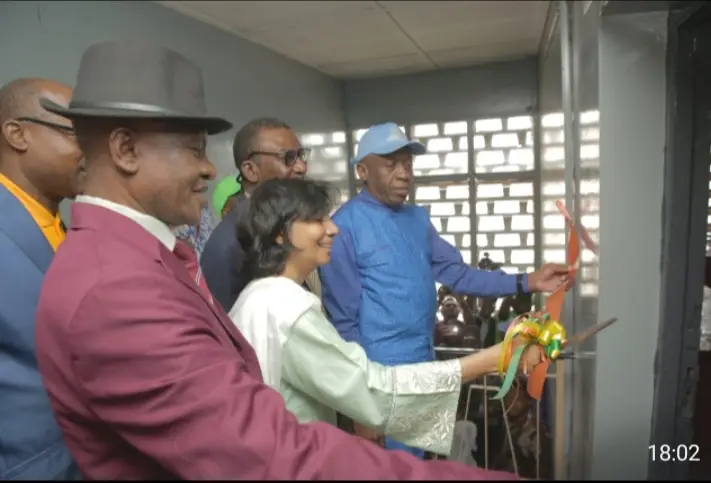
The United Nations Children’s Fund (UNICEF) has launched the BIRD-Lab Nigeria, a behavioural insights research and design laboratory, to prioritise children and communities in development.

It held at the College of Medicine, Lagos State University Teaching Hospital Idi-Araba, on Friday.

Speaking at the launch, UNICEF Nigeria Country Representative, Wafaa Saeed, described the initiative as transformative, enabling deeper understanding of children’s realities and co-creation of practical responses.

She said the laboratory was not merely an event launch, but an opportunity to reshape UNICEF’s child-focused work and invest in Nigeria’s long-term prosperity.

Saeed recalled that UNICEF’s mandate from the United Nations General Assembly is to help member states ensure children receive the best start in life and fulfil their potential.

“Everything UNICEF does begins and ends with children. This is why BIRD-Lab Nigeria unites experts from psychology, sociology, nutrition, communication and other disciplines,” she explained.

She said the laboratory would serve as a hub for collaboration, innovation, and behavioural research to better understand decision-making by children and their communities.

Saeed added that BIRD-Lab would provide tools to ask the right questions, gather insights, and co-create sustainable solutions alongside children and their communities.

She commended the Federal Ministry of Health and Social Welfare, the Ministry of Information and National Orientation, and the University of Lagos (UNILAG) for hosting the laboratory.

According to her, the initiative will also equip graduate students to work on real-time programmatic challenges, advancing careers while developing meaningful child-focused solutions.

“UNICEF is excited and fully committed. We are contributing ideas and creating real-time opportunities that will transform outcomes for children in Nigeria,” Saeed affirmed.

Prof. Bayo Onajole, Chairman of NETBRECSIN, described the lab as an inclusive hub fostering collaboration, knowledge-sharing, and innovative behavioural solutions to improve child development outcomes across communities.

He explained the project draws inspiration from Ethiopia’s behavioural insights lab, using creativity and expertise to design and test strategies for measurable, lasting impact.

“No project of this scale succeeds in isolation,” Onajole said, thanking stakeholders, sponsors, and partners for their consistent support and belief in the mission.

Representing the Vice-Chancellor, Prof. Folasade Ogunshola, Deputy Vice Chancellor (Development Services), Prof. Afolabi Lesi, expressed confidence in the project’s success, citing three key reasons.

He said it was multi-disciplinary, engaging sociologists, physicians and others; it had a national outlook as Africa’s second such initiative; and it emphasised strong partnerships with government and universities.

On the sidelines, Prof. Ademola Oremusu, Provost of the College of Medicine, said UNICEF and partner support would inspire the university to focus more on communities.

He reaffirmed commitment to behavioural research, stressing that BIRD-Lab would help tackle health challenges beyond hospitals by shaping practices and beliefs that influence maternal and child health.

Oremusu added that 19 Nigerian universities had already joined the consortium, with more expected, urging stronger government involvement and community participation to drive meaningful change.

“We will measure impact using indices such as reduced maternal and infant mortality, improved child survival, and better immunisation coverage — evidence to guide policy and reform,” he said.

UNICEF’s Chief of Social Behaviour Change, Kshitij Joshi, described BIRD-Lab as more than a facility, but an approach uniting universities, civil society, media, and private sector to understand behaviours.

He explained the lab is not restricted to Lagos or UNILAG, but represents a model for similar centres across Nigeria, creating hubs for innovation nationwide.

“The platform brings diverse expertise to address challenges from health to education and sanitation, focusing on behavioural science-driven solutions,” Joshi said.

He noted that student-generated data is being reviewed by professors, shaped into policy briefs, and used by government agencies to strengthen interventions.

Joshi added that the Federal Ministry of Health had dedicated space for integrating BIRD-Lab findings into national policies, aligning services with people’s realities for greater impact. 

Continue Reading
Click to comment

Leave a Reply

Your email address will not be published. Required fields are marked *

Cover

League of Bauchi Professionals Backs Tuggar for Governor, Cites “Integrity, Global Experience”

Published

on

…Group says state needs “leadership grounded in empathy,” urges fiscal discipline, security

The League of Bauchi Professionals has called on residents of Bauchi State to back the governorship bid of Yusuf Maitama Tuggar, saying he is “best positioned to unlock the state’s vast potential.”

In a press statement issued by its Secretary, Ibrahim Yusuf, following Tuggar’s official declaration and grand homecoming in Bauchi on Saturday, 25th April 2026, the League said Ambassador Tuggar “embodies the kind of leadership required to inspire progress and deliver results.”

“According to the statement, ‘Bauchi needs leadership that motivates through action and example—leadership grounded in empathy, inclusivity, and a clear vision. Ambassador Tuggar represents the type of leader capable of helping the people shape their collective destiny.’”

While commending the success of the declaration event, the League urged supporters “not to relent but to intensify efforts toward securing victory at the polls.” The group reiterated that the state “requires leadership anchored on service, integrity, and measurable progress.”

The League further emphasized that Tuggar’s track record in public service “demonstrates a consistent commitment to the security, prosperity, and well-being of the people.”

“He understands that leadership is not a matter of convenience, but a solemn responsibility to serve with dedication, accountability, and transparency,” the statement added.

Highlighting the basis of its endorsement, the League pointed to Tuggar’s “core values of trust, truth, consistency, and a strong sense of duty.” It noted that “his tenure as Nigeria’s Foreign Minister reflected a deep moral obligation to national service, adding that Bauchi stands to benefit from his blend of global experience and local understanding.”

The statement also stressed “the urgent need for prudent financial management in the state, calling for leadership that will sanitise public finances, eliminate waste, and enforce fiscal discipline.”

“Bauchi’s resources must work for the many, not the few. Ambassador Tuggar possesses the experience and vision to drive sustainable solutions and attract genuine investment,” the group stated.

Reinforcing its position, the League cited Tuggar’s “commitment to ensuring safety and economic stability across the state.”

“Farmers must be able to access their farmlands without fear, traders must move freely, and every child must feel safe going to school,” it said.

The group further underscored “the importance of transparency and inclusive development, insisting that all wards across the 20 Local Government Areas must be fully informed and involved in how public resources are allocated.”

“Anything less would amount to repeating past mistakes,” the statement warned.

Describing Tuggar as “a proud son of Gamawa and a seasoned statesman with proven integrity on the global stage,” the League argued that “he is uniquely qualified to lead Bauchi into a new era of prosperity.”

It also noted “the need for equitable leadership opportunities across the state, pointing out that since the return of democracy in 1999, certain zones have yet to produce a governor.”

“Ambassador Tuggar’s extensive experience across multiple sectors, combined with his reform-driven governance philosophy—particularly in public procurement and accountability—places him far ahead of other contenders,” the statement added.

The League concluded by reaffirming its belief that “Bauchi’s future depends on leadership capable of understanding its challenges and delivering practical, sustainable solutions.”

“Bauchi requires focused, principled, and forward-thinking leadership. We firmly believe that Ambassador Yusuf Maitama Tuggar is the man for the job.”

Continue Reading

Cover

Advocates Slam Atiku’s Criticism of Tinubu’s Economy as ‘Cheap Politics and Propaganda’

Published

on

The Advocates for Economic and Political Advancement on Tuesday described recent criticisms of the Nigerian economy by former Vice President Atiku Abubakar as “cheap politics dressed up as concern” and pure propaganda.

Speaking at a press conference on Tuesday, the group said Atiku’s comments were not rooted in genuine economic analysis but driven by bitterness after multiple unsuccessful attempts to lead the country.

In his address, Dr Opialu Fabian dismissed Atiku’s reference to Nigeria’s external reserves of about $48.45 billion as evidence of failure.

He noted that the same economic framework projects the reserves to rise above $51 billion within the year, describing the situation as a managed adjustment within an ongoing reform cycle rather than a decline.

The group argued that reserves are influenced by several factors, including exchange rate management, capital flows, and liquidity interventions by the Central Bank, and should not be viewed in isolation or used for political effect.

“Select a number. Strip it of context. Amplify it for political effect. That is not economic analysis. That is political theatre,” the group stated.

The Advocates highlighted what they described as significant macroeconomic improvements under President Bola Ahmed Tinubu’s Renewed Hope Agenda.

They pointed to projected economic growth of 4.49 percent, a sharp drop in inflation from over 34 percent to about 14.5 percent — with expectations of further decline to around 12.94 percent — as well as a balance of payments surplus and gradual return of investor confidence.

The group praised the appointment of Taiwo Oyedele as Minister of Finance and Coordinating Minister of the Economy, saying it signals a new era of policy coherence, structured tax reforms, improved revenue generation, and better utilisation of idle funds and public assets.

They noted that over $20 billion currently sits idle in the banking system under reserve requirements, while many public assets worth tens of trillions of naira remain underutilised, adding that addressing these inefficiencies forms a core part of the ongoing reforms.

While acknowledging that Nigeria is still in a transition phase with attendant challenges, the group maintained that the bold decisions taken by the Tinubu administration, particularly the removal of fuel subsidies and unification of the foreign exchange market, were necessary and are beginning to produce positive results, including increased disbursements to states for development projects.

The Advocates urged Nigerians to focus on the broader picture of structural reforms rather than short-term fluctuations, calling on political actors, especially Atiku Abubakar, to engage honestly with facts instead of recycling talking points that ignore visible progress.

“The economy is stabilising. The reforms are taking hold. The direction is clear. No amount of political noise can change that reality,” the group concluded.

Continue Reading

Branded Content

Senator George Akume and the Test of Party Democracy in Benue

Published

on

Senator George Akume, CON, represents a rare breed of Nigerian politician. In a political culture often characterised by impatience, self-interest, and inconsistency, he has distinguished himself through patience, loyalty, and an enduring commitment to teamwork.

I have worked closely with him and witnessed his steady rise since 1999, when he became Governor of Benue State. From there, he went on to serve as Senator, Minister of the Federal Republic, and now Secretary to the Government of the Federation (SGF). His trajectory has been defined not by haste, but by discipline and a remarkable ability to work within the system.

These qualities have been severely tested in recent times, particularly in his relationship with Governor Hyacinth Alia. Governor Alia entered the political arena with significant backing despite having limited political experience, modest resources, and no established structure to contend with seasoned figures such as Barnabas Gemade and Steven Lawani. Against these odds, he emerged victorious.

However, from the moment he assumed office, his relationship with Senator Akume deteriorated without any clear provocation. What began as a strained engagement has since evolved into a persistent political rift.

When discussions later emerged about a potential second term for the governor, many of us close to Senator Akume were understandably concerned by what appeared to be the position of the party’s national leadership. Yet, true to his nature, Akume remained calm and aligned himself with the party, even where the circumstances were personally unfavourable.

This included accepting the controversial dissolution of the duly elected state party leadership and the installation of a caretaker committee—decisions he embraced in the interest of party unity. More notably, when he conveyed the directive that political office holders, including the governor, should be returned unopposed, he did so with restraint, placing party cohesion above personal considerations.

At a gathering in Makurdi, he stated:

“All those elected on the platform of the APC, from the State Assembly to the National Assembly, are expected to return automatically… and of course, the Governor is also expected to be returned.

That position, however, was publicly rejected by Governor Alia, who insisted there would be no automatic tickets, citing the stance of the President and the party’s national leadership. In effect, this signalled a willingness to proceed without regard for the political structure that facilitated his emergence.

For many of us, that moment was decisive.

Senator Akume, despite what can only be described as sustained political provocation, has remained composed—much like the biblical Job—accepting both favourable and difficult circumstances within the party framework.

But this is no longer about personalities.

It is about the survival of political order and internal democracy within the All Progressives Congress (APC) in Benue State.

There is a dangerous assumption at play—that power can be consolidated through imposition, that party structures can be ignored, and that those who built the system can be sidelined without consequence. That assumption is fundamentally flawed.

Those of us who have stood with Senator Akume have exercised restraint out of respect for his disposition. But restraint must not be mistaken for weakness.

The time has come for a necessary shift.

Our leader, Senator George Akume, must now allow his supporters—and indeed all party members—to fully exercise their political rights. Let there be open contest. Let aspirants emerge freely, without intimidation or artificial barriers. Let the people of Benue State decide.

Anything short of this will not only fracture the party; it will erode its credibility beyond repair.

And let no one be under any illusion: if the process is manipulated, if candidates are imposed, if the will of the people is subverted, it will mark the beginning of the end for the APC in Benue State.

As one who has followed Nigerian politics since the 1970s, I say this without hesitation: no political party survives sustained injustice against its own members.

The warning signs are already clear. What happens next will determine whether the party corrects itself—or collapses under the weight of its own contradictions.

A Benue APC chosen by the people, not imposed from above, will not only survive—it will endure and dominate.

Continue Reading

Trending

Copyright © 2023 - 2025 DailyMirror Nigeria. Design by AspireWeb.ng, powered by WordPress.