Cover
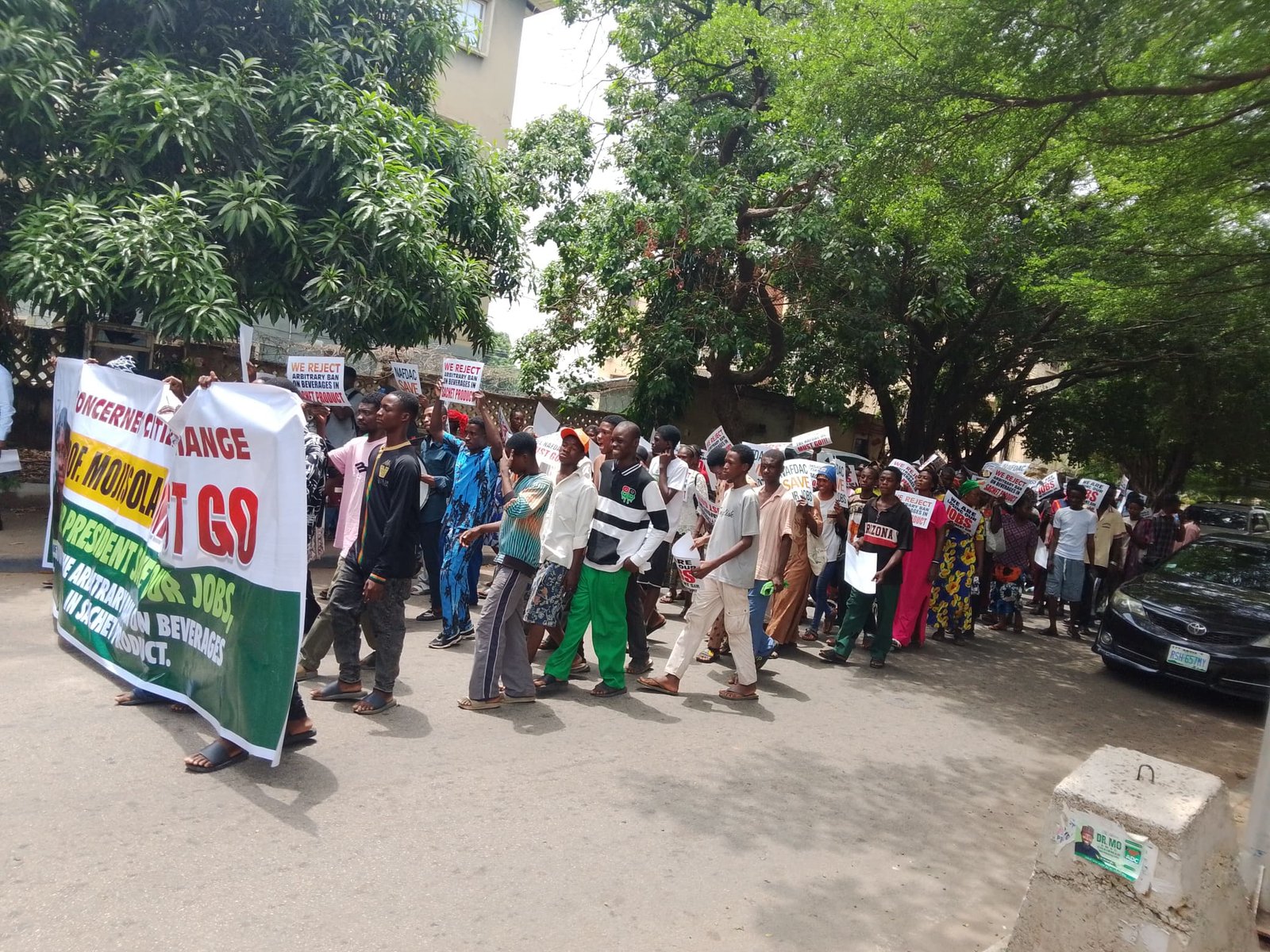
Alcohol Ban Sparks Fears of Illicit Trade, Group Demands NAFDAC DG’s Sack
A civil society group, Concerned Citizens for Change, has called for the immediate removal of the Director-General of the National Agency for Food and Drug Administration and Control (NAFDAC), Mojisola Christianah Adeyeye, alleging gross incompetence and abuse of office over the enforcement of a ban on sachet alcohol and small PET bottle alcoholic products.
Addressing a press conference in Abuja on Wednesday, the group’s Executive Director, Stephen Eriba, criticised what he described as the “arbitrary and illegal” enforcement of the restriction, insisting that it contravenes existing national policy frameworks.
Eriba argued that the ban violates provisions of the National Alcohol Policy approved by the Federal Ministry of Health, and also disregards a presidential directive halting enforcement actions pending the outcome of a joint committee review.
According to him, the decision further contradicts resolutions of the House of Representatives, which had, after stakeholder consultations and a public hearing, advised against such a ban and described it as anti-people.
The group warned that the policy could negatively impact businesses, jobs, and government revenue, while also risking increased circulation of illicit and unregulated alcohol products in the market.
It also rejected claims that sachet alcohol encourages abuse, maintaining that smaller packaging could help moderate consumption among users.
The group added that locally produced sachet alcohol products are certified by regulatory authorities and manufactured under hygienic conditions.
Eriba noted that industry players had already invested significant resources in campaigns promoting responsible alcohol consumption and discouraging underage drinking.
While expressing support for efforts to eliminate unsafe products, the group stressed that regulatory decisions should be based on empirical evidence rather than what it termed “emotional persuasion.”
The group, therefore, urged President Bola Ahmed Tinubu to take decisive action by removing the NAFDAC Director-General, stating that her continued stay in office was no longer in the public interest.
NAFDAC has yet to officially respond to the allegations as of the time of filing this report.

Cover
Energy Stakeholders Hail NMDPRA for Strengthening Transparency in Aviation Fuel Market
…Say Timely Disclosure on Jet A1 Pricing and Supply Has Helped Avert Operational Disruption by Airlines
An oil sector advocacy group has commended the Nigerian Midstream and Downstream Petroleum Regulatory Authority (NMDPRA) for stabilising the aviation fuel market, saying the regulator’s recent intervention helped to ease tensions across the aviation sector and avert a potential disruption to air travel operations.
In a statement issued on Tuesday, the Centre for Energy Market Integrity and Sustainability (CEMIS) said the NMDPRA’s clarification on fuel availability and pricing came at a critical moment when uncertainty over Jet A1 costs had heightened anxiety among airline operators and industry stakeholders.
The statement, signed by the centre’s executive director, Dr. Tunde Adeyemi, noted that confirmation of over 70 days of aviation fuel sufficiency reflects a strong supply position and underscores the resilience of Nigeria’s downstream petroleum framework.
Adeyemi said the regulator’s data-backed disclosure helped to counter widespread speculation, including claims of a possible surge in aviation fuel prices to unsustainable levels, which had triggered concerns about flight disruptions and fare increases.
“The timely intervention by the Authority provided much-needed clarity and helped to calm frayed nerves within the aviation ecosystem. At a time when misinformation could easily have escalated into a crisis, the regulator chose transparency and facts, which is commendable,” Adeyemi said.
He added that aviation fuel remains one of the most significant cost drivers for airlines in Nigeria, making stability in supply and pricing critical to the sustainability of the sector.
According to him, the NMDPRA’s emphasis on the deregulated nature of the Jet A1 market is also important in shaping realistic expectations among stakeholders, noting that pricing is influenced by global oil trends, foreign exchange fluctuations, and logistics costs.
“It is essential for industry players to understand that aviation fuel pricing is not arbitrary but driven by market dynamics. What the regulator has done is to provide a clear picture of the situation, which helps to guide informed decision-making,” he observed.
The group also pointed to the role of domestic refining in moderating fuel prices, describing it as a positive development that could reduce Nigeria’s exposure to external shocks.
CEMIS said indications that locally refined aviation fuel is being sold at rates slightly below international benchmarks highlight the growing impact of domestic capacity on price stability.
The centre further commended the NMDPRA’s commitment to monitoring supply and pricing trends nationwide, noting that proactive oversight is key to preventing profiteering and ensuring that consumers are not subjected to undue costs.
It urged stakeholders across the aviation fuel value chain to engage constructively and avoid amplifying unverified claims that could distort market realities or undermine confidence in the sector.
“Responsible engagement is critical at this time. All parties must work together to sustain stability and ensure that the gains recorded are not reversed by panic or misinformation.”
Adeyemi also praised the leadership of Engr. Saidu Aliyu Mohammed, the Authority Chief Executive (ACE), for what he described as a steady and reassuring approach to regulation.
“Engr. Saidu Aliyu Mohammed has demonstrated that calm, informed leadership can make a significant difference in moments of uncertainty. His approach to addressing the aviation fuel concerns reflects a commitment to transparency, coordination, and market stability, which has helped to reinforce confidence in the regulatory system,” he said.
CEMIS called on the federal government to continue supporting regulatory institutions in the energy sector, stressing that strong oversight and consistent policies are essential to sustaining progress.
The group maintained that the recent intervention by the NMDPRA highlights the critical role of effective regulation in safeguarding both economic activity and public confidence, particularly in sectors as interconnected as energy and aviation.
Cover
Combat, Endurance, Firepower: Army Competition Opens in Benin
The 2 Division Inter-Brigade Corporals and Below Competition 2026 commenced on Monday at the Nigerian Army Cantonment, Ekehuan Barracks, Benin City, with 4 Brigade, Nigerian Army, serving as host of the week-long event.
Speaking at the opening ceremony, the Commander of 4 Brigade, Brigadier General Ahmed Balogun, welcomed participants from various formations and expressed gratitude for their safe arrival.
He noted that the competition comes at a critical time when Nigeria faces evolving security challenges, emphasizing the importance of strengthening the operational readiness of personnel.
Balogun stated that the exercise is designed to enhance combat proficiency, leadership capacity, teamwork, endurance, and organisational skills among junior soldiers.
He added that the competition would also promote esprit de corps and better prepare participants to respond effectively to emerging threats.
Events scheduled for the competition include drill, weapon handling and firing, combat cross-country run and obstacle crossing, map reading, and combat swimming.
In his remarks, the General Officer Commanding (GOC) 2 Division, Major General Chinedu Nnebeife, represented by the Commander 32 Artillery Brigade, Brigadier General Justin Ifeanyi, urged participants to maintain professionalism throughout the exercise.
He assured that a team of impartial judges had been constituted to ensure fairness and transparency, stressing that no team would be favoured or disadvantaged.
Nnebeife also disclosed that adequate arrangements had been made to guarantee a smooth and successful competition.
He called on all participants and officials to adhere strictly to the rules and take the exercise seriously.
He further appreciated the Chief of Army Staff, Lieutenant General Waidi Shaibu, for providing the necessary resources for the competition, as well as the Army Headquarters Department of Army Training for its continued support in improving the annual event.
Participating formations in the 2026 competition include 4 Brigade, 12 Brigade, 32 Artillery Brigade, 22 Armoured Brigade, 42/52 Engineers and Signals Brigade, and 2 Division Garrison.
The opening ceremony was attended by heads of security agencies in Edo State and other invited guests. Highlights of the first day included drill competitions among participating formations, presentation of souvenirs, and group photographs.
Cover
NITDA’s Reforms Power Digital Growth, Boost Cybersecurity Nationwide — CWAI
The National Information Technology Development Agency (NITDA) has recorded significant strides in digital technology development, cybersecurity, and strategic partnerships under its current leadership, according to the Citizen Watch Advocacy Initiative (CWAI).
In a statement signed by CWAI’s Director of Media and Stakeholders Engagement, Mahmud Bello, the agency was commended for advancing its mandate of developing, regulating, and advising on information technology in Nigeria.
CWAI noted that since the appointment of NITDA’s Director-General, Kashifu Inuwa Abdullahi, the agency has been repositioned as a key driver of digital transformation, innovation, and economic development. It added that NITDA now plays a central role in implementing the National Digital Economy Policy, setting IT standards, promoting local content, and strengthening cybersecurity frameworks.
The organisation stated that the agency has also improved digital literacy and capacity building across the country, while enhancing data protection and collaboration with industry stakeholders.
According to CWAI, Abdullahi recently called for stronger collaboration among stakeholders to unlock Nigeria’s digital economy potential. Speaking at a stakeholders’ meeting themed “Creating Opportunities, Breaking Boundaries,” he described Nigeria as being at a critical point where digitalisation could drive economic diversification, job creation, and sustainable growth.
The statement further highlighted NITDA’s implementation of its Strategic Roadmap and Action Plan (SRAP 2.0) and the National Digital Literacy Framework, aimed at equipping citizens with digital skills.
It revealed that the agency has established over 100 IT centres nationwide to support learning and innovation.
CWAI also referenced the Director-General’s remarks at the GITEX Africa Summit 2026, where he warned of emerging threats posed by artificial intelligence and stressed the need for a “total resilience” approach to cybersecurity.
Abdullahi, according to the statement, emphasised that cybersecurity is no longer just a technical issue but a national development priority, noting that human error accounts for the majority of digital breaches.
The group said the Federal Government’s National Digital Literacy Programme aims to achieve 95 per cent digital literacy by 2030, with an interim target of 70 per cent by 2027.
It added that NITDA is working with several public and private institutions to strengthen national cyber resilience and protect critical infrastructure.
CWAI further commended NITDA’s collaboration with stakeholders, including its engagement with the National Institute for Policy and Strategic Studies (NIPSS), which focused on leveraging digital innovation and the Orange Economy for economic growth.
The statement noted that the agency continues to promote innovation through initiatives such as the National Digital Literacy Programme and the “3 Million Tech Talent” programme, aimed at developing skills in cybersecurity, data science, and artificial intelligence.
It also highlighted Abdullahi’s call for increased partnerships at the Nigerian Satellite Week 2026 in Abuja, where he urged stakeholders to drive innovation through collaboration and practical solutions.
CWAI concluded that NITDA’s initiatives and regulatory approach are helping to build a resilient, inclusive, and globally competitive digital economy, while encouraging continued support for programmes that empower young innovators and attract investment into Nigeria’s technology ecosystem.
-
Cover8 months agoNRC to reposition train services nationwide.. Kayode Opeifa
-
Fashion9 years agoThese ’90s fashion trends are making a comeback in 2017
-
Entertainment9 years agoThe final 6 ‘Game of Thrones’ episodes might feel like a full season
-
Opinion1 year agoBureaucratic Soldier, Kana Ibrahim heads Ministry of Aviation and Aerospace After Transformative Tenure at Defence
-
Opinion1 year agoHon. Daniel Amos Shatters Records, Surpasses Predecessor’s Achievements in Just Two Years
-
Politics2 weeks agoNNPP Diaspora Stakeholder and Key Kwankwaso Ally, Dr. Usman Tijjani Shehu, Rejoins APC
-
Opinion5 months agoBarrister Somayina Chigbue, Esq: A rising legal leader shaping institutioal excellence in Nigeria
-
News9 months agoNigerian Nafisa defeats 69 Countries at UK Global Final English Competition