Cover
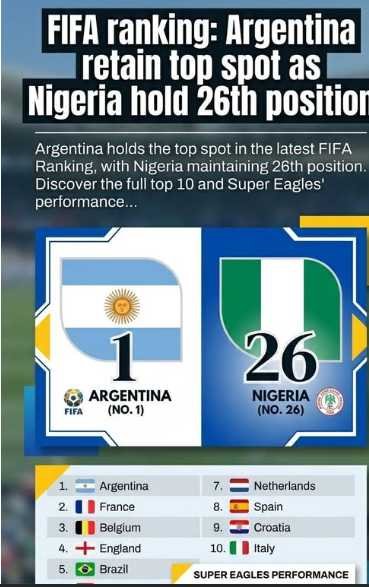
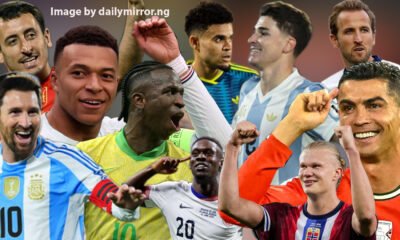
FIFA Rankings: Argentina Lead, Nigeria 26th As Morocco Shine
World champions Argentina have once again underlined their dominance by retaining the top spot in the latest FIFA rankings released on Thursday. The Albiceleste continue to lead global football after a string of convincing performances in recent international fixtures.
Spain remains in second place, holding firm after a draw and a win in their latest matches. France, however, slipped to third following a defeat before recovering with subsequent victories. England and Portugal complete the top five, while Brazil sit just outside in sixth position.
Nigeria’s Super Eagles held steady at 26th place in the global standings. Their recent performances have been mixed, reflecting both promise and inconsistency. At the Unity Cup in London, Nigeria impressed with victories over Zimbabwe and Jamaica. Yet, momentum slowed when they were held to a 2-2 draw by Poland and later lost narrowly 2-1 to Portugal in a friendly.
Morocco continues to shine as Africa’s highest-ranked team, now placed seventh in the world. The Atlas Lions’ rise reflects their strong performances on the international stage and signals Africa’s growing competitiveness in global football.
The Netherlands, Belgium, and Germany round out the top ten, each maintaining their positions among football’s elite.
This latest ranking arrives as the football world turns its attention to the 2026 FIFA World Cup. The tournament, jointly hosted by the United States, Mexico, and Canada, will feature 48 teams for the first time in history. The expanded format promises to deliver the largest and most inclusive World Cup yet, offering nations like Nigeria and Morocco greater opportunities to showcase their talent on the global stage.
For Nigeria, holding 26th place underscores both stability and the need for improvement. The Super Eagles remain a force in African football, but consistency against top-tier opponents will be crucial as preparations intensify for the World Cup.
Morocco’s seventh-place ranking, meanwhile, highlights Africa’s growing presence in world football. Their success serves as inspiration for other African nations aiming to break into the top tier of global rankings.
As the countdown to 2026 continues, Argentina’s dominance, Spain’s resilience, France’s recovery, and Africa’s rise set the stage for a World Cup that promises drama, competition, and history-making moments.
List FIFA Rankings
Argentina
Spain
France
England
Portugal
Brazil
Morocco
Netherlands
Belgium
Germany
Cover
Matawalle Defends Tinubu’s, Dismisses Opposition Propaganda
Minister of State for Defence, Dr. Bello Muhammad Matawalle, has dismissed claims of declining support for President Bola Ahmed Tinubu in the North-West, insisting that the region remains firmly behind the president as the 2027 elections approach.
Matawalle’s remarks came in response to recent surveys and opposition statements suggesting that economic hardship and insecurity were eroding Tinubu’s popularity. The minister argued that such narratives were driven by propaganda aimed at undermining the administration’s achievements.
He pointed to the NOI Polls survey, which gave Tinubu’s government a 30 per cent approval rating after three years in office. Opposition figures, including Mallam Bolaji Abdullahi, interpreted the result as evidence of widespread rejection. Abdullahi argued that the administration could no longer claim to have inherited Nigeria’s challenges.
Matawalle countered that critics were deliberately amplifying isolated incidents of insecurity to overshadow progress. He highlighted coordinated military operations in Sokoto, Zamfara, Katsina, Kaduna, and Kebbi states, which he said had eliminated notorious bandit leaders, dismantled criminal hideouts, and restored relative peace in affected communities.
“The opposition is uncomfortable with the visible progress being recorded in the fight against insecurity and the ongoing developmental strides across the country,” Matawalle stated.
He praised the Armed Forces and security agencies for their sacrifices, noting that many personnel had paid the ultimate price in the line of duty. He also cited improvements in the fight against insurgency in the North-East and efforts to reduce communal violence in the North-Central region.
Beyond security, Matawalle stressed that Tinubu’s Renewed Hope Agenda was delivering results in infrastructure, agriculture, social investment, and economic reforms. He listed federal interventions in Northern Nigeria, including road rehabilitation, agricultural value chain support, food security programmes, rail and energy projects, and empowerment initiatives for youth and women.
According to him, these policies are resonating with citizens and will translate into political support for Tinubu in 2027. “The people of the region understand the efforts being made to improve their security, livelihoods and overall well-being. They are witnessing the results firsthand,” he said.
Matawalle expressed confidence that no amount of political blackmail or misinformation would diminish the administration’s achievements. He insisted that Tinubu remained focused on governance, national development, and improving the welfare of Nigerians.
He urged political leaders to prioritise national interest over partisan rivalry, stressing that consolidating peace and development should be the collective goal. The minister concluded that the gains of the Renewed Hope Agenda would continue to strengthen Tinubu’s support base in the North-West and across Nigeria as the 2027 elections draw closer.
Cover
US Denial Ivory Coast Fans Visa Ahead of 2026 World Cup
The build-up to the 2026 FIFA World Cup has taken a controversial turn after the United States denied visas to hundreds of Ivory Coast supporters. The decision has forced many fans to abandon plans to travel for the tournament, raising questions about visa policies and their impact on global sporting events.
Julien Kouadio Adonis, president of the National Committee of Elephants Supporters (CNSE), confirmed the setback. He said the refusal had left fans disappointed and unable to fulfil their role of cheering the national team on the world stage.
“The supporters have cancelled the trip because the US government does not want to see supporters from certain countries, including the Ivory Coast, on its soil,” Kouadio explained. He described the situation as deeply painful, stressing that supporting the team is considered a “sacred duty” by many Ivorians.
The CNSE, operating under the Ministry of Sport, is responsible for organising travel for fans during international competitions. Earlier this year, Kouadio had expressed optimism that about 500 supporters would make the journey to North America. That hope has now been dashed, with only a handful of committee officials receiving clearance to travel.
Despite the restrictions, CNSE officials say they will focus on coordinating support from Ivorian fans already living in the United States. Kouadio noted that more than 1,000 diaspora supporters are expected to attend matches, ensuring the team will not be left without encouragement in the stands.
Ivory Coast will play two of their three group-stage matches in Philadelphia. They face Ecuador on June 15 and Curacao on June 25. Between those fixtures, the team will travel to Toronto for a clash against Germany. The absence of travelling supporters from Abidjan and other cities is expected to affect the atmosphere, but organisers hope diaspora fans will fill the gap.
The visa denials have not only affected Ivory Coast. Earlier this week, Somali referee Omar Artan was reportedly denied entry, while members of Iran’s support staff also faced rejections. These developments have sparked wider concerns about how US immigration policies intersect with international sporting events.
For Ivory Coast, the setback underscores the challenges African nations face in mobilising supporters for global tournaments. While the team prepares for tough matches against Ecuador, Germany, and Curacao, the absence of their traditional fan base could be felt both on and off the pitch.
Kouadio insisted that the CNSE remains committed to ensuring visible support for the Elephants. “A handful of our officials will be present to look after Ivorian supporters based in the United States,” he said. The committee hopes to coordinate chants, banners, and cultural displays to maintain the team’s spirit during the competition.
The issue highlights the broader tension between global sports and national immigration policies. As the World Cup expands to 48 teams for the first time, organisers face the challenge of balancing security concerns with the inclusive spirit of football.
For Ivorian fans, the disappointment is profound. Many had saved for months to make the trip, only to be stopped by visa restrictions. Yet, with diaspora supporters stepping in, the Elephants will still hear familiar voices as they chase success in the 2026 World Cup.
Cover
Aisha Criticises Dickson’s Leadership Style, Urges Him To Focus
Activist Aisha Yesufu has sharply criticized Senator Seriake Dickson, national leader of the Nigeria Democratic Congress (NDC), accusing him of appearing insecure and acting as though he competed with the party’s presidential candidate, Peter Obi.
Her remarks came in response to Dickson’s interview on ARISE NEWS, where he defended the NDC leadership and dismissed criticisms from Obi supporters following the party’s primaries. Yesufu, however, argued that Dickson’s tone and focus during the interview undermined confidence in the party’s readiness for the 2027 elections.
Yesufu described a portion of the interview as “painfully appalling,” stressing that Dickson’s first major media appearance after the primaries should have been used to reassure party members and promote candidates. Instead, she said, the leader made the conversation about himself rather than the party’s collective mission.
She rejected Dickson’s suggestion that some members had failed to follow internal rules because of their popularity. According to her, she complied with the party’s processes during the primaries and even worked to calm aggrieved supporters in the Federal Capital Territory.
Yesufu explained that she toured parts of Abuja to pacify members who felt disrespected after waiting for primaries that did not take place. She insisted that her actions demonstrated loyalty to the party and commitment to its broader goals.
The activist further accused Dickson of treating the NDC as a “special purpose vehicle” whose objective ended with registration, rather than as a political party determined to win the 2027 general election. She emphasised that the leader’s responsibility was to pacify aspirants and encourage supporters, not antagonise them.
“As a leader of a political party, your number one job in that interview was to pacify aspirants, many of whom are rightfully aggrieved, and secondly to call on supporters to bear with the party and support it,” she wrote. “But you ended up antagonising the very people you would need to win an election. Every vote counts!”
Yesufu stressed that no one was challenging Dickson’s leadership but warned that fragile egos must not distract from the urgent task of rescuing Nigeria. She urged the NDC to focus on building unity and preparing for the 2027 polls.
“There is a whole battle ahead of us. Rescuing Nigeria from the current state it is in should be the main focus, not people’s fragile ego,” she added.
Dickson, a former governor of Bayelsa State, had earlier defended the party against criticisms, insisting that the NDC remained united despite disagreements from the primaries. He dismissed suggestions of an internal crisis and argued that attacks on the party were counterproductive to Obi’s ambition.
The exchange highlights growing tension within the NDC as it positions itself for the 2027 elections. While Dickson insists the party is stable, Yesufu’s intervention underscores concern among members about leadership style and strategy.
Observers note that the NDC’s ability to manage internal disagreements will be crucial as it seeks to present itself as a credible alternative in Nigeria’s political landscape. With the 2027 elections approaching, activists like Yesufu are pressing for a shift from personality-driven disputes to collective action aimed at winning power and addressing Nigeria’s challenges.
-
Cover9 months agoNRC to reposition train services nationwide.. Kayode Opeifa
-
Fashion9 years agoThese ’90s fashion trends are making a comeback in 2017
-
Entertainment9 years agoThe final 6 ‘Game of Thrones’ episodes might feel like a full season
-
Politics2 months agoNNPP Diaspora Stakeholder and Key Kwankwaso Ally, Dr. Usman Tijjani Shehu, Rejoins APC
-
Opinion1 year agoBureaucratic Soldier, Kana Ibrahim heads Ministry of Aviation and Aerospace After Transformative Tenure at Defence
-
Opinion1 year agoHon. Daniel Amos Shatters Records, Surpasses Predecessor’s Achievements in Just Two Years
-
Opinion6 months agoBarrister Somayina Chigbue, Esq: A rising legal leader shaping institutioal excellence in Nigeria
-
News10 months agoNigerian Nafisa defeats 69 Countries at UK Global Final English Competition