
Branded Content
NIPSS, Kano govt recognise ENGAUSA founder for orange economy contribution

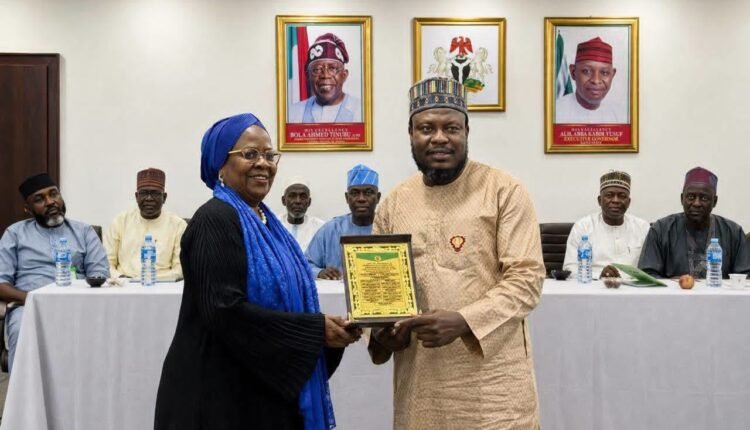
Founder and Chief Executive Officer of ENGAUSA Global Tech Hub Ltd, Engr. Mustapha Habu Ringim, has received an award recognising his contribution to the development of Kano State’s Orange Economy.
The recognition was presented during the Senior Executive Course 48 (2026) study tour of the National Institute for Policy and Strategic Studies (NIPSS), Kuru, Plateau State, to Kano State, where Ringim also presented a paper on youth entrepreneurship.
The award was, similarly, in recognition of the impact of ENGAUSA’s innovative programmes on youths
The study tour, held on August 13, 2026, at the Kano State Government House, was themed “Economic Diversification and National Development: Leveraging the Orange Economy and Entrepreneurship for Sustainable Growth in Nigeria.”
In his presentation titled “Transforming the Youths through Entrepreneurship Development,” he highlighted entrepreneurship, practical skills development, innovation and digital literacy as important pathways to empowering young Nigerians and promoting sustainable economic development.
He said the theme of the study tour resonated with the work ENGAUSA had undertaken over the past six years in developing industry-relevant skills, nurturing entrepreneurship, promoting innovation and creating opportunities for young people to participate in the digital and creative economy.
A key component of the organisation’s approach, he explained, is the use of mother-tongue learning to localise digital and Artificial Intelligence (AI) literacy, making emerging technologies more accessible, understandable and relevant to underserved communities.
“Language should not be a barrier to participation in the Orange Economy. Rather, local languages can serve as powerful vehicles for transferring digital and AI knowledge,” he said.
According to him, combining indigenous knowledge and creativity with digital skills, entrepreneurship and emerging technologies such as AI could enable young people to transform cultural and creative assets into commercially viable products and sustainable enterprises.
He maintained that Nigeria’s creativity, culture, fashion, food, music, film, photography, design, digital content and crafts should be viewed not merely as expressions of identity, but also as economic resources capable of generating wealth, employment and sustainable businesses.
Speaking on ENGAUSA’s impact, he disclosed that the organisation’s six-year report recorded 9,120 trainees and apprentices trained, more than 700 startups and SMEs incubated and accelerated, and over 10,978 jobs created.
He said ENGAUSA had grown from a small cubicle into two large training centres in Kano, alongside its online learning platform, ENGAUSA Academy, which provides distance learning and access to internationally recognised AI certifications through its collaboration with AI CERTs.
The organisation’s training participation, he added, grew from 63 participants in 2019 to 3,275 in 2025, driven by expanded course offerings, improved teaching methods and referrals from its growing community of beneficiaries.
He, however, said the figures represented only part of the organisation’s impact, noting that the real measure was the transformation in the lives of beneficiaries.
According to him, ENGAUSA’s podcast features firsthand accounts from graduates and beneficiaries who have progressed from unemployment, underemployment and informal livelihoods to becoming skilled professionals, entrepreneurs and employers of labour.
He said the beneficiaries included Almajiris, out-of-school children and persons with disabilities who had acquired technology skills and were now participating in the digital economy.
The entrepreneur said the country needed an ecosystem where young Nigerians could identify opportunities, acquire relevant skills, access technology and markets, protect their intellectual property and build sustainable enterprises.
“I believe the Orange Economy should be viewed not simply as a cultural or entertainment sector, but as an important component of human capital development, entrepreneurship, innovation, digital transformation and economic diversification,” he said.
He expressed appreciation to the Kano State Government, under the administration of Governor Abba Kabir Yusuf, and NIPSS for providing a platform that brought practitioners, policymakers and strategic leaders together to discuss entrepreneurship, youth development and the Orange Economy.
He described the award as a collective recognition of the efforts of the ENGAUSA team, instructors, trainees, apprentices, entrepreneurs, partners and supporters who had contributed to the organisation’s growth.
“The award presented to me is not merely a personal recognition. I receive it on behalf of the entire ENGAUSA family,” he said.
The study tour was led by Brig. Gen. L.A. Jimoh, MNI, with Mrs Barrister Afolake Abubakar Lawal, Treasurer of SEC 48 Group One, among the participants.
Also in attendance were the Director-General of the Kano State Information and Communication Technology Development Agency (KASITDA), Dr Bashir Abdullahi Muzakkari, and representatives of Kannywood.
The tour formed part of NIPSS’s broader programme of exposing participants to practical, home-grown experiences and solutions relevant to economic diversification, entrepreneurship and national development.


Shettima departs Abuja for nutrition leadership exchange in Ethiopia

Senate postpones security summit in honour of air crash victims

Cristiano Ronaldo Gives Condition To Make Portugal Return Amid Jesus Rift

Now Hiring: Academic and Technical Staff at a Leading Private University in Gombe State

LAUTECH 18th Convocation: EEE Class ’05 Alumni Celebrate as Electronic and Electrical Engineering Department Produced the School’s Overall Best Graduating Student


