
Business
PORT HARCOURT REFINERY AND THE TRUTH WE MUST KNOW

By Eguono King
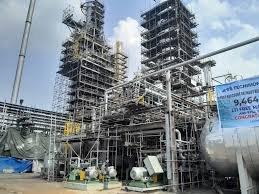
The story of the Port Harcourt Refinery’s alleged operation is one that stands out as a significant lesson in the developing tale of Nigeria’s petroleum industry. It is replete with deceit, laced with ineptitude, and a violation of public confidence. The Nigerian National Petroleum Company Limited’s (NNPCL) Group Chief Executive Officer (GCEO), Mele Kyari, has once again demonstrated that he is better at publicity stunts than at executing true leadership. His recent statements regarding the refinery are not only false, but they also represent a larger systemic breakdown that jeopardizes the future of Nigeria’s oil industry.
It would take just a little digging to unpack the layers of deception surrounding the Port Harcourt Refinery. Kyari’s role in perpetuating this fraud is now very clear to President Tinubu to see him for what he truly is: an inherited problem from the Buhari administration who must be pruned from his administration and held accountable for the grave injustice done to Nigerians. The oil sector is too critical to Nigeria’s economy and national security to be left in the hands of unaccountable individuals.
It would be important to understand that the Port Harcourt Refinery has long served as a representation of Nigeria’s faltering oil sector. Once a ray of hope for the country’s ability to produce its own refined petroleum products, it has been enmeshed in political mismanagement, corruption, and operational inefficiency for decades. Nigerians are now dependent on imported petroleum products since the refinery has not lived up to expectations despite billions of dollars in alleged “rehabilitation” works.
In this context, many knowledgeable observers already viewed Kyari’s statement of the refinery’s purported functionality with skepticism. And rightly so: further investigation has shown that the refinery has not actually started refining Premium Motor Spirit (PMS) as stated. Rather, the entire story seems to have been made up to score cheap political points and divert attention away from the NNPCL leadership’s persistent failure.
The scope of this fraud that NNPCL masterminded under Kyari’s direction is demonstrated by a two-phased reports.
Firstly, a quick observation of this charade highlights a stark similarity between the Port Harcourt Refinery and the doomed Nigeria Airways project. It can be recalled that the Nigerian Airways was a ponzi joke which lasted for a while, and was cunningly used to siphon public funds under the pretense of developing our aviation sector. These programs have come to reflect the level of incompetence and deceit going on in the government. The refinery’s touted functionality is nothing more than a flightless dream – an obvious mirage designed to manipulate and sway public perception.
Secondly, information from a whistleblowers within NNPCL have revealed the shocking reality: PMS is not being refined at all by the refinery. These insiders claim that NNPCL has resorted to blending imported products such as Naphtha and cracked petroleum resins, to provide the illusion of domestic refining. This deceitful behavior not only erodes public confidence but also calls into question the integrity of NNPCL’s leadership. The revelation that parts of the refinery capable of producing PMS are still non-functional further discredits Kyari’s claims. It is now evident that the trucking of petroleum products from the refinery was staged, with NNPCL relying on external purchases to mask the refinery’s continued dormancy.
There has been a pattern of mismanagement, dishonesty, and a blatant disregard for accountability during Mele Kyari’s time as NNPCL’s GCEO. A number of his acts have undermined trust in NNPCL, its capacity to fulfill its purpose, and his handling of the Port Harcourt Refinery issue is just the most recent. The tenure of Kyari’s leadership has seen the oil industry devolved into a theater of unfulfilled promises. From botched refinery restoration initiatives to dubious financial dealings, Kyari has continuously and consistently prioritized short-term optics above long-term fixes. His leadership style has been defined by a lack of transparency and a reluctance to confront the systemic problems that the oil and gas industry Is facing. The question of concern remains, Why is President Bola Tinubu still working with such burden in his administration?
The Port Harcourt Refinery debacle exemplifies Kyari’s modus operandi: using elaborate publicity stunts to mask underlying failures. By falsely claiming that the refinery is operational, Kyari has not only misled Nigerians but also jeopardized the credibility of NNPCL at a critical time when the nation is grappling with economic challenges and rising energy costs.
The damage Inflicted by Mele Kyari on Nigeria’s oil and gas sector extends beyond immediate financial and operational losses, it has deeply undermined public trust in the industry and government. For decades, Nigerians have been promised a robust and self-sufficient refining sector, yet time and again, these promises have been betrayed. The Port Harcourt Refinery fiasco symbolizes the culmination of years of mismanagement and deceit, and the public’s patience is wearing thin. His actions are a stark betrayal of confidence imposed in him by his employer, the president. Without he himself realizing it, he has created a subconscious, deep-seated longing for the sort of invidiously stratified, poor regime that’s being strengthened with every bad Policy and public stunts he has ever adopted for a cover-up.
Kyari must be held accountable for his acts if Nigeria’s petroleum industry is to regain public confidence. President Tinubu needs to take firm action to stop the corruption in NNPCL and acknowledge Kyari as a liability that was passed down from the Buhari administration. The Port Harcourt Refinery allegations and other contentious choices taken during Kyari’s leadership should first be the subject of an impartial investigation. Finding the entire scope of the deceit and identifying the syndicates he employed in deceiving the public should be the goals of this investigation.
Secondly, NNPCL’s operations and leadership need to be completely overhauled, because it’s obvious that with the level of corruption going on there, nothing good will come from such leadership. A new generation of leaders dedicated to transparency and commitment must be introduced, and the culture of impunity that Kyari has fostered must be destroyed.
Lastly, real refinery restoration initiatives that are led by professionals and devoid of political interference must be given top priority by the government. Only by establishing a viable, self-sufficient refining industry will Nigeria’s reliance on imported petroleum products be lessened as a national security threat.
It is a fact that , “From error to error, one discovers the entire truth,” Sigmund Freud once said. In other words, errors in speech and in writing sometimes serve as lenses that help reveal an unconscious, suppressed, or subdued desire or internal thought. Nigerians have endured this multiple errors thrown at them, and now it’s time to embrace the truth. Kyari’s actions are intentional errors that were made to profit some few individuals at the expense of the livelihood of millions of individuals. Mr President error is in retaining a catastrophe like Kyari in his administration up till this present moment, and it will be a great disservice to the country if he doesn’t remove him from his position.
To tell Nigerians the truth, Mele Kyari’s tenure as GCEO of NNPCL has been a disaster for Nigeria’s oil and gas sector and for the future of millions of Nigerians dependent on it. His deceptive claims about the Port Harcourt Refinery are a proven stark reminder of the dangers of entrusting critical national assets to individuals who lack the vision and integrity to manage them effectively. One of the biggest enablers of corruption and inefficiency in Nigeria’s oil sector is the culture of impunity that allows officials like Kyari to operate without fear of accountability. This must change. A strong message needs to be sent that no one, regardless of position or influence, is above the law.
The Port Harcourt Refinery controversy is more than just a scandal to be debated upon, it is a reflection of the systemic dysfunction that has plagued Nigeria’s oil sector for decades. The final decision is in the hands of Mr President if he’s truly conscious of implementing his renewed hope agenda. President Tinubu has a unique opportunity to chart a new course for Nigeria’s petroleum sector. By confronting the failures of the past and taking bold steps to address the systemic issues within NNPCL, he can lay the foundation for a brighter, more sustainable future.
Kyari must be seen for what he is: a menace to the oil sector, a disappointment to the presidency, a liability, and a remnant of the failed policies of the Buhari administration that must be excised for the good of the nation. It is time for him to be pruned and convicted, and for NNPCL to undergo the radical transformation it so desperately needs. The truth about the Port Harcourt Refinery is just the tip of the iceberg—beneath it lies a deeper crisis that demands urgent attention and decisive action.
This is a crossroads moment for Nigeria. The decisions made in the coming months will determine whether the country continues to stumble under the weight of past failures or rises to meet the challenges of the future. Kyari must go, and the truth about the Port Harcourt Refinery must be a turning point, not just for the oil sector, but for the nation as a whole.
King wrote this piece from Port Harcourt.




Pumpkin Property, a fast-growing real estate development firm committed to creating modern, affordable, and sustainable housing solutions across Nigeria, has announced a groundbreaking initiative that integrates high-speed satellite internet into its housing projects, redefining modern living standards in the country.
Under this initiative, homebuyers in selected Pumpkin Property estates will receive Starlink hardware, professional installation, and three months of complimentary high-speed internet subscription upon purchasing a home.
The initiative will initially be available in Prime Living Estate and Prime View Estate located within Millennium City, Kaduna, as well as Pumpkin Homes located in Karsana, Abuja.
Pumpkin Property focuses on developing well-planned residential communities supported by essential infrastructure—including road networks, drainage systems, street lighting, and modern utilities—while embracing innovative technology that enhances residents’ quality of life.
To support the rollout of this initiative, Pumpkin Property has entered into a collaboration agreement with Konga Online Nigeria Limited for the supply, installation, and technical support of Starlink hardware and related connectivity products across Pumpkin housing projects and real estate developments in Nigeria.
In addition, Pumpkin Property has partnered with TD Africa, an authorized distributor of Starlink solutions in Africa. Through this partnership, Pumpkin Property will have direct access to the latest Starlink hardware, including Starlink kits and accessories, ensuring reliable deployment within its estates.
Starlink, the satellite internet constellation developed by SpaceX, delivers high-speed broadband connectivity through a network of low-Earth orbit satellites. The technology expands access to reliable internet in regions where traditional fibre or terrestrial infrastructure remains limited. As Elon Musk explained:
“Starlink is designed to provide high-speed, low-latency broadband internet to places where access has been unreliable, expensive, or completely unavailable.”
Speaking on the initiative, the CEO of Pumpkin Holdings Limited, Mr Oladeji Bamidele, emphasized the growing importance of digital infrastructure in modern housing developments.
“Connectivity has become as essential as electricity and water in modern communities. By integrating Starlink technology into our housing developments, we are ensuring that our homeowners enjoy reliable high-speed internet from the moment they move in. This initiative reflects our commitment to building future-ready communities across Nigeria.”
By integrating satellite connectivity into its housing projects, Pumpkin Property is positioning itself at the forefront of technology-enabled real estate development in Nigeria, setting a new benchmark for smart living communities.
Prospective homeowners and investors interested in the Starlink-powered homes at Prime Living Estate and Prime View Estate in Millennium City, Kaduna, and Pumpkin Homes in Karsana, Abuja, are encouraged to contact Pumpkin Property for further information on availability and purchase options.
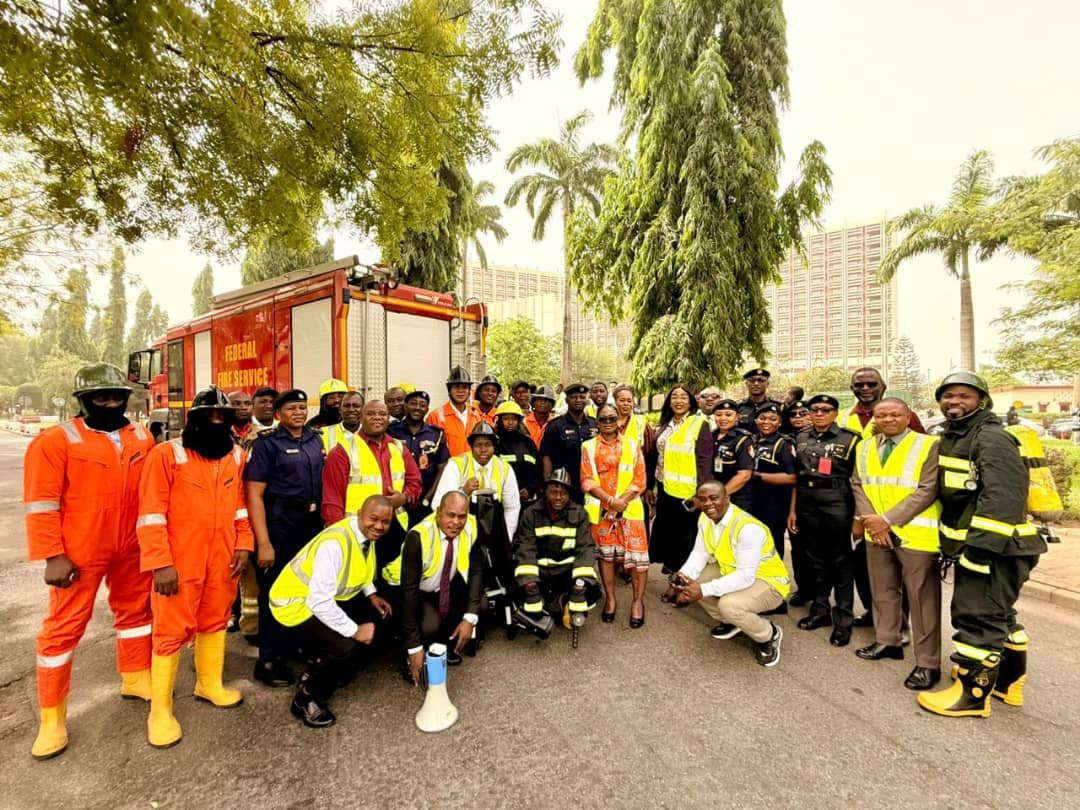
Transcorp Hilton Abuja has conducted its first-quarter unannounced fire drill simulation as part of efforts to strengthen safety measures and emergency preparedness within the facility.
The exercise, which took place on 19th February 2026, was carried out in collaboration with the Federal Fire Service. The simulation forms part of the hotel’s structured safety programme aimed at ensuring a high level of emergency readiness and effective coordination with relevant authorities.
Management of the hotel said the initiative underscores its unwavering commitment to the safety and well-being of guests and team members.
“We successfully carried out our Q1 unannounced fire drill simulation with the support of the Nigeria Fire Service. This exercise forms part of our structured safety programme, designed to ensure a high level of emergency preparedness and effective coordination with relevant authorities,” the management stated.
The drill comes shortly after the hotel hosted its Valentine’s Day weekend promotion across its rooms and restaurants. The celebration, characterised by romance, entertainment and vibrant experiences, was warmly received by guests.
As preparations begin for the Holy Month of Ramadan, the management reassured guests of a safe, serene and memorable stay.
“We appreciate the understanding of our guests and apologise for any inconvenience the exercise may have caused,” the management added.
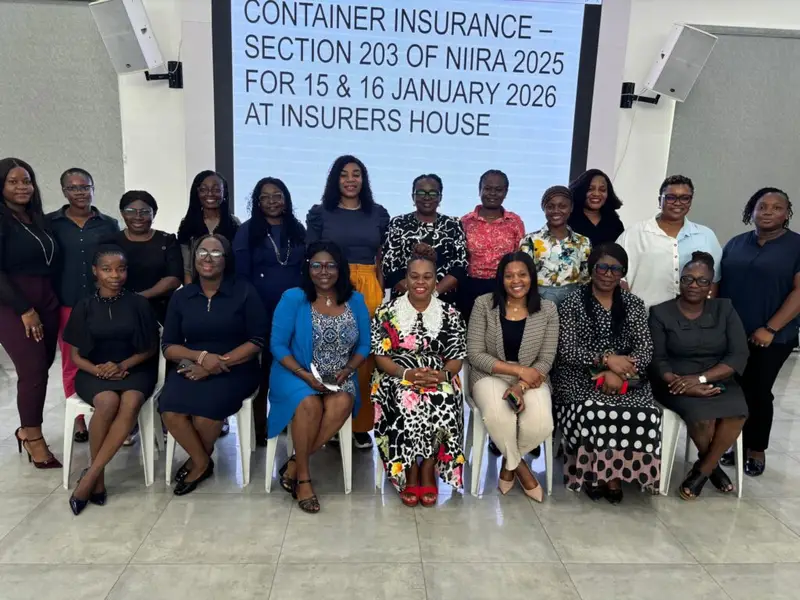
The Nigerian Insurers Association (NIA) has commenced a two-day training workshop for underwriters on the Nigerian Insurance Industry Reform Act (NIIRA) 2025.
According to a statement from NIA, the training is focused on Sections 75 and 76, as well as the Compulsory Container Insurance scheme.
The workshop, which began on Thursday, is scheduled to end on Friday.
The News Agency of Nigeria (NAN) reports that no fewer than 40 underwriters involved in container insurance, were participating in the training held at the Insurers House, Victoria Island, Lagos.
At the opening of the workshop, Director-General of the NIA, Mrs Bola Odukale, said that insurance remained a critical pillar of national development and economic stability.
Odukale noted that a well-regulated and legally backed insurance industry, was essential for economic growth, investor confidence and the protection of the public.
She urged participants to engage actively in the sessions, adding that the training would strengthen professional capacity and improve effective implementation of compulsory insurance provisions for the overall benefit of the economy.
NAN reports that facilitators at the workshop include: Mrs Margaret Ogbonnah, Director at the Nigerian Shippers’ Council; Mr Soji Oni, Controller 1, Technical, NIA, Mr Owolabi Longe, Chief Executive Officer of Ironlink Communications, among others.


NUJ FCT Chairman, Grace Ike, Hailed as Transformative Leader on Birthday

It’s Grace Ike’s Day: NUJ FCT Chairman Celebrated Across Board

The Political Economy of Nigeria’s 2027 Elections: APC’s Path to Victory by Olugbesan Idris, Ph.D
-

 Cover7 months ago
NRC to reposition train services nationwide.. Kayode Opeifa
-

 Fashion9 years ago
These ’90s fashion trends are making a comeback in 2017
-
Entertainment9 years ago
The final 6 ‘Game of Thrones’ episodes might feel like a full season
-
 Opinion1 year ago
Bureaucratic Soldier, Kana Ibrahim heads Ministry of Aviation and Aerospace After Transformative Tenure at Defence
-
 Opinion1 year ago
Hon. Daniel Amos Shatters Records, Surpasses Predecessor’s Achievements in Just Two Years
-

 Opinion4 months ago
Barrister Somayina Chigbue, Esq: A rising legal leader shaping institutioal excellence in Nigeria
-

 News8 months ago
Nigerian Nafisa defeats 69 Countries at UK Global Final English Competition
-
 Special Report1 year ago
Golden Jubilee: Celebrating Tein Jack-Rich’s Life of Purpose and Impact