Uncategorized
Stop Kyari from Investing Proceeds of Nigeria’s Refinery Money in MSM, Group Cautions AGF, EFCC
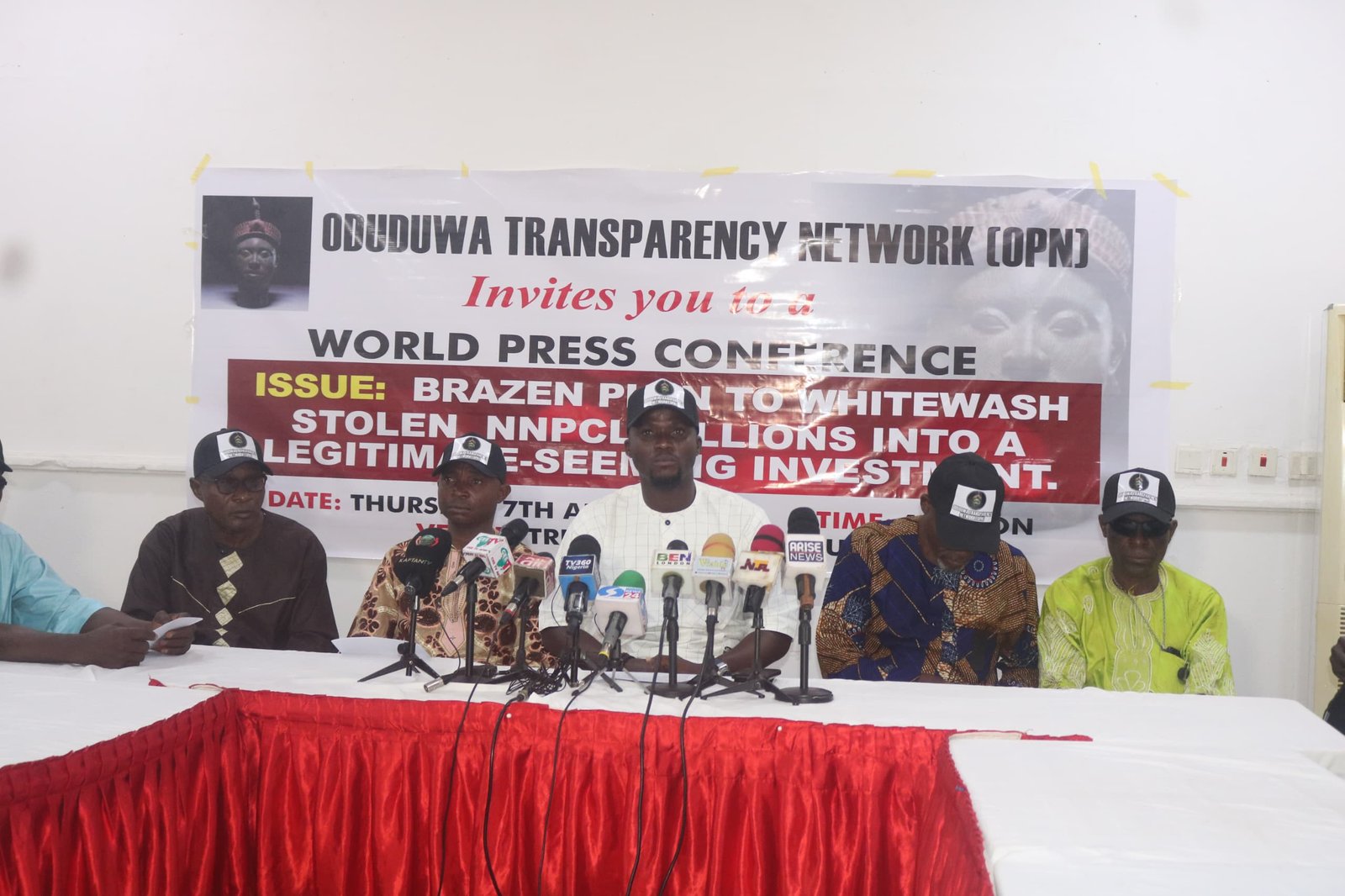
The Oduduwa Transparency Network (OPN) has called on the Attorney General of the Federation (AGF) and the Economic and Financial Crimes Commission (EFCC) to urgently investigate an alleged scheme by former Nigerian National Petroleum Company Limited (NNPCL) Group Managing Director, Mele Kyari, to funnel stolen refinery funds into the MSM Group’s $2.4 billion cement manufacturing venture.
In a press conference held in Abuja on Wednesday, August 6, 2025, OPN President Mahmud Adebayo accused Kyari and his associates of using MSM Group as a front to launder $2.8 billion meant for the rehabilitation of Nigeria’s Port Harcourt, Warri, and Kaduna refineries.
Adebayo highlighted MSM Group’s sudden rise, particularly its $2.4 billion deal with the Kebbi State Government to build a three-million-metric-ton-per-annum cement plant, announced by Chairman Alhaji Muazzam Mairawani.
He noted the striking similarity between this investment and the $2.896 billion allocated for refinery repairs under Kyari’s tenure, which the EFCC is probing.
“What is Kyari not telling Nigerians about how funds were passed under the table to his proxies in MSM Group?” Adebayo questioned, pointing to the presence of former NNPC executives Henry Ikem Obih and Aisha Katagum on MSM’s board, both of whom worked closely with Kyari.
The OPN alleged that MSM Group’s opaque ownership structure and lack of disclosed funding sources—whether from the stock exchange, money markets, or consortiums—raise suspicions of illicit financial flows.
Adebayo further claimed that Kyari’s former bank account officer, now a director at MSM Group, facilitated the diversion of NNPCL funds.
He described a recent “fake resignation” rumour surrounding NNPCL’s current Group CEO, Bayo Ojulari, as a distraction to mask MSM’s cement venture announcement.
“We find it insulting that Kyari assumed Nigerians cannot decipher this matrix,” Adebayo said, demanding that MSM Group disclose its investors’ identities and funding origins.
The OPN aligned with calls for a thorough EFCC investigation into Kyari and his associates, urging the recovery of allegedly stolen funds.
“It is against natural justice for a clique of cronies to steal the commonwealth and use it to buy up the country,” he added.
The EFCC has not commented on the allegations, but the OPN’s statement intensifies scrutiny on Kyari, whose tenure saw NNPCL’s strategic partnerships fail to deliver functional refineries.

Uncategorized
Mobile Operators Plan $1bn Investment In Network Infrastructure – NCC
Nigerian Communications Commission (NCC) has revealed that Nigeria’s telecommunications operators plan to increase capital expenditure on network infrastructure in 2026, with investments expected to exceed the more than $1billion (about N1.4 trillion) spent across the sector in 2025.
The planned increase follows infrastructure expansion in 2025, when operators deployed over 2,850 new network sites nationwide. The rollout extended coverage across urban areas, rural communities and major transport routes, while supporting the expansion of fifth-generation (5G) services.
Aminu Maida, executive vice chairman of the NCC, said improvements recorded in the regulator’s latest network performance report were driven by industry investment in 2025.
He said the report reflects the impact of sustained capital spending on network capacity and coverage.
“Industry investment of over $1bn in 2025 supported the deployment of more than 2,850 new sites to expand coverage and capacity nationwide,” Maida said. “The commission has received commitments from operators to exceed these investment levels in 2026.”
Nigeria faces increasing pressure on telecommunications infrastructure due to rising data consumption, higher operating costs and the need to extend reliable connectivity beyond major cities, a challenge common across emerging markets.
The increase in investment follows a period of financial strain in the sector, during which operators sought tariff adjustments. A 50 per cent increase in service charges, approved by the NCC and the Ministry of Communications and Digital Economy, helped improve cash flow and restore operators’ capacity to invest in network expansion.
The NCC’s fourth-quarter 2025 report showed improvements in key performance indicators, including higher median download speeds in both urban and rural areas. The report also indicated a reduction in differences in video streaming quality between locations and continued strengthening of the 4G network.
Maida said the commission uses independently verified performance data to guide regulatory decisions on spectrum management, infrastructure upgrades, service quality enforcement and rural connectivity expansion.
Despite these improvements, the NCC said challenges remain. The report identified gaps in 5G availability, disparities in upload speeds and areas with limited mobile coverage.
The commission said increased infrastructure spending in 2026 would be important to addressing these gaps and supporting growing demand for data services. It added that the publication of network performance reports is part of its effort to promote data-driven regulation, supported by analysis from network intelligence firm Ookla.
With operators expected to invest beyond $1bn in 2026, the NCC said it anticipates further improvements in network reliability, speed and coverage.
The commission said it will continue to work with industry stakeholders to ensure that higher investment leads to measurable improvements in service quality for subscribers.
News
Federal fire service decorates 130 officers in Kano
The Kano State Command of the Federal Fire Service (FFS) has decorated 130 officers recently promoted to various ranks in a ceremony held in Kano.
The Command’s Controller in the state, Kazeem Sholadoye disclosed this in a statement issued by the service’s Public Relations Officer, Al-Hassan Kantin on Wednesday in Kano.
Congratulating the officers, the state controller described their promotion as well deserved and a call to greater responsibility and professionalism.
Sholadoye charged the officers to see their new ranks as an opportunity to demonstrate increased commitment to protection of lives and property.
He reminded them that promotion comes with higher expectations in service delivery.
Speaking on behalf of the promoted officers, Deputy Superintendent of Fire in the command, DSF Abdullahi Muhammad expressed appreciation to the management for organising what he described as a befitting ceremony.
He reiterated the readiness of the officers to rededicate themselves to duty and uphold core values of the Federal Fire Service.
Cover
Call for sugar tax detrimental to manufacturing sector- CPPE
The Centre for the Promotion of Private Enterprise (CPPE) has expressed concern over renewed calls in some quarters for the imposition of additional taxes on sugar-sweetened non-alcoholic beverages in Nigeria.
CPPE Founder, Dr Muda Yusuf, made this known on Wednesday in Lagos via a statement.
Accorsing to Yusuf, while public health challenges such as diabetes and cardiovascular diseases warrant urgent attention, the proposition of a sugar-specific tax is misplaced and economically risky.
He said that the call was not adequately contextualised within Nigeria’s prevailing structural, social, and macroeconomic realities.
“Advocacy for sugar taxation in Nigeria is largely driven by externally derived policy templates, particularly those associated with global health institutions.
“However, global best practice does not support sugar taxation as a sustainable or standalone solution to non-communicable diseases, especially in economies characterised by high inflation, weak purchasing power, fragile industrial recovery, and widespread poverty, such as Nigeria,” he said.
Yusuf noted that the country’s food and beverage industry remained the largest and most dynamic segment of the manufacturing sector, with the non-alcoholic beverages sub-sector playing a particularly significant role.
He said data from the National Bureau of Statistics indicated that the food and beverage industry contributed approximately 40 per cent of total manufacturing output, making it a critical driver of industrial growth, employment and value creation.
He added that beyond factory-level operations, the sector sustained an extensive value chain that spans farmers, agro-input suppliers, processors, packaging companies, logistics providers, wholesalers, retailers, and the hospitality industry.
“Collectively, these activities support millions of livelihoods nationwide.
“Any policy that undermines this sector therefore carries wide-ranging economic consequences, including job losses, declining household incomes, reduced investment and setbacks to poverty-reduction efforts,” he said.
The CPPE boss added that manufacturers of non-alcoholic beverages were among the most heavily taxed and cost-pressured businesses in the Nigerian economy.
He listed existing fiscal obligations to include 30 per cent Company Income Tax, 7.5 per cent Value-Added Tax (VAT), N10 per litre excise duty, four per cent National Development Levy on assessable profits.
Others, he said, were four per cent Free on Board levy on imported inputs, import duties of five per cent to 15 per cent on intermediate raw materials, 0.5 per cent ECOWAS levy, property taxes at sub-national levels and multiple state and local government levies.
“These fiscal pressures are further compounded by Nigeria’s challenging operating environment, including high energy costs, prohibitive logistics expenses, exchange-rate volatility, and elevated interest rates.
“The cumulative effect has been rising production costs, shrinking margins, subdued investment appetite, and higher consumer prices,” he said.
Yusuf said available evidence suggested that sugar taxes delivered limited public health benefits unless embedded within broader, long-term lifestyle, behavioural, and structural interventions.
He added that in Nigeria, the rising incidence of diabetes and related non-communicable diseases was driven primarily by poor overall diet quality, particularly carbohydrate-heavy meals, physical inactivity and sedentary lifestyles.
Other causes, he observed, included urban design that discouraged walking and cycling, genetic and hereditary factors.
Yusuf said that while taxation may marginally influence consumption patterns, it does not address these root causes.
“Conversely, the economic costs of additional taxation, higher consumer prices, reduced demand, job losses, and weakened industrial investment are immediate, tangible, and potentially severe,” he said.
Yusuf said a more sustainable path to public health outcomes would be for policymakers to prioritise evidence-based, inclusive and development-friendly alternatives.
They include lifestyle and nutrition education, community-based health awareness programmes, promotion of physical activity and exercise, encouragement of fruit and vegetable consumption.
Others, he said, were healthy food subsidies rather than punitive taxation and urban planning that supports walking, cycling and active transportation.
“These measures directly address the underlying drivers of diabetes and cardiovascular diseases, deliver broader social benefits, and avoid undermining a critical pillar of Nigeria’s manufacturing and employment base.
“Nigeria’s economy remains in a delicate recovery phase.
“Introducing additional sugar-specific taxes at this time risks reversing recent industrial gains, weakening employment outcomes, and undermining the objectives of ongoing manufacturing-friendly fiscal reforms,” he said.
-
Cover7 months agoNRC to reposition train services nationwide.. Kayode Opeifa
-
Fashion9 years agoThese ’90s fashion trends are making a comeback in 2017
-
Entertainment9 years agoThe final 6 ‘Game of Thrones’ episodes might feel like a full season
-
Opinion1 year agoBureaucratic Soldier, Kana Ibrahim heads Ministry of Aviation and Aerospace After Transformative Tenure at Defence
-
Opinion1 year agoHon. Daniel Amos Shatters Records, Surpasses Predecessor’s Achievements in Just Two Years
-
Opinion4 months agoBarrister Somayina Chigbue, Esq: A rising legal leader shaping institutioal excellence in Nigeria
-
News8 months agoNigerian Nafisa defeats 69 Countries at UK Global Final English Competition
-
Special Report1 year agoGolden Jubilee: Celebrating Tein Jack-Rich’s Life of Purpose and Impact