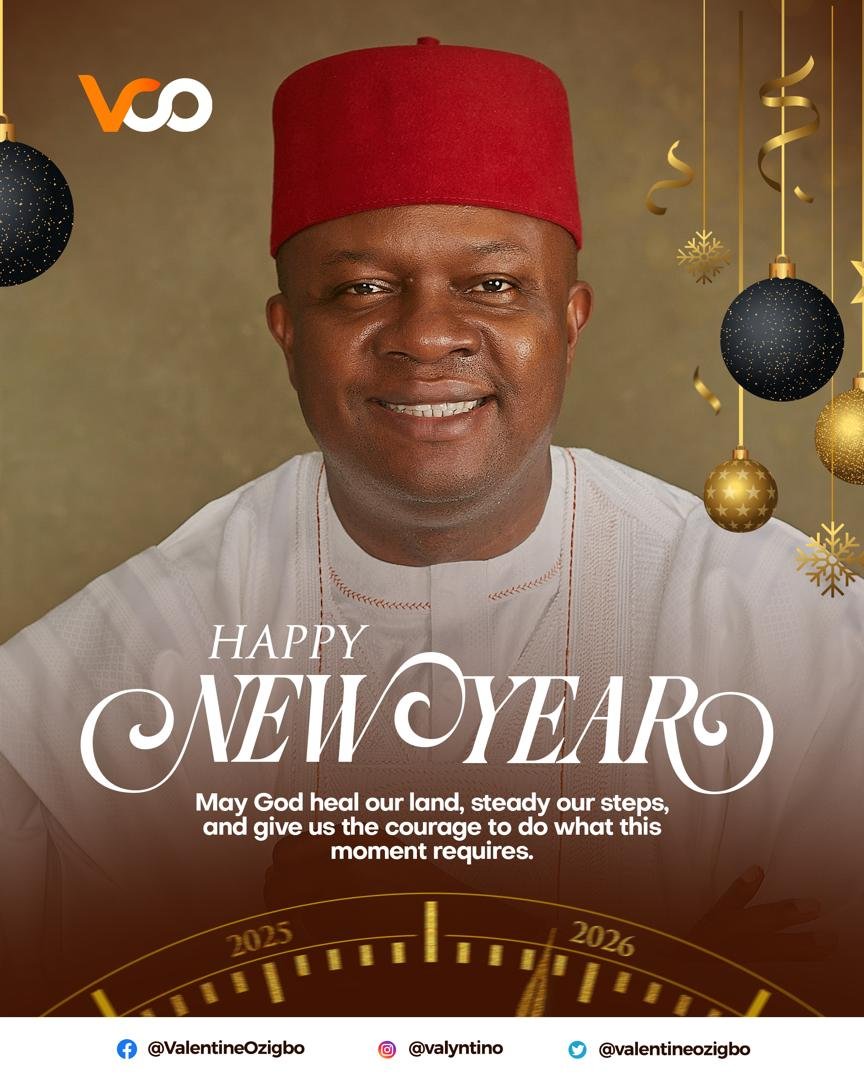
Cover
A NEW YEAR, A DEEPER BEGINNING, BY VALENTINE OZIGBO
*Why Nigeria’s Next Progress Must Be Spiritual, Not Just Political
Today, January 1st, the calendar turns, and we say, “Happy New Year.” Time itself has turned a page. However, history teaches us that not all beginnings are equal. Some years ask for resolutions. This year demands repentance, charity, and courage.
After years in the boardroom, on the campaign trail, and in the place of prayer, one conviction has become impossible for me to ignore: Nigeria does not suffer from a shortage of ideas, intelligence, or hard work.
Our crisis is that we have tried to build national progress on a shallow moral and spiritual foundation. We have chased development while leaving the ground beneath it largely untouched.
WHAT EXPERIENCE HAS TAUGHT ME
Three lessons now stand before me with unusual clarity.
First, leadership matters deeply, but leadership alone is not enough. Whatever one administration builds can be quietly dismantled by the next if there is no deeper agreement about who we are as a people and what we are willing to protect together. Policies change quickly. Values change slowly. Foundations change last.
Second, for years, I have argued that Nigeria needs three things to move forward:
- The right leadership,
- A culture of continuous improvement, also called Kaizen, and
- An active, responsible citizenry.
I still believe this. But I now see, more clearly than ever, that if a shared moral and spiritual canopy does not cover these three principles, they cannot deliver lasting renewal. We must pursue leadership, a Kaizen culture, and active citizenship while rebuilding our moral centre. One without the other will keep failing us.
Progress without a moral anchor is fragile. It shines for a moment and fades at the first political storm.
Third, if we now understand this, a simple question confronts us: If the foundation is faulty, why are we not urgently fixing it?
Do we realise that if our generation fails to address this, much of our struggle will feel empty to those who come after us?
HOW OTHER SOCIETIES SECURED THEIR FOUNDATIONS
Nigeria is not the first diverse and complicated country to face this kind of crisis. Others have found ways to anchor their union on something more profound than raw power or temporary success.
- China holds together, not because everyone agrees on policy, but because there is a strong sense of civilizational continuity, a shared story and moral order that reaches beyond the politics of the day.
- Indonesia, one of the most religiously and ethnically diverse nations on earth, forged unity around Pancasila – a profound but straightforward charter that affirms belief in God, human dignity, national unity, social justice, and democracy, without enforcing any single religion.
- India draws resilience from a civilizational memory that predates the modern state by thousands of years. Whatever its present struggles, that long memory gives it a depth beyond the life span of any government.
- Singapore built trust on ethical discipline: merit, clean governance, and a deep sense that public office is a public trust, not a personal entitlement.
- From Russian Orthodoxy, we see how spiritual depth can give a people the capacity to endure historical trauma without losing all sense of identity, as long as faith remains a conscience above power, not its servant.
Different histories, different routes, one lesson: No complex society survives by accident. Every durable union chooses a shared moral or civilizational logic and then lives by it.
Nigeria did not do this work at independence. We are living with the consequences.
WHAT I MEAN BY “SPIRITUAL COVER”
When I speak of spiritual cover, I do not mean a Nigeria where one religion dominates the others, or where any faith is silenced. I do not mean a theocracy or an empty ceremonial religion.
I mean a shared minimum understanding that:
- Human life is sacred,
- Power has boundaries,
- Justice must stand above tribe, faith, or region, and
- No tribe is a stranger in the country it helped to build.
This moral framework is not a theological debate. It is about survival. It is about agreeing, as a people, that there are lines we will not cross, even when it appears to be the easy route.
Without that kind of moral floor, we will keep having elections without justice, reforms without continuity, and development without dignity.
WHERE THE ANSWER NOW LIES
Nigeria’s rebirth will not come from a single idea or group. It requires a new, honest consensus about the kind of union we want to be.
At the heart of that consensus, we must think clearly about two issues: our structure and our soul.
Structurally, we need:
- One Nigerian union, held together by shared values, mutual obligation, and a sense of common destiny, and
- Deep autonomy for its constituent peoples, so that Nigerians, by their own free choice, can organise their cultural, political, and developmental lives in ways that respect their histories and identities.
- Shared authority where unity is essential. Genuine self-government where diversity must breathe.
No one is suggesting a breakup or forced uniformity. It is the design of a mature federation: one union, many nations, unity by consent instead of compulsion.
Into this broader vision, several important streams of work already exist:
- The 2014 National Conference Report was the outcome of a broad-based national dialogue convened by President Goodluck Jonathan and chaired by Justice Idris Legbo Kutigi. Over 490 delegates, drawn from every geopolitical zone, professional bodies, traditional institutions, civil society, and interest groups, deliberated for months on Nigeria’s political structure, economy, security, and governance. The report distilled hundreds of resolutions aimed at justice, true federalism, devolution of power, and national cohesion. It remains the most comprehensive government-backed blueprint for restructuring Nigeria, and its significance lies in the rare national consensus that produced it.
- The Orange Union Model, advanced by the Fatherland Group, which directly addresses our spiritual and civilizational deficit and seeks to reframe Nigeria as a union of nations with a moral centre.
- The long-standing call for true federalism, championed by The Patriots and other eminent leaders, aims to restore real power closer to the people.
- Other sincere efforts to build a new civic identity defined by citizenship, dignity, and responsibility, rather than by blood or birthplace.
These are not rival projects. Seen correctly, they are converging paths toward what I call Nigeria’s “second founding”.
A FIVE-YEAR MORAL HORIZON
The next five years are critical.
We squandered a unique opportunity in 1960. We gained a flag but not a foundation.
By 2030, seventy years after independence, we will stand before another kind of crossroads. We cannot afford to miss it again.
If we genuinely care about what our children will inherit, then we can’t spend these next five years only managing crises. They must be devoted to grounding Nigeria in a shared moral understanding.
Infrastructure remains important. Economic reform remains essential. But without a common moral centre, none of these will endure.
MY NEW YEAR’S RESOLUTION
My personal resolve this year is simple, but demanding.
I intend to use whatever goodwill and access I have to persuade President Bola Ahmed Tinubu to embrace this deeper national project as a defining legacy, and as the natural completion of the decentralisation efforts already underway.
We have seen promising structural moves:
- Renewed emphasis on local government autonomy,
- Stronger regional development frameworks,
- Increased resources to the states, and
- Serious conversation about state policing.
These are important. But they need moral integration. A house that has been decentralised still needs a shared foundation, otherwise each wing will eventually pull away in splinters.
If we can combine structural reform with a clear moral settlement about the sanctity of life, the limits of power, and the dignity of every community, tribe, and faith group, we will give future leaders something firm to build on.
AN INVITATION TO YOU
If you permit me, I want to extend a New Year’s invitation that goes beyond personal goals.
Let your most important resolution this year be to contribute, in whatever space you occupy, to this work of moral and spiritual rebuilding.
Let business leaders decide that profit will never excuse exploitation.
Let religious leaders preach not only about miracles, but also about righteousness and justice.
Let public servants remember that every signature they append affects real lives.
Let citizens refuse to normalise corruption, lies, or cruelty, no matter who benefits.
Our people have a saying: “Azọta ala, achọba ute.” It means “you secure the land before you look for the mat.”
Nigeria must first secure its moral land. Every other blessing depends on that. We do not need more noise, but we do need more voices. Thoughtful, courageous, consistent voices.
IN CLOSING
I write this not as a call to rage. It is not a call to street theatre or to politics as usual.
It is a call to national maturity, to a more profound honesty about what has gone wrong, and to a new seriousness about what must be made right.
My prayer is that this January 1 will not be remembered only as another date on the calendar, but as the beginning of Nigeria’s second founding, when we finally decided to fix the ground beneath our feet.
Happy New Year.
May God heal our land, steady our steps, and give us the courage to do what this moment requires.
Valentine Ozigbo

Cover
IKOH NDI ABIA 2027: The Maturity Of Time For A Calm, Experience And Winning Leadership In Abia State
By Aaron Mike Odeh
Politics, especially in a developing democracy like ours, is beyond mere political activities and electoral contests. It is fundamentally about leadership, vision, emotional intelligence, capacity, and the ability to inspire confidence among the people. In moments when the destiny of a people stands at a defining crossroads, wisdom demands that political parties and stakeholders place competence, experience and acceptability above sentiments and unnecessary experimentation.
As someone who has actively participated in Abia politics for over twenty-six years, occupying different positions at appointment status, i believe I possess the moral standing and practical experience to speak with clarity on the political future of Abia State and the direction the All Progressives Congress (APC), should take ahead of the 2027 governorship election.
My political journey and Media Consultancy has taken me across the length and breadth of NIGERIA including Abia State. From Arochukwu to Ukwa, from Umunneochi to Ikwuano, I have interacted closely with party leaders, grassroots mobilizers, traditional institutions, youths, women groups and stakeholders across different divides. I have watched governments emerge and fade. I have seen political structures built and dismantled. I have equally studied the expectations, emotions and aspirations of Abia people over the years.
From this wealth of experience and practical evaluation of Abia politics, one fact has remained consistently clear: for APC to genuinely position itself for victory in 2027, the party must present a candidate with political maturity, administrative experience, emotional stability, credibility and the capacity to unite various interests within and outside the party.
Without hesitation, I strongly believe that Chief Henry Ikechukwu Ikoh perfectly fits into this critical expectation.
Chief Ikoh represents a rare blend of humility, experience, consistency and strategic political understanding. In a political environment often dominated by controversies, unnecessary bitterness and divisive tendencies, he has remained calm, focused, approachable and remarkably stable. These qualities may appear ordinary to some people, but in practical governance and political management, they are indispensable virtues that sustain leadership and build confidence among the electorate.
One of the strongest assets Chief Ikoh possesses is his maturity and ability to relate across political, ethnic and social lines. Politics in Abia today requires a leader who can build bridges rather than walls; a leader who understands that governance succeeds better when stakeholders are respected and united under a common vision. Chief Ikoh has demonstrated this quality over the years through his interactions with people across party affiliations and communities.
Beyond his personal qualities, Chief Henry Ikechukwu Ikoh possesses extensive experience in public service and political administration. Leadership is not learned overnight. It is developed through years of service, sacrifice, strategic engagement and practical exposure. Abia State at this moment requires a leader who understands governance, appreciates political realities and possesses the administrative competence to navigate the challenges confronting our people.
Another important factor that distinguishes Chief Ikoh is his consistency of purpose. His aspiration to govern Abia State is not a sudden ambition driven by opportunism or political convenience. Since 2003, he has remained steadfast, focused and committed to his vision for the state. Such consistency speaks volumes about conviction, preparedness and genuine passion for service.
In politics, consistency builds trust. It reassures the people that a leader is not merely pursuing personal ambition but is driven by a long-term vision and commitment to societal development. This is one quality many Abians have come to appreciate in Chief Ikoh.
Furthermore, APC as a party must begin to prioritize electability and acceptability ahead of internal sentiments. Elections are won not merely through slogans, but through strategic calculations, grassroots acceptance and broad-based support. The reality before us is that the people of Abia are yearning for a leadership that is calm, responsible, inclusive and development-oriented. They desire a leader who can listen, unite and inspire confidence across different sectors of society.
Chief Henry Ikechukwu Ikoh possesses these qualities in abundance.
His calm disposition, amiable personality and infectious ebullience naturally attract people to him. He is not known for needless controversies or divisive politics. Rather, he embodies the spirit of maturity and responsible engagement that APC needs to expand its acceptance across Abia State.
The journey toward 2027 should therefore not be approached with bitterness, selfish calculations or divisive tendencies. It should be approached with sincerity, wisdom and genuine concern for the future of Abia State and the success of our great party.
There comes a moment in the life of every people when destiny presents an opportunity that must not be ignored. I strongly believe that moment has come for APC in Abia State.
Indeed, as the Holy Scripture declares, “The time to favour Zion, yea, the set time, has come.” For Abia State, this is the maturity of time to embrace tested experience, political maturity and purposeful leadership.
With deep sense of responsibility and commitment to the progress of our state, I most respectfully appeal to APC stakeholders, leaders and delegates to rally behind Chief Henry Ikechukwu Ikoh and support the vision of IKOH NDI ABIA 2027.
This is not merely about an individual ambition; it is about giving APC the strongest opportunity to win the governorship election and provide purposeful leadership for the good people of Abia State.
The task before us is collective. The future is now. And the time is ripe for a leader with capacity, humility, experience and vision.
THE SET TIME IS NOW!
Aaron Mike Odeh, A Public Affairs Analyst, Media Consultant, Human and Community development advocate wrote from Post Army Housing Estate Kurudu Abuja
Cover
Alleged Coup Trial: Cleric Says He Warned That The Plot Would Fail
*Admits he received money for ‘prayers’
A Federal High Court in Abuja, on Monday, viewed a video- recorded statement by Sheikh Sani Abdulkadir, the sixth defendant in the ongoing trial of persons accused of conspiring to overthrow the government of President Bola Tinubu.
In the recording, the Sheikh, who admitted receiving money to pray for the success of the operation, however, claimed that he warned the alleged plotters that their plan was doomed and that they would be sabotaged from within.
The video recording was played during the continuation of trial proceedings, with the fourth prosecution witness (PW4) still in the witness box.
In the recording, Abdulkadir, an Islamic cleric, said he had known the alleged ringleader, Colonel Maaji, for less than a year and was approached through an intermediary identified as Sanda to offer spiritual support for the plot.
He told investigators that Sanda informed him that his “Oga” intended to stage a coup and needed prayers regarding its likely success. After conducting the prayers, Abdulkadir said he advised them the operation would fail and that two persons would eventually expose those involved.
A subsequent request was relayed back to him, he said, asking for further prayers to prevent those two individuals from speaking out. Money was later transferred to him for prayers and charity, and names of alleged participants were forwarded for inclusion.
Abdulkadir said he first learnt of the arrests through media reports, after Sanda had informed him that Colonel Maaji had been unreachable for four days. He maintained throughout the recording that the funds he received were strictly for prayers and not in support of any coup attempt.
He also acknowledged understanding that a coup meant a military overthrow of government but said he did not report the plot because he did not know who to report to.
The cleric said his arrest came after he visited the Economic and Financial Crimes Commission (EFCC) to resolve restrictions placed on his bank account.
Upon contacting an EFCC deputy director, he was invited to the commission’s office to explain the source of the funds. He denied making any coup-related statement while in EFCC custody and stated that he was neither assaulted nor tortured, and that all his statements were made voluntarily.
Following the playback, the prosecution sought to tender extra-judicial statements made by all six defendants before a Special Investigation Panel and military police authorities.
However, defence lawyers of all six defendants objected, arguing the statements were either involuntarily obtained or made in violation of the Administration of Criminal Justice Act (ACJA).
Their objections include failure to inform defendants of their right to legal representation; alleged discrepancies between video recordings and corresponding written statements; allegations of coercion, inducement and torture; and claims that the footage did not adequately establish the physical condition of defendants during recording.
Counsel to the fifth defendant further argued that, given the number of accused persons, the court should conduct separate trial-within-trial proceedings for each disputed statement rather than a combined exercise.
Responding, the prosecution urged the court to dismiss the objections, maintaining that the law does not mandate separate proceedings for each defendant and that the trial judge holds discretion over how evidence is received.
Justice Joyce Abdulmalik ruled in favour of a single joint trial-within-trial to determine the voluntariness and admissibility of all the disputed statements.
The case was then adjourned to May 12.
Cover
2027 zoning debate: Opposition must choose strategy over sentiment — Atiku camp warns
The media office of former Vice President Atiku Abubakar has cautioned opposition political actors against embracing what it described as a self-defeating and intellectually dishonest narrative that insists the 2027 presidential ticket must be zoned exclusively to the South.
In a statement issued on Monday in Abuja, signed by Olusola Sanni, media aide to former Vice President Atiku Abubakar, the camp said while the ruling APC may understandably retain its southern presidential configuration around incumbent President Bola Ahmed Tinubu, it would amount to political naivety for the opposition to adopt the same logic without a sober assessment of electoral realities.
The statement noted that politics must be driven by strategy, coalition-building, and hard electoral arithmetic—not emotional talking points or selective moral arguments.
“The first and most obvious question is this: how does a Southern opposition candidate realistically unseat a sitting Southern president? Nigerian political history offers no precedent for such an outcome. No incumbent president has ever been defeated by an opposition challenger from the same geopolitical bloc. To insist otherwise is to enter the contest already defeated,” the statement said.
The Atiku camp further argued that the moral argument being advanced in favour of southern zoning collapses under scrutiny.
“By 2027, the South would have held presidential power for approximately 18 years in the Fourth Republic, compared to about 10 years for the North. If the South retains power for another four years, that disparity widens even further. It therefore becomes difficult to understand the justice in an argument that seeks to deepen an already existing imbalance under the guise of equity,” the statement added.
The statement also accused some political actors of selective memory and opportunism, particularly those who abandoned the zoning principle in 2011 following the death of President Umaru Musa Yar’Adua, only to now present it as a sacred political doctrine.
“It is intellectually dishonest for those who enthusiastically supported a Southern presidency under Goodluck Jonathan in 2011, despite the North’s legitimate expectation under the informal zoning arrangement, to now suddenly posture as custodians of rotational justice. Principles do not become sacred only when they align with personal ambition.”
While affirming that the Southeast’s aspiration to produce a president remains legitimate and deserving of serious national engagement, the statement warned against reducing that aspiration to what it called “transactional political bargaining.”
“The Southeast deserves a sustainable and credible pathway to national leadership—not symbolic tokenism or bespoke arrangements tailored to satisfy one individual’s ambition,” it stated.
The statement concluded by urging the opposition to focus on building a credible national coalition capable of defeating the incumbent rather than embracing narratives that may inadvertently strengthen President Tinubu’s re-election prospects.
“Defeating an incumbent president requires realism, not romanticism; strategy, not sentiment; honesty, not selective memory. The opposition must decide whether its goal is to make an emotional statement or to actually win power.”
-
Cover8 months agoNRC to reposition train services nationwide.. Kayode Opeifa
-
Fashion9 years agoThese ’90s fashion trends are making a comeback in 2017
-
Entertainment9 years agoThe final 6 ‘Game of Thrones’ episodes might feel like a full season
-
Opinion1 year agoBureaucratic Soldier, Kana Ibrahim heads Ministry of Aviation and Aerospace After Transformative Tenure at Defence
-
Politics1 month agoNNPP Diaspora Stakeholder and Key Kwankwaso Ally, Dr. Usman Tijjani Shehu, Rejoins APC
-
Opinion1 year agoHon. Daniel Amos Shatters Records, Surpasses Predecessor’s Achievements in Just Two Years
-
Opinion5 months agoBarrister Somayina Chigbue, Esq: A rising legal leader shaping institutioal excellence in Nigeria
-
News9 months agoNigerian Nafisa defeats 69 Countries at UK Global Final English Competition