Connect with us

Cover

Wike-Backed Lagos PDP Appeals To George Ahead Of 2027 Elections

Published

on

A faction loyal to Nyesom Wike is publicly courting one of its fiercest internal critics — and the timing tells its own story.
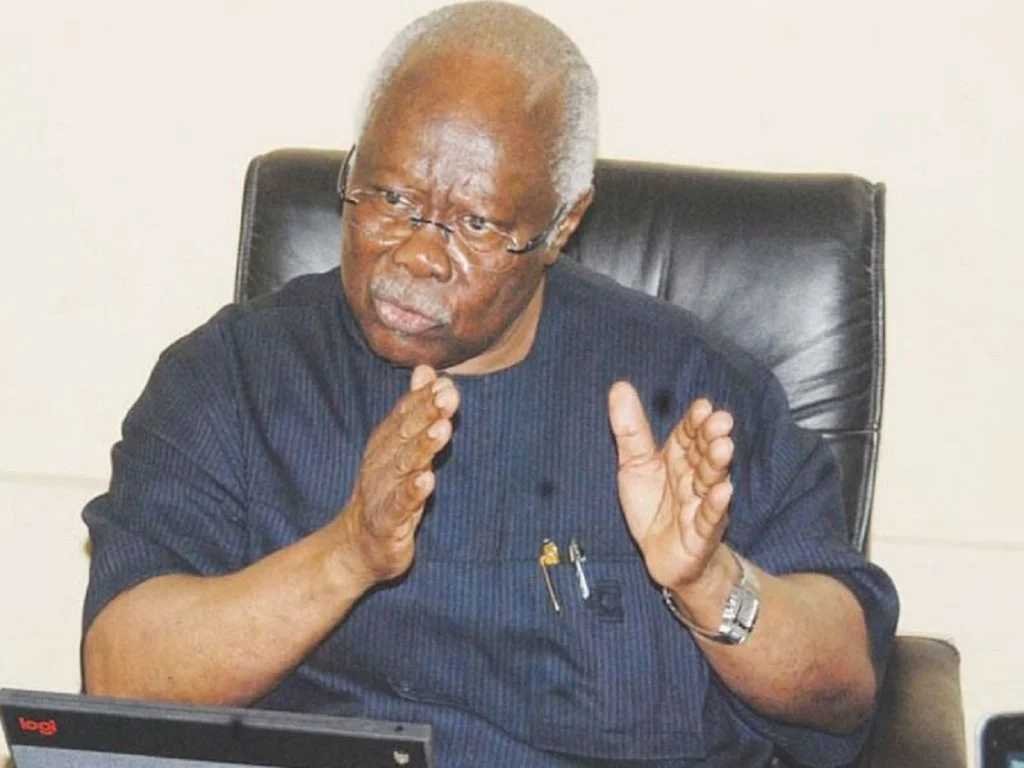
The Lagos State chapter of the Peoples Democratic Party aligned with the Minister of the Federal Capital Territory has extended a public appeal to Chief Bode George, urging the former Deputy National Chairman to return to what it calls the party’s “mainstream leadership structure” ahead of the 2027 general elections.

The appeal arrived through the faction’s State Organising Secretary, Hakeem Olalemi, in an interview with the News Agency of Nigeria in Lagos on Sunday. Coming from a Wike-aligned structure, the overture is notable for one simple reason: George has spent much of the ongoing PDP leadership crisis as one of Wike’s most vocal critics.

George’s position within the party’s current factional dispute is unambiguous. He aligns with the National Working Committee led by Dr Kabiru Turaki, a structure backed by Oyo State Governor Seyi Makinde — the camp standing in direct opposition to the Wike-supported leadership under Alhaji Abdurahman Mohammed.

Despite that alignment, Olalemi insisted George remains, in his words, family. “Chief Bode George is always welcome in the PDP. We have great respect for him, and there is room for him within the party,” Olalemi said. “He is our father. He is a foundation member; nobody can ask where he is coming from. We will welcome him back to the fold.”

The language is carefully chosen. Calling George “our father” and “a foundation member” positions any future disagreement as a family matter rather than an irreconcilable political rift — a framing that leaves the door open regardless of how sharply George has criticised Wike’s handling of the party crisis.

Olalemi framed the overture within a broader narrative of party unity, describing internal discipline and reconciliation as part of the PDP’s enduring political culture.
“The PDP is a family,” he said. “If we use one hand to discipline a child, we use the other hand to bring him back. That is what has been keeping us together. There is room for everybody who believes in the progress of the party.”

He extended the appeal beyond George specifically, calling on all members who have drifted from the party’s recognised structure to return. “We must forget the past. We want everyone on the other side to come back and be with us to build this party again.”

The metaphor — discipline with one hand, embrace with the other — is a familiar rhetorical device in Nigerian intra-party politics, typically deployed when a faction needs to project strength and openness simultaneously: firm enough to maintain authority, welcoming enough to avoid permanent fractures that could damage electoral prospects.

Beyond the internal reconciliation message, Olalemi used the interview to address Lagos’s broader opposition landscape — and he did not mince words.
“There is no other opposition in Lagos except PDP in Lagos,” he said. “All those people that I call mushroom parties cannot match us in terms of experience, exposure and political structure.”

He challenged anyone to compare the pedigree of rival governorship candidates with the PDP’s own contender, framing the party as the only credible alternative to the ruling All Progressives Congress in the state. He went further, suggesting that many figures currently in opposition parties were themselves PDP members at some point — implying a cyclical pattern of departure and eventual return.
“Those who have left will come back to the fold,” Olalemi said. “All of them will return to PDP because they know where the structure is.”

Beyond the rhetoric directed at George and rival parties, Olalemi confirmed the PDP has begun reorganising its structures across Lagos State ahead of the 2027 general elections.
He said party members were actively mobilising support at ward, local government, and zonal levels — the foundational organisational layers that determine a party’s ground-level effectiveness during elections.

“PDP in Lagos State is more than ready to slug it out with APC in the 2027 general elections,” Olalemi said. “We are rejigging our machinery at the various local governments, wards and zones. PDP is everywhere in Lagos State.”

The appeal to George arrives at a moment when the PDP, nationally and in Lagos specifically, continues to grapple with the consequences of its prolonged leadership dispute. Two competing National Working Committees — one backed by Wike, the other by Makinde — have left state chapters across Nigeria navigating divided loyalties heading into a critical election cycle.

Whether George responds to the Lagos faction’s overture remains uncertain. His public criticism of Wike has been consistent and pointed throughout the crisis, and reconciliation gestures from a Wike-aligned structure may not be sufficient to bridge that gap on their own.

What is clear is that Lagos PDP, regardless of which national faction it ultimately aligns with most closely, recognises that 2027 cannot be approached with a fractured internal house. Whether courting George succeeds in repairing that fracture — or simply highlights how deep it remains — will become clearer as the pre-election period intensifies.

Continue Reading
Click to comment

Leave a Reply

Your email address will not be published. Required fields are marked *

Cover

Japan Overpowers Tunisia With 2-0 World Cup Triumph

Published

on

Japan delivered a composed performance to secure a 2-0 victory over Tunisia in their World Cup group stage encounter, underlining their growing reputation as one of Asia’s most disciplined sides.

The game kicked off, and it was evident immediately who was on the front foot – Japan! They imposed their game plan with their midfield Trio, passing the ball around smoothly, putting Tunisia on the back foot as they chase shadows. Their work ethic was impeccable, pressing high and recovering possession instantly before launching swift counterattacks.

Tunisia simply could not cope with the pace and organisation and couldn’t build a flow from their back line.

Japan took the lead midway through the first half as a well-constructed attack down the right flank culminated in a sharp finish that went in without hope. This represented their dominance in converting pressure into goals. They doubled their lead in the second half, essentially killing the game as a quick break caught Tunisia off guard and their striker coolly slot home. Their efficiency in both goals showed their quality when attacking the goal.

Tunisia came into the match hoping to cause a surprise, but they simply could not get into gear.

Their forwards were isolated up front, and their creativity was hampered by Japan’s oppressive pressing game. Despite some brave attempts to break down the resolute Japanese defense, even their long balls and set-pieces couldn’t cause a problem as the Japan defenders stood tall and cleared danger. Although there were instances of flashes of brilliant individual skill, Tunisia was lacking cohesion on the pitch.

Their failure to consistently maintain attacks often exposed their goal to Japanese counters. Japan’s defense also deserves a mention. They were so compact and disciplined.

There was no space in the final third of the pitch, leaving the opposition goalkeeper having relatively nothing to do, thanks to the fantastic anticipation of the defenders.

Japan were able to effectively control the game throughout due to their ability to simultaneously deny Tunisia space and create chances of their own; this clearly shows how disciplined they are as a side. Japan’s win keeps their confidence high and positions them strongly to qualify for the knock-out stages of the World Cup. They’ve shown that they can play with technically skillful players, combined with tactically mature football, the ingredients for World Cup success. For Tunisia, there are concerns from this game.

If they can’t find a better rhythm or if their attacking options don’t step up, this game could be difficult for their tournament journey.

Japan’s 2-0 victory over Tunisia showcased an exceptional performance that combined discipline, lethal efficiency, and robust defensive organization, strengthening their group position and boosting their belief in their ability to progress in the World Cup. Tunisia, on the other hand, have shown in this match that they may have a tough road ahead at this prestigious event.

Continue Reading

Cover

Ecuador Held By Curaçao As Eloy Room Shines

Published

on

Ecuador’s clash with Curaçao in the World Cup ended in a goalless draw, but the story of the night was not the scoreline. It was the heroics of Curaçao’s goalkeeper, Eloy Room, who delivered a performance that will be remembered for years.

Room faced relentless pressure from Ecuador’s attack, yet he stood firm. With 15 saves, he denied every attempt, frustrating forwards who had expected to break through with ease. His composure and reflexes ensured Curaçao earned their first-ever World Cup point, a milestone for the Caribbean nation.

Ecuador dominated possession and created numerous opportunities. Enner Valencia and Gonzalo Plata both came close, but their efforts were repeatedly thwarted by Room. The South Americans pressed high, moved the ball quickly, and tested Curaçao’s defense, but lacked the finishing touch.

The frustration grew as the match wore on. Ecuador’s inability to convert chances highlighted a recurring issue: dominance without clinical execution. For a side aiming to progress deep into the tournament, the draw felt more like a setback than a point gained.

While Room was the standout, Curaçao’s defensive unit also deserves credit. The backline remained compact, closing spaces and forcing Ecuador into difficult angles. Their discipline ensured that despite Ecuador’s attacking waves, clear-cut chances were limited.

ALSO READ

Late Goal Seals Win For Czechia

Curaçao’s strategy was clear: absorb pressure, rely on their goalkeeper, and seize rare counter-attacking opportunities. Though they created little going forward, their resilience paid off with a result that will boost confidence.

For Curaçao, this draw was more than just a point. It was a statement. Competing against a seasoned South American side, they showed that determination and organization can level the playing field. The result marks their first point in World Cup history, a moment of pride for players and fans alike.

Room’s performance will likely be remembered as one of the finest goalkeeping displays in recent World Cup memory. His saves not only kept Ecuador at bay but also gave Curaçao belief that they belong on the global stage.

For Ecuador, the draw raises questions about their attacking efficiency. Despite controlling the game, they failed to break down a resolute opponent. Their forwards lacked sharpness, and their midfield struggled to find decisive passes in the final third.

Coach Félix Sánchez will need to address these issues quickly. With tougher fixtures ahead, Ecuador cannot afford to waste opportunities. Their campaign now hinges on finding goals to match their possession and pressure.

The match drew attention worldwide, with analysts praising Room’s heroics. His 15 saves set a new benchmark for resilience in a single World Cup game. Fans celebrated Curaçao’s achievement, while Ecuador supporters expressed disappointment at missed chances.

Ecuador’s dominance met Curaçao’s defiance, and the result was a historic 0-0 draw. Eloy Room’s brilliance ensured his nation walked away with a point that will inspire future generations. For Ecuador, the night was a reminder that possession and pressure mean little without goals.

Continue Reading

Cover

Oyebanji Wins Ekiti Re-Election With 85%, Sweeps All 16 LGAs

Published

on

Governor Biodun Oyebanji secured re-election by sweeping all 16 local government areas and claiming 85 per cent of the popular vote, a margin that places this contest among the most decisive governorship outcomes recorded in the South West in recent years.

The Independent National Electoral Commission‘s Returning Officer, Professor Adenike Oladiji, announced the result at about 3:13 a.m. on Sunday, confirming Oyebanji’s victory with 319,224 votes. The Peoples Democratic Party’s Oluwole Oluyede trailed distantly with 40,543 votes, while Dare Bejide of the African Democratic Congress polled 12,872 votes.

Oladiji, who doubles as Vice-Chancellor of the Federal University of Technology, provided a full breakdown of Saturday’s exercise. A total of 384,940 voters were accredited across the state’s 16 local government areas. Of the 382,109 total votes cast, 375,777 were valid, while 6,332 ballots were rejected.

The arithmetic confirms what the headline figures already suggested: Oyebanji’s victory was not narrow, contested, or marginal. It was a comprehensive sweep that touched every corner of the state, from Ado-Ekiti’s urban core to the most rural communities in the local government areas.

The governor’s reaction, issued in a statement following the declaration, combined the customary language of gratitude with a more pointed commitment to governance.
“The voice of the people has reverberated from every part of our great state, and the message is clear,” Oyebanji said. “I am deeply humbled by the scale of this victory. Securing a clean sweep across all 16 local government areas and 85 per cent of the popular vote is a humbling vote of confidence from Ekiti Kete.”

He extended the framing beyond simple electoral arithmetic, describing the result as evidence of unified public sentiment. “From our urban centres to our most remote communities, you have spoken with one thunderous voice for continuous development, stability and a future of endless opportunities.”

ALSO READ

APC’s Asogwa Wins Enugu North Amid Disputed By-elections

Beyond the celebratory tone, Oyebanji used the moment to outline what he believes the mandate now demands of his administration.
“This mandate means that our work must touch every household even deeper,” he said. “There are no winners or losers today; there is only one united Ekiti determined to continue its journey of upward mobility. I pledge to honour this immense trust by continuing to lead with humility, dedication and fairness.”

The phrase “touch every household even deeper” is a deliberate signal. Second-term governors in Nigeria frequently use the post-election period to recommit to specific development priorities — education, healthcare, rural infrastructure, and job creation typically feature prominently. Whether Oyebanji’s second term translates that rhetoric into measurable improvements in household welfare across Ekiti’s 16 local government areas will be the central test of his renewed mandate.

Saturday’s election proceeded largely without major disruption, a point worth noting given Nigeria’s history of contentious state-level contests. However, the process was not entirely free of friction. Reports emerged of technical challenges in some polling units, alongside allegations of irregularities in select locations.

Neither issue appears to have significantly altered the overall outcome, given the scale of Oyebanji’s victory margin. A result this decisive — 85 per cent of the popular vote and a sweep of every local government area — would typically be difficult for any losing party to credibly contest on the basis of isolated technical hitches.
Whether the PDP or ADC formally challenge any aspect of the process through Nigeria’s election petition tribunals remains to be seen. As of this report, no such legal action has been announced by either of Oyebanji’s two main challengers.

For political observers across Nigeria’s South West, Oyebanji’s landslide carries implications beyond Ekiti’s borders. A clean sweep of all 16 local government areas, combined with an 85 per cent vote share, represents the kind of decisive endorsement that incumbent governors across the region will study closely.

It also raises the bar for what accountability looks like during a second term. Voters who deliver a mandate of this magnitude typically expect commensurate delivery — in infrastructure, in social services, and in the kind of household-level impact that Oyebanji himself referenced in his victory statement.
Ekiti residents have given their governor an unambiguous vote of confidence. The next four years will determine whether that confidence was well placed.

Continue Reading

Trending

Copyright © 2023 - 2025 DailyMirror Nigeria. Design by AspireWeb.ng, powered by WordPress.