Metro
Troops Neutralise Suspected Bandit, Recover Rustled Livestock in Plateau
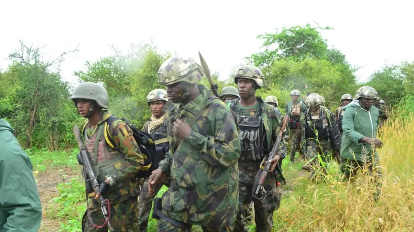
Troops of Operation Enduring Peace (OPEP) have neutralised a suspected bandit during a clearance operation in Jos South Local Government Area after coming under attack from armed men.
The development was disclosed by security analyst Zagazola Makama in a post shared on X.
According to him, the operation was carried out at about 7:00 a.m. on June 26 following credible intelligence about the activities of armed livestock rustlers around the Gero high grounds in Jos South.
During the operation, troops reportedly intercepted a herd of cattle believed to have been rustled while grazing on cultivated farmland. Shortly after the interception, suspected militia members opened sporadic gunfire on the security personnel.
The troops held their ground and called for reinforcements. Additional personnel from Sector 3 at Rafin Bauna, along with other reinforcements led by the Commander of Sector 6, were deployed to the area and engaged the attackers.
According to Zagazola, one suspected bandit was killed during the exchange of gunfire, while others escaped.
A search of the area led to the recovery of two mobile phones and ₦14,000, which were believed to have been abandoned by the fleeing suspects.
The intercepted cattle were moved to a secure location for further action.
Troops have continued clearance operations and domination patrols across the area to prevent further attacks and deny criminal groups freedom of movement in Plateau State.

Metro
DSS Frees Farmer Cleared of Boko Haram Links, Pays ₦3 Million Compensation
The Department of State Services (DSS) has released a farmer, Nura Idris, after an investigation found no evidence linking him to the Boko Haram insurgent group.
According to reports, the Director-General of the DSS, Oluwatosin Adeola Ajayi, ordered Idris’ release and approved a compensation payment of ₦3 million to help him rebuild his life and business.
Idris, a farmer and herder from Soba Local Government Area, was arrested in Suleja in 2024 over allegations of having links to terrorists before he was handed over to the DSS.
A review panel set up by the agency later found no evidence connecting him to terrorist activities, leading to an immediate order for his release.
Speaking after regaining his freedom, Idris commended the DSS leadership for the way he was treated while in detention. He said the ₦3 million compensation would help him restart his life and farming business.
Security sources also disclosed that the DSS is reviewing old detention cases involving individuals who have been held for long periods to ensure innocent people are not kept in custody unnecessarily.
According to the reports, more than 30 people whose cases have been reviewed have received over ₦300 million in compensation, as part of the agency’s efforts to protect citizens’ rights while maintaining national security.
Metro
Becoming a Digital Marketing Star (Simple Tips for Kids Who Love the Online World)
How would you describe your secondary school days?
My secondary school days were a bit fun. I never thought of being an engineer; I always wanted to be an accountant because I was very good at mathematics and calculations. I was in the social sciences class. I switched from the social sciences to the sciences in SS2 because I wanted to study engineering. I decided because of my dad. He did not ask me to study engineering.
He wanted to study engineering but could not continue his studies due to financial difficulties. My dad used to say that he would have been an engineer if he had had the opportunity to attend university. When I looked at my life, I could see it was something I would do. I thank God it was the best decision I made.
Are you the first person in your family to study engineering?
Yes, I’m currently the only engineer in my family. It became something the whole family was proud of. The decision to study engineering came to me from the moment I left social sciences for the sciences. I had to study hard to make it work.
Why didn’t you choose other branches of engineering?
I was planning to study mechanical engineering, not industrial engineering. I had never heard of industrial engineering before going to university. After my Unified Tertiary Matriculation Examination, my score was low, which compelled me to change my course. I initially picked mechanical engineering, but after buying the change-of-course form, I changed to industrial engineering for the admission process.
What was your best subject in secondary school?
When I was in social sciences, my best subjects were mathematics and accounting. But when I moved to sciences, they were mathematics and physics. The reason those subjects became my favourites hinged on my ability to excel in calculations. Aside from mathematics and physics, the calculation aspect of chemistry was also interesting to me.
How did you cope in science class?
It was during a particular long vacation. I attended a tutorial class close to my house, so I was taking science classes after I switched. I was able to understand many things during that July/August holiday. My strength has always been calculations, so that was why I was able to catch up with physics and the calculation aspect of chemistry.
In my school, I was the best in mathematics and there was another girl who was the best in chemistry, so the teachers contemplated making either of us the head girl. However, our principal said neither of us would become head girl because we were not from Edo State. I’m from Anambra State, while the other girl is from Ondo State.
Did you maintain that brilliance in your first year at the university?
When I was offered industrial engineering, the first thing I did was research the course. I wanted to know what it was all about. After doing that, I focused on studying industrial engineering and when I wrote my first semester examinations, the results were good. In my second semester, however, I had an issue with one of my courses. I got an F and had to rewrite the course in 200-level.
Did you know from the start that you wanted a first-class degree?
I’ve always wanted to graduate with a first class. Before I switched to engineering, I told myself that I wanted to be one of the best, if not the best. I thought that if it were my father studying the course, he would be the best, so I needed to give him the best result.
What were the strategies and study habits that earned you a first class?
Night classes helped me a lot. I attended them regularly. I also had good mentors. When I saw my 100-level results, I was a bit shaky and scared because I never imagined I would have a carryover course.
I thought I would not be able to graduate with a first class. I was at the point of giving up, but I spoke with my mentor. Fortunately for me, my mentor and friends encouraged me. I needed their advice and I worked hard to improve my results.
At what point did you know that your first class was certain?
It was in 400-level. It became very clear to me that graduating with a first class was almost certain when I saw my 400-level results. I became very confident that I would make a first class because I had a 5.0 GPA. It meant I got A’s in all my courses. It happened to be my best year in school.
How did your male coursemates feel when you topped the class?
I didn’t really experience any rivalry from either the opposite sex or my female colleagues, but I guess the guys in my class were just relaxed. There were only two guys who appeared serious, but they were obviously not chasing a first class. All they wanted was a degree and to leave school. I did not face any form of bullying from anyone.
Did you feel bullied at any time by the male students?
The only thing they used to say was that engineering had taken away the feminine side of me. They would say studying engineering had made me serious and that I behaved like the guys. They usually said it jokingly.
Since you didn’t have any rivalry, did you get support from your classmates?
In my department, I had reading partners because we attended night classes together. I had reading partners from my department and other departments. We studied together, set questions for one another and marked them together. We also encouraged one another and advised ourselves not to abandon our goals.
Did you face any particular challenges as a female in the university?
The challenges were not peculiar to me as a female. I faced challenges as a student, especially as someone from an average family trying hard to make excellent grades.
Did you have any life outside studying?
I worked as a teacher in a secondary school within the university community from my 100-level. At the same time, I was sewing to make money to support myself in school. I was sewing and teaching simultaneously. I did not really have a social life in my first two years.
However, I occasionally followed my friends to parties whenever I was less busy, maybe once a month. My life was not all about books. I was also honoured as the most influential graduating female student.
Why did you have to sponsor yourself through school?
I’m the sixth of seven children. There was little financial support, so I had to find a way to sponsor myself in school. There were financial difficulties at home. In fact, I finished secondary school in 2017/2018, but I wrote the UTME in 2020/2021 because of financial problems.
I had already been teaching before then and started saving money. I told myself that if I did not save, I would not be able to go to university. In 200-level, we were introduced to core engineering courses because I had taken mainly physical science courses in 100-level. In my second year, there was no time for my part-time teaching job because it clashed with my classes.
After 200-level, I stopped teaching and focused on catering. At some point, a friend and I started cooking for people for pay. We delivered cooked food. In 300-level, I started Forex trading.
All these activities were ways for me to make money and support myself in school. It was tough. I still studied hard while trying to do several things at the same time.
How did you emerge as the most influential graduating female student?
My faculty student association gave me the award for my dedication, outstanding performance and selfless service. There was a time I volunteered to stand in for our general course representative for two months because he was preparing for his father’s burial. At that time, many people got to know me, and I became popular.
I was calling lecturers, organising classes, handling assignments and combining several student activities. I guess that was when many people became familiar with me. They used to refer to me as “Cheta Engineering.” Cheta is the shortened form of my name.
Source: Punch
Metro
Troops Rescue 53 Civilians As ISWAP Roadblock Is Dismantled In Borno
Troops of Operation Hadin Kai have dismantled an ISWAP roadblock along the Buratai–Kamuya Road in Biu Local Government Area of Borno State, rescuing 53 civilians and recovering eight vehicles reportedly seized by the insurgents.
The development was announced in a statement issued by the Headquarters of the Joint Task Force North East, Operation Hadin Kai, and signed by the Acting Military Information Officer, Captain Mohammed Goni.
According to the military, the operation was carried out on June 24, 2026, by troops of the 135 Special Forces Battalion under Sector 2 of Operation Hadin Kai.
The statement explained that troops stationed at Dutse Kura detected suspected ISWAP terrorists blocking the Buratai–Kamuya highway through surveillance cameras. A Quick Reaction Force was immediately deployed to the scene.
The troops pursued the fleeing insurgents toward the Mangari–Dora area, where a gun battle ensued, forcing the suspects to retreat.
Following the operation, security forces rescued 53 civilians and recovered eight vehicles that had allegedly been seized by the terrorists.
The troops also cleared the suspected escape route used by the insurgents and carried out further searches in the area, although no additional contact with the suspects was made.
According to the military, all rescued civilians, recovered vehicles and other property were safely evacuated to Buratai town. The rescued victims are currently undergoing documentation and medical evaluation.
The Theatre Command commended the troops for their professionalism and swift response during the operation.
The statement added:
“The Theatre Command OPHK commends the professionalism and swift response of the troops.”
Residents within the Joint Operations Area were also urged to remain vigilant and continue providing timely information on suspicious movements and activities to security agencies.
The military said the security situation in the area remains calm, while troops continue offensive operations and maintain dominance across the region.
-
Cover10 months agoNRC to reposition train services nationwide.. Kayode Opeifa
-
Entertainment9 years agoThe final 6 ‘Game of Thrones’ episodes might feel like a full season
-
Fashion9 years agoThese ’90s fashion trends are making a comeback in 2017
-
Politics3 months agoNNPP Diaspora Stakeholder and Key Kwankwaso Ally, Dr. Usman Tijjani Shehu, Rejoins APC
-
Opinion2 years agoBureaucratic Soldier, Kana Ibrahim heads Ministry of Aviation and Aerospace After Transformative Tenure at Defence
-
Opinion1 year agoHon. Daniel Amos Shatters Records, Surpasses Predecessor’s Achievements in Just Two Years
-
Opinion7 months agoBarrister Somayina Chigbue, Esq: A rising legal leader shaping institutioal excellence in Nigeria
-
News11 months agoNigerian Nafisa defeats 69 Countries at UK Global Final English Competition