Cover
NRC MD names assaulted journalist Ladi Bala Ambassador for Media Advocacy
…. Apologizes to her, media community
The Managing Director of the Nigerian Railway Corporation (NRC), Dr. Kayode Opeifa, has publicly apologized to the Nigerian media for verbally assaulting Nigerian Television Authority (NTA) journalist Comrade Ladi Bala while she was covering the aftermath of a train derailment along the Abuja-Kaduna rail corridor.
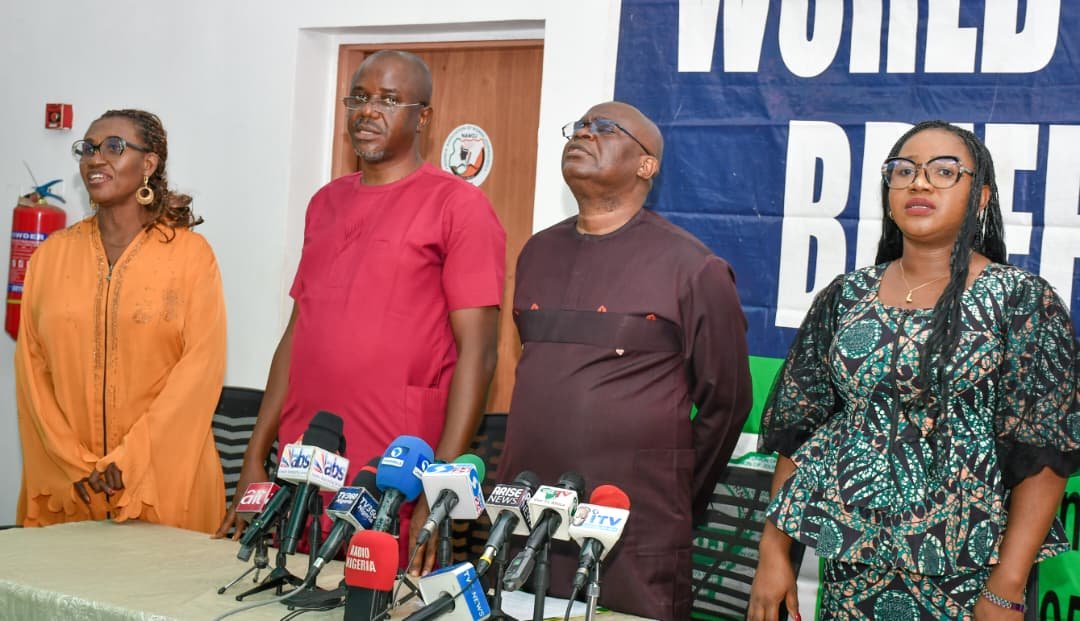
Speaking at a press conference held at the Nigeria Union of Journalists (NUJ) FCT Council Secretariat in Abuja on Sunday, Dr. Opeifa explained that his remarks, made under intense pressure while managing the crisis, were misunderstood as hostility towards the press.
Comrade Bala, the immediate past president of the Nigerian Association of Women Journalists (NAWOJ), was reportedly subjected to unprovoked verbal attacks by Dr. Opeifa while performing her official duties at the derailment scene.
The NUJ FCT Council condemned Dr. Opeifa’s conduct, describing it as dehumanizing and a serious violation of press freedom.
During the apology, Dr. Opeifa said:
“I wish to sincerely apologize for the regrettable remarks I made, which were directed at a seasoned journalist and reflected poorly on both the NUJ FCT and NAWOJ.
“Acting under pressure and in the heat of the moment while trying to ensure safety, I uttered some unkind words for which I take full responsibility.”
In recognition of Comrade Bala’s resilience, professionalism, and dedication to factual reporting despite the unfortunate incident, Dr. Opeifa bestowed upon her the honorary title of “Ambassador for Media Advocacy.”
He explained that the derailment involved eight coaches and one locomotive, placing huge demands on his team to coordinate rescue efforts, inform the presidency and the public, and activate emergency procedures simultaneously.
On the day of the accident, the NRC’s newly revised emergency protocol was immediately put into action, engaging key agencies such as the News Agency of Nigeria (NAN), National Emergency Management Agency (NEMA), Federal Ministry of Health, Kaduna State Government, FCT Administration, and Nigerian military.
Dr. Opeifa said there were 618 passengers onboard at the time of the derailment. Seven coaches and the locomotive were damaged, with around 20 passengers sustaining injuries—seven critically.
The NRC quickly provided replacement coaches to evacuate stranded passengers and began contact tracing using passenger manifests within 45 minutes of the crash.
“Some passengers had already traveled to nearby towns, but we managed to trace them by phone,” he added. “I personally visited at least seven injured passengers, including one who had made his way to Zaria.”
He also praised the swift response from the Nigerian Army, Air Force, police, local vigilantes, and other emergency personnel, whose actions saved lives.
Ambulances and medical teams were deployed by NEMA, the Federal Ministry of Health, Kaduna State Government, and FCT Administration. Medical staff on the trains prioritized life-saving efforts at the scene.
Dr. Opeifa tendered a direct apology to Comrade Bala, acknowledging she bore the brunt of his earlier comments:
“To her, I offer my fullest apology. I also extend the same to the NTA, NAWOJ, and the wider journalism community.”
He described himself as a longtime advocate for human rights and trade unionism, recalling his history with the Campaign for Democracy, leadership in the Academic Staff Union of Universities (ASUU) at LASU, and involvement in the June 12 struggle.
“I have fought alongside journalists before; I am not their enemy,” he stressed.
Dr. Opeifa highlighted NRC’s gender-inclusive policies, noting that 50% of the corporation’s management directors are women promoted on merit.
He reaffirmed his commitment to partnering with the media to advance railway development and provide accurate, timely information.
Regarding recovery efforts, he disclosed that by Saturday two coaches and one locomotive were cleared from the crash site, with two more coaches expected to be removed by Sunday’s end.
Engineers had laid about 50 meters of new track to facilitate this.
He praised the resilience of NRC’s rolling stock, noting that business-class passengers were unaware of the accident until disembarking, demonstrating the equipment’s quality and impact-absorbing capability.
On media relations during emergencies, Dr. Opeifa commended journalists for their coverage but urged accuracy to prevent panic.
He also detailed NRC achievements, including reactivation of the Jos–Bukuru line, expansion of the Lagos–Ibadan corridor, and plans to connect major ports like Tin Can, Warri, and Onne to the rail network, describing these as unprecedented in over 60 years of Nigerian railway history.
Dr. Opeifa announced the establishment of a Customer Service and Relations Department to engage passengers and the media, noting the unit had contacted over 400 passengers affected by the Kaduna accident.
He concluded that despite the accident, the incident strengthened NRC’s resolve to modernize railway services and expand rail access in partnership with state governments and the Renewed Infrastructure Fund.
“The media remain our partners, not adversaries. We will deepen collaboration with the NUJ, NAWOJ, and civil society to promote transparency and public trust,” he affirmed.
NUJ FCT Council Chairman Comrade Grace Ike, representing journalists, said the council would continue defending press freedom and resisting intimidation. She welcomed the public apology as a step toward rebuilding trust while stressing that the NUJ FCT has zero tolerance for intimidation, harassment of journalists.
“We will persist in fighting for our members’ rights and freedom of speech, which is a right, not a privilege. I am pleased the MD has joined us in opposing harassment and intimidation of journalists and will champion this cause,” she said.
“With Comrade Ladi Bala as the NRC’s Ambassador for Media Advocacy, we anticipate increased media activities and campaigns promoting the welfare and development of Nigerian journalists, especially in the FCT.”
Senior Special Assistant to the President on Media and Special Duties, Tunde Rahman, who accompanied Dr. Opeifa, praised the NRC boss’s humility in offering the apology and pledged ongoing collaboration between the presidency, NRC, and the media.

Cover
Citizen Network Condemns NAFDAC’s Enforcement of Sachet Alcohol Ban, Warns of Mass Action
The Citizen Network has strongly criticized the National Agency for Food and Drug Administration and Control (NAFDAC) over its decision to commence the enforcement of a ban on sachet alcoholic beverages, describing the action as arbitrary, anti-people, and detrimental to the nation’s economy.
Speaking in Abuja on Tuesday, the group’s representative, Comrade Johnson Kolawole Michael, expressed concern that the enforcement, announced under the leadership of NAFDAC Director-General, Professor Mojisola Christianah Adeyeye, is disrupting the livelihoods of workers and operators in the wines and spirits sector, a segment the group said contributes significantly to Nigeria’s Gross Domestic Product (GDP).
According to the Citizen Network, the decision contradicts an earlier directive issued by the Office of the Secretary to the Government of the Federation (SGF) on December 15, 2025, which instructed that enforcement of the ban be suspended.
The group also noted that the action runs contrary to resolutions of the House of Representatives contained in document NAS/10/HR/CT.33/77c of March 14, 2024, where lawmakers, following public hearings and consultations with stakeholders, restrained NAFDAC from implementing the ban, describing it as unacceptable and anti-people.
The group accused NAFDAC of selectively relying on a Senate resolution that, it claimed, excluded critical stakeholders and failed to reflect public opinion. It disclosed that it has formally approached the Senate, expressing confidence that lawmakers would reconsider the matter after further consultations.
Comrade Michael said the conflicting directives from different arms of government have created confusion among industry operators, leaving them uncertain about which authority to comply with.
He further argued that sachet and small PET bottle alcohol products were introduced to cater to adult consumers with limited purchasing power and that banning them would deny such consumers their fundamental right of choice. He dismissed claims that sachet alcohol encourages abuse, stating instead that smaller portions help discourage excessive consumption typically associated with larger containers.
The Citizen Network also maintained that sachet alcoholic beverages produced locally meet hygienic standards and are duly certified by regulatory bodies, including NAFDAC. It added that allegations of underage abuse have been countered by independent empirical research, while industry players have invested over ₦1 billion in nationwide campaigns promoting responsible alcohol consumption and discouraging underage drinking.
While reaffirming its support for the removal of unsafe products from the market, the group insisted that regulatory decisions must be guided by empirical evidence rather than sentiment. It warned that the ban could lead to factory closures, job losses, and the influx of illicit, substandard, and smuggled alcoholic products, thereby depriving government of revenue and consumers of regulated options.
The Citizen Network called on President Bola Ahmed Tinubu, members of the National Assembly, and concerned Nigerians to intervene and urge the NAFDAC Director-General to halt the enforcement of the ban and comply with existing directives suspending it.
The group warned that failure to heed the call could leave it with no alternative but to embark on a nationwide mass action.
Cover
How Army, DSS, DIA foiled coup to topple, kill Tinubu
A covert intelligence operation coordinated by the Army Headquarters, the State Security Service (SSS), and the Defence Intelligence Agency (DIA), helped thwart a deadly plot to overthrow President Bola Tinubu’s government and assassinate key political figures, PREMIUM TIMES can authoritatively report.
Multiple senior administration insiders said the plot began to unravel in late September 2025 after an unnamed military officer with direct knowledge of the coup contacted the then Chief of Army Staff, Olufemi Oluyede. The officer reportedly disclosed the scheme, saying he feared being implicated as an accessory to treason if he failed to alert authorities.
Our sources said around the same time, the SSS independently gathered intelligence indicating that some serving army officers were plotting to “destabilise the government and undermine Nigeria’s democracy.” An official familiar with the matter said the Director-General of the SSS, Oluwatosin Ajayi, personally briefed Mr Oluyede on the findings.
Faced with converging intelligence from multiple sources, the two security chiefs agreed to act swiftly. A wide-ranging but discreet joint operation was launched by the army and the SSS, with coordinated arrests planned across different parts of the country to neutralise the coup’s masterminds and other collaborators.
On 30 September 2025, as President Tinubu travelled to Imo State for an official visit, unaware of the plot to depose and possibly assassinate him, the joint operation went into effect. The sweep led to the arrest of the alleged principal architects of the coup, alongside other military and civilian suspects.
The Chief of Defence Intelligence (CDI), Emmanuel Undiandeye, and the then Chief of Defence Staff, General Christopher Musa, were subsequently briefed. Mr Undiandeye was then requested to detain the suspects in the underground holding facility of the Defence Intelligence Agency.
Following the initial arrests, President Tinubu was formally informed of the foiled plot. A visibly shaken president immediately ordered the cancellation of the 1 October National Independence Day parade. He also approved the constitution of a special investigative panel, which later led to additional arrests. The investigative panel was led by General Undiandeye.
One of the detained soldiers later escaped custody but was rearrested by SSS operatives in Bauchi, a military insider said. Meanwhile, a retired officer identified as General Adamu and a former governor, Timipre Sylva, accused of bankrolling the coup plotters, remained at large.
Mr Tinubu later fired and retired the then Chief of Defence Staff, General Musa as well as the chiefs of the navy and airforce. Mr Oluyede was appointed CDS and promoted to the rank of General. Weeks later, Mr Musa returned to government as minister of defence.
In a statement issued on 4 October, the Defence Headquarters said the arrested officers were being investigate for “indiscipline and breach of service regulations.” It added that preliminary findings suggested the officers’ grievances were linked to “career stagnation and failure in promotion examinations.”
Despite mounting evidence and a series of detailed reports by PREMIUM TIMES and other media outlets, the military repeatedly denied that a coup plot existed.
In an 18 October statement the Defence Headquarters described the probe involving the 16 arrested officers as a routine internal investigation aimed at maintaining discipline and professionalism within the armed forces.
However, on 26 January, the military publicly acknowledged for the first time that officers had indeed plotted to illegally overthrow President Tinubu’s administration. It announced that those indicted would be arraigned before a military judicial panel.
According to the Defence Headquarters, the investigation was “comprehensive” and conducted in line with established procedures, examining “all circumstances surrounding the conduct of the affected personnel.”
It said the findings revealed “a number of officers with allegations of “plotting to overthrow the government,” describing such conduct as “inconsistent with the ethics, values and professional standards required of members of the Armed Forces of Nigeria.”
“Accordingly, those with cases to answer will be formally arraigned before an appropriate military judicial panel to face trial in accordance with the Armed Forces Act and other applicable service regulations,” the statement added.
The plot to oust, kill Tinubu and others
In an earlier report, PREMIUM TIMES quoted sources with direct knowledge of the investigation as identifying top officials allegedly marked for assassination. They include President Tinubu, Vice President Kashim Shettima, Senate President Godswill Akpabio, and Speaker of the House of Representatives, Tajudeen Abbas.
“There are other people targeted,” one source said. “But those are the key targets.”
The plotters also planned to detain senior military officers, including the service chiefs. “They did not want to kill them,” the source added.
According to the sources, the conspirators intended to assassinate the political leaders simultaneously. “They were waiting for a day when all of them would be in the country,” one official said. “Wherever they were, they would be assassinated.”
The sources said the plotters relied on informants within the Presidential Villa and around the officials slated for elimination.
“They have people inside the Villa who monitor the movements of these officials,” the source said. “The plan was to kill them at the same time and install a military government.”- PREMIUM TIMES
Cover
Workplace Safety and Health: Today’s Choices Determine the Future – NSITF Boss
As the NSITF-NECA Safe Workplace Intervention Project kicks off in Lagos, Managing Director of the Nigeria Social Insurance Trust Fund, (NSITF) Barrister Oluwaseun Falaye, has enjoined employers of labour in Nigeria to be intentional about compliance with workplace safety and health regulations as he said that the future is determined by today’s choices.
In his welcome address at the Lagos Stakeholders’ Interactive Enlightenment Forum and Awards Ceremony on Tuesday, Barrister Faleye said, “the future of work in Nigeria will be defined by how much we protect our workforce while driving productivity and growth.”
“At the core of the Employees’ Compensation Act 2010 is a simple but profound truth: every worker matters. No job is worth a life. And no organization can sustainably thrive when safety is treated as an afterthought,’ he stated.
Barrister Faleye urged organizations that are yet to fully align with safety compliance to avail themselves of the event to do so.
He stressed that no job is worth a life, and no organisation can sustainably thrive when safety is treated as an afterthought.
Speaking on the theme of the program: ‘Enhancing Workplace Safety, Strengthening Compliance, Celebrating Excellence’, the NSITF MD said “the theme captures the full spectrum of our engagement today. Compliance must be seen not as a regulatory obligation alone, but as a strategic business decision that safeguards human capital, reduces operational risk, and enhances organisational reputation”.
According to him, SWIP has, over the years, evolved into a strategic platform for driving awareness, strengthening compliance, and fostering collaboration around occupational safety and health, adding that the forum represents a critical interface between policy, practice, and performance, where employers, workers, regulators, and partners engage constructively on how to build safer and more productive workplaces.
“Today’s gathering is not merely an information session; it is a shared commitment. It reflects our collective resolve to ensure that economic growth does not come at the expense of worker safety, and that productivity is anchored on environments that protect lives, dignity, and livelihoods,” he stated.
Speaking on the awards, Faleye said, “today, we also take time to celebrate organisations that have distinguished themselves through demonstrable commitment to occupational safety and health. These awards are not just acknowledgements; they are benchmarks. They signal that compliance is achievable, that safety delivers value, and that excellence in worker protection deserves recognition”.
The NSITF boss thanked the parent Ministry of Labour and Employment, NECA, participating organizations, and other partners for the success of the event and reiterated the Fund’s commitment to “deepen collaborations, strengthen compliance, and promote a culture where every workplace is a safe workplace.”
Explaining the SWIP forum, Director General , NECA, Mr Adewale-Smatt Oyerinde, said safety in the work place should be taken as a fundamental issue and core responsibility of employers.
He said while employers are pursuing maximum or optimum profit, safety of their workers should also be priorities.
He described workplace safety as a life-and-death matter that is still treated with dangerous nonchalance by both employers and employees, despite its far-reaching consequences.
The NECA DG expressed confidence that the initiative would not only reward excellence but also reset the national conversation on workplace safety
The Minister of Labour and Employment , Alhaji Maigari Dingyadi, in a keynote address at the 2025 SWIP kick-off, said the Safe Workplace Intervention Project is a collaborative occupational health and safety initiative designed to enhance workplace safety across Nigeria through structured audits, engagement and recognition.
He said the occupational health and safety is everyone’s responsibility, adding that the ministry cannot do it alone.
He commended NECA and NSITF for sustaining SWIP, describing it as a model of effective collaboration between government and the private sector.
.
In a presentation titled “Employees’ Compensation Act, 2010: The Journey so Far,” the Executive Director Operations at NSITF, Honourable Mojisola Ali-Macauley said that Section 3 of the ECA 2010 makes provisions for Occupational Safety and Health as part of NSITF’s mandate.
She revealed that Scheme has a little less than two hundred thousands organizations translating to around eight million employees under its cover. She further stated that 142,745 persons have so far benefited in one form or another from the Scheme.
Seven companies in the Lagos Region received award for maintaining a high standard of Occupational Health and Safety in their workplaces. While Chivita and Nigeria Breweries received an ambulance each, five others received infrastructure OSH awards of first aid kits, PPEs and other safety gadgets for the workplace.
The SWIP, a partnership project between the Nigeria Social Insurance Trust Fund and Nigeria Employers’ Consultative Association, was designed to promote voluntary compliance with workplace safety standards and regulations by organizations through creation of awareness, safety audit and motivation in form of awards to exemplary organisations. It adopts a method that downplays enforcement.
The NSITF-NECA SWIP Awards 2025 is scheduled for Lagos, Enugu, and Abuja for the grand final.
-
Cover5 months agoNRC to reposition train services nationwide.. Kayode Opeifa
-
Fashion9 years agoThese ’90s fashion trends are making a comeback in 2017
-
Entertainment9 years agoThe final 6 ‘Game of Thrones’ episodes might feel like a full season
-
Opinion1 year agoBureaucratic Soldier, Kana Ibrahim heads Ministry of Aviation and Aerospace After Transformative Tenure at Defence
-
Opinion1 year agoHon. Daniel Amos Shatters Records, Surpasses Predecessor’s Achievements in Just Two Years
-
Opinion2 months agoBarrister Somayina Chigbue, Esq: A rising legal leader shaping institutioal excellence in Nigeria
-
News6 months agoNigerian Nafisa defeats 69 Countries at UK Global Final English Competition
-
Special Report1 year agoGolden Jubilee: Celebrating Tein Jack-Rich’s Life of Purpose and Impact