News
Lagos residents lament air pollution, seek stricter law enforcement
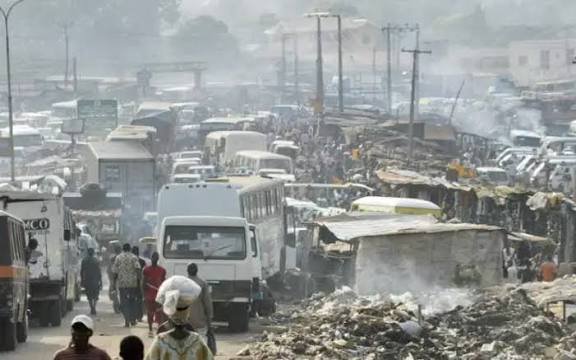
As Lagos continues to battle environmental challenges associated with its rapid urbanisation, residents across the state have raised concerns over its worsening air quality, largely attributed to indiscriminate waste burning, vehicular emissions, and poor sanitation practices.
They disclosed this in separate interviews with the News Agency of Nigeria (NAN) on Sunday in Lagos.
NAN reports that from Ikorodu to Sasha, Oshodi to Alagbado among others, fumes from refuse fires, exhaust pipes and industrial discharges hang in the air, posing serious threats to public health and the environment.
Mrs Itunu Dada, a civil servant and resident of Ikorodu, told NAN that air pollution in her community is largely caused by refuse burning.
“Instead of patronising the PSP operators, many residents prefer to burn their waste.
“When you go outside, you see fumes of smoke from effluents. This causes cough and chest irritation. Around the markets, refuse dumped on the road median emits offensive odours. It’s appalling,” she said.
Dada called on the Lagos State Government to shut down markets with poor sanitation and strengthen its waste evacuation efforts.
“Those evacuating waste from the drainage leave them for weeks before removing them. When it rains, the waste washes back into the drains. This is not good.
“There should be a task force to monitor illegal dumping and burning of refuse within the metropolis,” she said.
In Sasha, a suburb in the Alimosho Local Government Area, Mrs Stella Lawrence, a teacher, said air pollution has become an everyday reality for residents.
“The huge population of Lagos contributes to it. Many commercial vehicles are not roadworthy and emit thick fumes.
“Generator use also adds to the problem. The government should ban unfit vehicles and ensure the PSPs remove refuse regularly to discourage waste burning. Providing regular electricity supply will also help to reduce generator fumes,” she added.
Similarly, Miss Chioma Ndukwe, a communications expert and resident of Okota, said air pollution has become severe in densely populated areas such as Oshodi.
“When you walk through Oshodi Market, you can hardly breathe; emissions from industries, waste burning, traffic fumes and poor sanitation combine to create a choking environment,” she said.
Ndukwe urged the government to provide public toilets, conduct regular vehicle emission checks and regulate industrial discharges.
“We need to take air pollution seriously. Everyone deserves to breathe clean air in Lagos,” Ndukwe said.
In Lekki, Mr Bruno Ajede, a businessman, acknowledged that while the area is relatively clean, pollution persists in crowded parts such as markets and Ajah.
“Car fumes are the main problem. Air pollution affects human health and can cause respiratory issues like asthma,” Ajede said.
Also, Mr Ajibola Ajayi, a marketer and resident of Alagbado, said the community suffers from huge vehicular pollution.
“Many vehicles here emit heavy smoke because there’s little or no regulation,” Ajayi said.
Reacting to the development, Mr Friday Oku, President, Association of Wastepickers of Lagos, said Nigeria’s continued dependence on fossil fuel is worsening both environmental and health hazards.
“There’s a lot of danger associated with fossil fuel use. It’s causing serious harm to the environment and to human health.
“That’s why we are working to promote renewable energy and find ways to mitigate air pollution in our society,” Oku said.
He, however, criticised what he described as inconsistent government policies that undermine emission reduction efforts, citing the recent ban on waste pickers using carts, known locally as “cart pushers,” as an example.
“When we are trying to cut emissions from fossil fuels, the government suddenly bans cart pushers without providing any sustainable alternative.
“How do you ban them and replace them with tricycles that cause even more pollution? It shows a lack of policy direction,” he said.
Oku added that while private and civil society groups are striving to reduce emissions through renewable energy and cleaner alternatives such as Compressed Natural Gas (CNG), government actions often contradict climate commitments.
“For us, we are against fossil fuel emissions from vehicles and markets. We must shift towards renewable energy and CNG. That’s the only way to reduce greenhouse gas emissions,” he emphasised.
He also stressed the need for behavioural change among Nigerians.
NAN reports that health experts opine that prolonged exposure to polluted air increases the risk of respiratory infections, heart disease and lung cancer.
However, the Lagos State Government, through the Ministry of the Environment and Water Resources, has reiterated its commitment to tackling air pollution through its Blue and Green Economy Initiative and Air Quality Monitoring Network.
The state has also deployed mobile sensors in strategic locations to measure pollution levels and enforce compliance among industries and transport operators.
NAN reports that residents and environmental advocates argue that until citizens stop burning waste and the government enforces environmental laws effectively, Lagos’ quest for clean air may remain elusive.

Cover
Official waste of government resources and national wealth, group slams NNPCL GMD over MOU with Chinese firm to revive dead refineries
…demands accountability into past investment of $3.5b for PHC, Warri and Kaduna refineries
A coalition of oil sector reform advocates has criticised the latest agreement by the Nigerian National Petroleum Company (NNPC) Limited with Chinese firms to revive Nigeria’s refineries, describing the move as a wasteful recycling of failed strategies and a troubling signal of weak accountability in the management of public resources.
The group, the Centre for Energy Sector Transparency (CEST), made its position known in a statement issued on Wednesday and signed by its executive director, Dr Oghenetega Edafe, following the announcement of a new memorandum of understanding between NNPC Ltd and two Chinese companies for a proposed technical equity partnership.
The agreement is aimed at completing rehabilitation work and restarting operations at the Port Harcourt and Warri refineries, assets that have remained largely dormant despite multiple rounds of government-funded turnaround maintenance.
Edafe said the development raises serious questions about fiscal discipline, policy coherence, and the absence of accountability for previous investments running into billions of dollars.
“What Nigerians are witnessing is a troubling pattern of policy repetition without reflection. The same refineries that have gulped enormous public funds over the years are once again at the centre of a fresh round of agreements, yet there has been no transparent accounting of what has already been spent or why those investments failed to deliver results,” he said.
The group specifically referenced earlier government approvals of over $1 billion for refinery rehabilitation projects, warning that proceeding with new partnerships without a public audit of past expenditures undermines trust in the system.
“It is unacceptable that after committing over one billion dollars to refinery rehabilitation, the nation is being asked to embrace yet another agreement without a clear and verifiable audit of previous interventions. This is not just about policy failure; it is about the potential erosion of public trust in how national wealth is managed,” Edafe said.
He argued that while the introduction of a technical equity model may appear innovative, it does not absolve the government and NNPC Ltd of responsibility for past inefficiencies and possible mismanagement.
“The idea of bringing in technical partners with equity stakes is not inherently flawed. However, it becomes deeply problematic when it is introduced as a substitute for accountability. Before we speak of new partnerships, Nigerians deserve a full disclosure of how past funds were utilised, who was responsible for project delivery, and why the expected outcomes were not achieved,” he said.
The group also warned that without institutional reforms, the proposed collaboration risks becoming another cycle of investment without sustainable results.
“What is being presented as a strategic shift may, in reality, become another expensive experiment if the underlying governance issues are not addressed. Technical expertise alone cannot fix a system that lacks transparency, oversight, and consequences for failure,” Edafe said.
The Centre called on the National Assembly and relevant anti-corruption agencies to initiate a comprehensive probe of refinery rehabilitation projects over the past decade, including contract awards, disbursements, and project execution timelines.
“This moment demands more than optimism; it demands scrutiny. We call on oversight institutions like the National Assembly, Economic and Financial Crimes Commission (EFCC) and others to undertake a forensic examination of all funds committed to refinery rehabilitation, including the recent billion-dollar interventions. Nigerians must know what has been done with their resources and why the country is still dependent on fuel imports despite repeated promises of self-sufficiency,” he said.
The Centre added that restoring confidence in Nigeria’s oil sector would require not just new agreements, but a demonstrable commitment to transparency, accountability, and institutional integrity.
News
Court Adjourns El-Rufai’s Bail Application To June
Justice Darius Khobo of the Kaduna State High Court has adjourned the bail hearing of former Kaduna State governor Nasir El-Rufai to the first week of June, 2026.
El-Rufai is being arraigned on multiple charges bordering on alleged financial crime and abuse of office by the Independent Corrupt Practices and Other Related Offences Commission (ICPC).
“Similarly, another charge, number KDH/KAD/ICPC/01/26, against Malam Nasir El-Rufa’i and one Amadu Sule (LEDA) has also been filed before a Kaduna State High Court in the Kaduna Judicial Division,” the ICPC said last month.
“The charges in the State High Court case range from abuse of office, fraud, and intent to commit fraud to conferring undue advantage, among others. Both charges were filed by the ICPC on the 18th of March, 2026.”
Speaking after the court session, counsel to the former governor, Ukpon Akpan, kicked against the lingering adjournment of the bail hearing by one presiding judge as politically motivated.
The high-profile case has drawn significant public attention, with heightened security presence observed around the court premises.
The former governor had arrived at the court at about 9 am in a convoy accompanied by ICPC officials and operatives of the Department of State Services (DSS).
During the proceedings, supporters of the former governor gathered outside the courtroom, while security agencies maintained order and restricted movement within the vicinity.
Inside the courtroom, journalists, as usual, were not allowed, as proceedings are expected to focus on arguments presented by both the defence and prosecution regarding the bail request.
At the last sitting, the defence team had maintained that their client poses no flight risk and is willing to comply with all conditions set by the court.
Meanwhile, the prosecution has urged the court to carefully consider the gravity of the charges.
The 66-year-old former governor of Kaduna has been in ICPC custody since February 19 following his release by the Economic and Financial Crimes Commission (EFCC).
El-Rufai, a former minister of the FCT, was, however, released on March 27 based on compassionate grounds following his mother’s death.
News
Gunmen Kidnap 15 Boat Passengers In Cross River
Gunmen have abducted 15 boat passengers in Cross River. They were whisked away during a pirate attack on a ferry along the Calabar-Oron waterways.
The spokesman of Police Zone 6 Command, Jefferson Osupe, said the victims were abducted on April 16, 2026. The kidnapped persons were aboard a boat going from Calabar, the Cross River capital, to Oron in Akwa Ibom State.
Following the incident, the Assistant Inspector-General of Police in charge of Zone 6 Command, Calabar, Auwal Mohammed, ordered an “immediate and sustained joint security operation”.
The AIG has mandated the Commissioners of Police in Cross River State, Rashid Afegbua, and Akwa Ibom State, Baba Azare, “to immediately activate a robust, intelligence-driven, and coordinated interstate security framework aimed at the swift rescue of the victims and the apprehension of all perpetrators.”
“The directive emphasises seamless collaboration between both state commands, in synergy with the Nigerian Navy and other relevant security agencies, to dominate the waterways, dismantle criminal networks, and restore confidence in maritime safety across the zone,” the statement read in part.
Mohammed charged them to set aside all jurisdictional limitations and operational boundaries and to deploy all available tactical and intelligence assets to achieve this mission.
He said the rescue of the abductees remains an operational priority and warned that the command will pursue the perpetrators relentlessly until justice is served.
While condemning the attack, Mohammed reassured residents and maritime operators in both states that the Nigeria Police Force under Zone 6 remains resolute, proactive, and fully committed to safeguarding lives and property.
He urged the public to remain calm and law-abiding and report any suspicious activities, particularly along coastal and riverine communities.
“Furthermore, the Zone 6 Headquarters reiterated its commitment to transparency and timely communication as operations progress, in order to sustain public trust and mitigate undue tension,” he said.
“The Zone assures that there will be no safe haven for criminals within Zone 6.”
-
Cover8 months agoNRC to reposition train services nationwide.. Kayode Opeifa
-
Fashion9 years agoThese ’90s fashion trends are making a comeback in 2017
-
Entertainment9 years agoThe final 6 ‘Game of Thrones’ episodes might feel like a full season
-
Opinion1 year agoBureaucratic Soldier, Kana Ibrahim heads Ministry of Aviation and Aerospace After Transformative Tenure at Defence
-
Politics1 month agoNNPP Diaspora Stakeholder and Key Kwankwaso Ally, Dr. Usman Tijjani Shehu, Rejoins APC
-
Opinion1 year agoHon. Daniel Amos Shatters Records, Surpasses Predecessor’s Achievements in Just Two Years
-
Opinion5 months agoBarrister Somayina Chigbue, Esq: A rising legal leader shaping institutioal excellence in Nigeria
-
News9 months agoNigerian Nafisa defeats 69 Countries at UK Global Final English Competition