Connect with us

News

Lagos residents lament air pollution, seek stricter law enforcement

Published

on

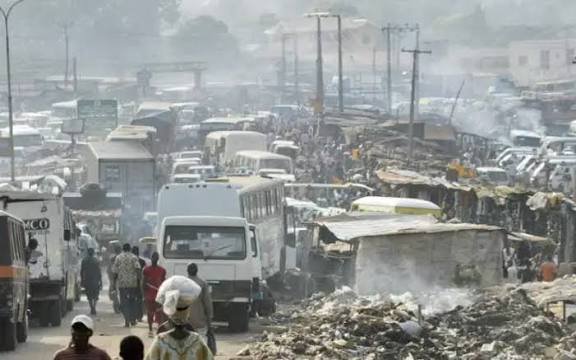
As Lagos continues to battle environmental challenges associated with its rapid urbanisation, residents across the state have raised concerns over its worsening air quality, largely attributed to indiscriminate waste burning, vehicular emissions, and poor sanitation practices.

They disclosed this in separate interviews with the  News Agency of Nigeria (NAN) on Sunday in Lagos.

NAN reports that from Ikorodu to Sasha, Oshodi to Alagbado among others, fumes from refuse fires, exhaust pipes and industrial discharges hang in the air, posing serious threats to public health and the environment.

Mrs Itunu Dada, a civil servant and resident of Ikorodu, told NAN that air pollution in her community is largely caused by refuse burning.

“Instead of patronising the PSP operators, many residents prefer to burn their waste.

“When you go outside, you see fumes of smoke from effluents. This causes cough and chest irritation. Around the markets, refuse dumped on the road median emits offensive odours. It’s appalling,” she said.

Dada called on the Lagos State Government to shut down markets with poor sanitation and strengthen its waste evacuation efforts.

“Those evacuating waste from the drainage leave them for weeks before removing them. When it rains, the waste washes back into the drains. This is not good.

“There should be a task force to monitor illegal dumping and burning of refuse within the metropolis,” she said.

In Sasha, a suburb in the Alimosho Local Government Area, Mrs Stella Lawrence, a teacher, said air pollution has become an everyday reality for residents.

“The huge population of Lagos contributes to it. Many commercial vehicles are not roadworthy and emit thick fumes.

“Generator use also adds to the problem. The government should ban unfit vehicles and ensure the PSPs remove refuse regularly to discourage waste burning. Providing regular electricity supply will also help to reduce generator fumes,” she added.

Similarly, Miss Chioma Ndukwe, a communications expert and resident of Okota, said air pollution has become severe in densely populated areas such as Oshodi.

“When you walk through Oshodi Market, you can hardly breathe; emissions from industries, waste burning, traffic fumes and poor sanitation combine to create a choking environment,” she said.

Ndukwe urged the government to provide public toilets, conduct regular vehicle emission checks and regulate industrial discharges.

“We need to take air pollution seriously. Everyone deserves to breathe clean air in Lagos,” Ndukwe said.

In Lekki, Mr Bruno Ajede, a businessman, acknowledged that while the area is relatively clean, pollution persists in crowded parts such as markets and Ajah.

“Car fumes are the main problem. Air pollution affects human health and can cause respiratory issues like asthma,” Ajede said.

Also, Mr Ajibola Ajayi, a marketer and resident of Alagbado, said the community suffers from huge vehicular pollution.

“Many vehicles here emit heavy smoke because there’s little or no regulation,” Ajayi said.

Reacting to the development, Mr Friday Oku, President, Association of Wastepickers of Lagos, said Nigeria’s continued dependence on fossil fuel is worsening both environmental and health hazards.

“There’s a lot of danger associated with fossil fuel use. It’s causing serious harm to the environment and to human health.

“That’s why we are working to promote renewable energy and find ways to mitigate air pollution in our society,” Oku said.

He, however, criticised what he described as inconsistent government policies that undermine emission reduction efforts, citing the recent ban on waste pickers using carts, known locally as “cart pushers,” as an example.

“When we are trying to cut emissions from fossil fuels, the government suddenly bans cart pushers without providing any sustainable alternative.

“How do you ban them and replace them with tricycles that cause even more pollution? It shows a lack of policy direction,” he said.

Oku added that while private and civil society groups are striving to reduce emissions through renewable energy and cleaner alternatives such as Compressed Natural Gas (CNG), government actions often contradict climate commitments.

“For us, we are against fossil fuel emissions from vehicles and markets. We must shift towards renewable energy and CNG. That’s the only way to reduce greenhouse gas emissions,” he emphasised.

He also stressed the need for behavioural change among Nigerians.

NAN reports that health experts opine that prolonged exposure to polluted air increases the risk of respiratory infections, heart disease and lung cancer.

However, the Lagos State Government, through the Ministry of the Environment and Water Resources, has reiterated its commitment to tackling air pollution through its Blue and Green Economy Initiative and Air Quality Monitoring Network.

The state has also deployed mobile sensors in strategic locations to measure pollution levels and enforce compliance among industries and transport operators.

NAN reports that residents and environmental advocates argue that until citizens stop burning waste and the government enforces environmental laws effectively, Lagos’ quest for clean air may remain elusive.

Continue Reading
Click to comment

Leave a Reply

Your email address will not be published. Required fields are marked *

News

New Petrol Import Permits May Reverse Nigeria’s Push for Domestic Refining and Increase Pressure on Foreign Reserve” — Energy Policy Group Tells President Tinubu

Published

on

An energy policy group has advised President Bola Ahmed Tinubu to reconsider the wider economic consequences of newly issued permits allowing marketers to import petrol into the country, warning that the move could undermine Nigeria’s efforts to strengthen domestic refining and stabilise the economy.

In a statement released on Sunday in Abuja, the Energy Transparency and Market Justice Initiative (ETMJI) said the approvals granted by the Nigerian Midstream and Downstream Petroleum Regulatory Authority (NMDPRA) could produce unintended consequences if not carefully managed.

The group’s president, Dr. Salako Kareem, said Nigeria was at a delicate moment in its energy transition and that policy choices made now would determine whether the country finally escapes its decades-long dependence on imported refined petroleum products.

Kareem said while the regulator’s responsibility to guarantee adequate fuel supply is understood, expanding import permissions at this stage could weaken the policy direction required to encourage local production and long-term sector stability.

“Our respectful appeal to President Bola Ahmed Tinubu is that decisions concerning petrol importation must be carefully weighed against their long-term economic consequences,” Kareem said.

“Nigeria has spent decades trying to overcome the paradox of being a major crude oil producer while relying heavily on imported refined products. Any policy action that appears to reopen the floodgates of importation may slow down the progress that has been made toward strengthening domestic refining capacity.”

He warned that increasing petrol imports could place additional pressure on the country’s foreign exchange reserves, especially at a time when the government is pursuing difficult economic reforms aimed at stabilising the naira and improving fiscal discipline.

“For many years, the country has lost enormous volumes of foreign exchange importing petroleum products that could ideally be refined locally,” Kareem said.

“If import volumes begin to rise again, the demand for foreign currency will inevitably grow. This could place renewed strain on the naira and undermine the broader economic stabilisation programme that the government is currently pursuing.”

The group also warned that excessive reliance on imported petrol could create opportunities for product dumping and the entry of substandard fuel into the Nigerian market, a challenge that has troubled regulators and consumers in the past.

According to Kareem, Nigeria’s downstream sector has historically struggled with quality control issues whenever importation becomes widespread, because imported fuel often travels through multiple intermediaries before reaching domestic depots.

“One of the lessons from the past is that when imports dominate the supply chain, the market sometimes becomes vulnerable to the dumping of inferior petroleum products,” he said.

“This not only creates regulatory complications but also exposes Nigerian consumers to fuels that may damage vehicles, affect industrial machinery and ultimately impose hidden economic costs on the country.”

He added that encouraging domestic refining and strengthening local supply chains would provide better product traceability and improve overall market transparency.

Kareem stressed that the group’s intervention was not intended as criticism of the NMDPRA, noting that regulators must often make complex decisions to prevent supply disruptions in a volatile energy market.

However, he urged the federal government to ensure that short-term supply management does not weaken long-term national objectives in the petroleum sector.

“We recognise that the regulator has the responsibility to ensure that Nigerians do not experience fuel shortages, and that duty is extremely important,” he said.

“But at the same time, policy coherence is essential. The country must avoid sending signals that could discourage investment in local refining or create uncertainty about Nigeria’s commitment to energy self-sufficiency.”

Kareem said Nigeria now has a rare opportunity to restructure its downstream petroleum industry in a way that strengthens domestic production, protects foreign exchange reserves and builds long-term industrial capacity.

He urged the president to ensure that the country’s regulatory framework reflects that strategic vision.

“Our appeal is simply for policy alignment. If Nigeria truly wants to build a resilient energy economy, then every major decision in the downstream sector must reinforce the goal of reducing import dependence, strengthening domestic production and protecting the country’s economic stability,” Kareem noted.

The group added that careful policy coordination between regulators and the presidency would help ensure that Nigeria avoids repeating the costly fuel import cycles that have historically drained public resources and weakened the national economy.

Continue Reading

News

OKL Launches Free Digital Skills Scholarships for 1,000 Lagos Central Youths, Pledges New Approach to Leadership

Published

on

Olumide Kola-Lawal (OKL), an aspirant for the Lagos Central Senatorial seat, has launched a major youth empowerment initiative that will provide free enrolment and 100 percent scholarships to 1,000 young people across the district for internationally relevant Information Technology and Vocational (ITV) courses.

The initiative was announced on March 11 during a Ramadan lecture themed “Ramadan and the Role of Youths in Building a Moral and United Society,” organized by the National Youth Council of Nigeria, Surulere branch, at the Senator Oluremi Tinubu Hall.

Speaking as the special guest of the event, Kola-Lawal used the platform to outline what he described as a new model of politics centered on opportunity creation, innovation, and people-driven solutions.

“My priority is connecting the grassroots to global opportunities for young people and entrepreneurs,” he said. “I remain confident that bold, people-centered ideas can still drive meaningful change.”
Building Pathways from Lagos to the Global Economy

The scholarship scheme, which represents the first phase of a broader youth development strategy, will train participants in high-demand digital skills in partnership with the London Til Career Institute, an international career and professional development institution focused on career acceleration, innovation, and smart school technology.

Participants will receive training and certification in areas such as:

  • Software development
  • UI/UX design
  • Data analysis
  • Cybersecurity
  • Digital marketing
  • Photo and media editing

The program is designed not only to equip young people with employable skills but also to create sustainable income opportunities and foster entrepreneurship within Lagos Central.

A Different Kind of Political Vision
Kola-Lawal, a globally exposed professional, emphasized that his approach to public service will focus on leveraging international networks and private-sector partnerships to create real economic pathways for constituents.

According to him, the initiative reflects a belief that leadership must move beyond campaign promises to deliver practical, scalable solutions for youth employment and innovation.

By equipping young residents with globally relevant digital skills, he said the program could produce a multiplier effect across the local economy, increasing earnings potential and supporting new business creation throughout Lagos State.

Youth at the Center of Development
Addressing the audience of young participants and community leaders, Kola-Lawal noted that the future of Lagos depends heavily on empowering its youth population with the right tools for the modern economy.

He said the scholarship initiative is intended to bridge the opportunity gap between local talent and global digital markets, positioning Lagos Central as a hub of innovation and entrepreneurial activity.

For many attendees at the event, the announcement signaled what supporters describe as a forward-looking and solutions-driven style of leadership—one that blends global exposure with grassroots engagement.

As the political landscape ahead of the next electoral cycle begins to take shape, Kola-Lawal’s initiative is likely to resonate with a growing constituency of young voters seeking practical opportunities rather than traditional political rhetoric.

Continue Reading

News

Life Is A Warfare Not Funfare – Komaiya

Published

on

The presiding pastor of Masters Place International, Pastor Korede Komaiya, has said “Life is warfare never funfare”.

Komaiya made the assertion in a recently released and shared video message.

He said “Never be surprised that you have battles, the greater your destiny, the greater your battles”.

According to the revered cleric, “A life without battles is a dead life, your battles shows your importance, glory and it indicate your greatness”.

He explained that, Small destiny attracts small battles while the greater the battle, the greater glory and “things are manipulated from the spirit realm to happen physically”.

Stressing and emphasising that, “if you joke with your destiny, you will end up a joke”.

Using this a backdrop about his own transformation, stages in life and fulfilling destiny, Komaiya concluded “No one can fulfill their destiny in a grand style without the annointing”.

Continue Reading

Trending

Copyright © 2023 - 2025 DailyMirror Nigeria. Design by AspireWeb.ng, powered by WordPress.