News
Common citizens now feeling impacts of President Tinubu’s economic policies, says Group
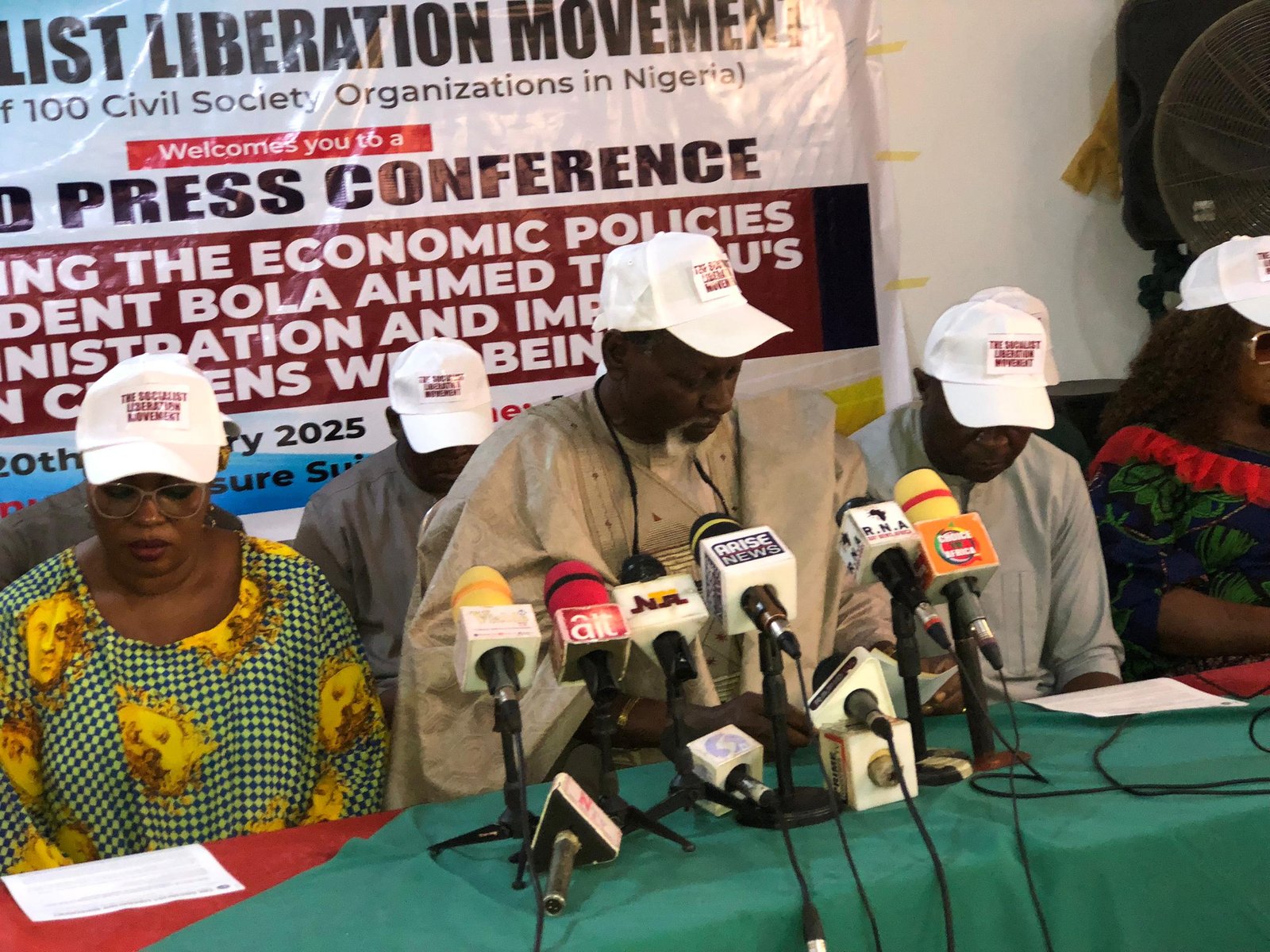
The Socialist Liberation Movement (SLM), a coalition of 100 civil society organizations, has said Nigerian citizens are now feeling the impacts of President Bola Tinubu administration’s economic policies and plans for Nigeria.
At a press conference on Monday in Abuja, the movement’s convener, Dr. Agabi Emmanuel, acknowledged the administration’s efforts to address the country’s economic challenges.
Significantly, the movement noted that common citizens are beginning to feel the impact of these policies snd projects across the country.
According to Dr. Emmanuel, President Tinubu’s policies, such as removing fuel subsidies and floating the currency, have shown promise in restoring confidence in Nigeria’s economy.
The movement also praised the establishment of the Presidential Economic Coordination Council (PECC) and the Economic Management Team Emergency Taskforce (EET) which aim to enhance Nigeria’s economic governance frameworks.
Emmanuel also praised the administration’s commitment to upgrading Nigeria’s infrastructure, particularly in roads, railways, and energy projects.
The movement noted that these investments, made through public-private partnerships, are expected to reduce transportation costs and improve market access.
Furthermore, Emmanuel acknowledged the administration’s focus on digital economy expansion, broadband penetration, and tech startup growth through initiatives like the Digital Nigeria program.
The movement believes that these efforts will drive innovation, enhance financial inclusion, and create jobs.
The Socialist Liberation Movement also hailed the administration’s efforts to transform Nigeria’s agricultural sector, prioritizing food security and economic growth.
The movement noted that initiatives like the Food Security and Agricultural Mechanization Programme and the National Agriculture Growth Scheme-Agro-pocket have the potential to enhance food production and reduce import reliance.
“After an extensive scrutiny of some of the policies introduced by the present administration, It was observed that President Bola Tinubu has taken steps to restore confidence in the economy by reducing inflation, stabilizing the foreign exchange market, and improving fiscal management,” the statement added.
“He has also invested in infrastructure development, such as roads, railways, and energy projects, to support economic growth,”the statement said.
“President Bola Tinubu’s administration is prioritizing the digital economy, driving innovation and financial inclusion through initiatives like the Digital Nigeria program. This flagship program aims to enhance digital literacy, employability, and economic growth, while boosting GDP, entrepreneurship, and job creation.
“By investing in digital technology, empowering small businesses, and creating opportunities across sectors, President Tinubu seeks to leverage digital transformation to reduce poverty and improve living standards.
“With commitments to training three million youths in digital technology and creating one million new tech jobs, the administration is poised to unlock Nigeria’s digital potential and drive sustainable economic growth.
“The Bola Tinubu administration has implemented transformative initiatives to boost Nigeria’s agricultural sector, prioritizing food security and economic growth. Notably, the Food Security and Agricultural Mechanization Programme aims to enhance food production and reduce import reliance.
“Additionally, the National Agriculture Growth Scheme-Agro-pocket provides training, certified inputs, and subsidized irrigation equipment to millions of farmers, increasing productivity and incomes.
“President Tinubu’s declaration of a state of emergency in the agriculture sector underscores the administration’s commitment to addressing sectoral challenges, while initiatives like the Green Imperative Programme and partnerships with international organizations further demonstrate the government’s dedication to transforming Nigeria’s agricultural landscape.
“President Bola Tinubu’s administration has introduced transformative policies to revitalize Nigeria’s health sector, demonstrating a commitment to improving healthcare outcomes and increasing access to quality services.
“Key initiatives include the Health Sector Renewal Investment Initiative, which has mobilized $2.2 billion in external financing, and the redesigned Basic Health Care Provision Fund (BHCPF) to enhance access to essential healthcare services.
“Additionally, the National Health Insurance Authority Act (NHIAA) aims to achieve Universal Health Coverage (UHC) by mandating health insurance for all Nigerians, while programs like the National Health Fellows Programme and prioritized domestic health financing further underscore the administration’s dedication to strengthening Nigeria’s healthcare system.
“In the educational sector, President Bola Tinubu has introduced several education policies aimed at transforming Nigeria’s education sector. One notable initiative is the “#WeAreEqual” campaign, which promotes inclusive education, skill development, and gender equity.
“The government has also approved four new education policies, including the creation of a data repository, out-of-school children education, teacher training and development, and skill development and acquisition.
“Additionally, President Tinubu has launched the Student’s Loan scheme to ensure that every eligible child gets quality higher education in Nigeria with the overarching objective to improve education outcomes, increase access to quality education, and promoting gender equity in the education sector.
“President Bola Tinubu’s budget policy prioritizes national defense and internal security, job creation, macro-economic stability, investment environment optimization, human capital development, poverty reduction, and social security. Key initiatives include overhauling the internal security architecture, and promoting public-private partnerships to leverage private capital for infrastructure projects.
“In our considered opinion, President Bola Tinubu has embarked on a promising trajectory towards translating our hopes and aspirations into tangible realities, demonstrating a commitment to transformative governance and economic development.
“By implementing bold economic reforms, investing in critical sectors, and prioritizing the welfare and prosperity of citizens, the administration has shown determination to create a better Nigeria for this generation and the generation unborn.“
The Socialist Liberation Movement, therefore, urged well-meaning Nigerians to lend their support to the administration’s efforts, acknowledging the challenges and criticisms while maintaining a constructive dialogue.

Cover
Official waste of government resources and national wealth, group slams NNPCL GMD over MOU with Chinese firm to revive dead refineries
…demands accountability into past investment of $3.5b for PHC, Warri and Kaduna refineries
A coalition of oil sector reform advocates has criticised the latest agreement by the Nigerian National Petroleum Company (NNPC) Limited with Chinese firms to revive Nigeria’s refineries, describing the move as a wasteful recycling of failed strategies and a troubling signal of weak accountability in the management of public resources.
The group, the Centre for Energy Sector Transparency (CEST), made its position known in a statement issued on Wednesday and signed by its executive director, Dr Oghenetega Edafe, following the announcement of a new memorandum of understanding between NNPC Ltd and two Chinese companies for a proposed technical equity partnership.
The agreement is aimed at completing rehabilitation work and restarting operations at the Port Harcourt and Warri refineries, assets that have remained largely dormant despite multiple rounds of government-funded turnaround maintenance.
Edafe said the development raises serious questions about fiscal discipline, policy coherence, and the absence of accountability for previous investments running into billions of dollars.
“What Nigerians are witnessing is a troubling pattern of policy repetition without reflection. The same refineries that have gulped enormous public funds over the years are once again at the centre of a fresh round of agreements, yet there has been no transparent accounting of what has already been spent or why those investments failed to deliver results,” he said.
The group specifically referenced earlier government approvals of over $1 billion for refinery rehabilitation projects, warning that proceeding with new partnerships without a public audit of past expenditures undermines trust in the system.
“It is unacceptable that after committing over one billion dollars to refinery rehabilitation, the nation is being asked to embrace yet another agreement without a clear and verifiable audit of previous interventions. This is not just about policy failure; it is about the potential erosion of public trust in how national wealth is managed,” Edafe said.
He argued that while the introduction of a technical equity model may appear innovative, it does not absolve the government and NNPC Ltd of responsibility for past inefficiencies and possible mismanagement.
“The idea of bringing in technical partners with equity stakes is not inherently flawed. However, it becomes deeply problematic when it is introduced as a substitute for accountability. Before we speak of new partnerships, Nigerians deserve a full disclosure of how past funds were utilised, who was responsible for project delivery, and why the expected outcomes were not achieved,” he said.
The group also warned that without institutional reforms, the proposed collaboration risks becoming another cycle of investment without sustainable results.
“What is being presented as a strategic shift may, in reality, become another expensive experiment if the underlying governance issues are not addressed. Technical expertise alone cannot fix a system that lacks transparency, oversight, and consequences for failure,” Edafe said.
The Centre called on the National Assembly and relevant anti-corruption agencies to initiate a comprehensive probe of refinery rehabilitation projects over the past decade, including contract awards, disbursements, and project execution timelines.
“This moment demands more than optimism; it demands scrutiny. We call on oversight institutions like the National Assembly, Economic and Financial Crimes Commission (EFCC) and others to undertake a forensic examination of all funds committed to refinery rehabilitation, including the recent billion-dollar interventions. Nigerians must know what has been done with their resources and why the country is still dependent on fuel imports despite repeated promises of self-sufficiency,” he said.
The Centre added that restoring confidence in Nigeria’s oil sector would require not just new agreements, but a demonstrable commitment to transparency, accountability, and institutional integrity.
News
Court Adjourns El-Rufai’s Bail Application To June
Justice Darius Khobo of the Kaduna State High Court has adjourned the bail hearing of former Kaduna State governor Nasir El-Rufai to the first week of June, 2026.
El-Rufai is being arraigned on multiple charges bordering on alleged financial crime and abuse of office by the Independent Corrupt Practices and Other Related Offences Commission (ICPC).
“Similarly, another charge, number KDH/KAD/ICPC/01/26, against Malam Nasir El-Rufa’i and one Amadu Sule (LEDA) has also been filed before a Kaduna State High Court in the Kaduna Judicial Division,” the ICPC said last month.
“The charges in the State High Court case range from abuse of office, fraud, and intent to commit fraud to conferring undue advantage, among others. Both charges were filed by the ICPC on the 18th of March, 2026.”
Speaking after the court session, counsel to the former governor, Ukpon Akpan, kicked against the lingering adjournment of the bail hearing by one presiding judge as politically motivated.
The high-profile case has drawn significant public attention, with heightened security presence observed around the court premises.
The former governor had arrived at the court at about 9 am in a convoy accompanied by ICPC officials and operatives of the Department of State Services (DSS).
During the proceedings, supporters of the former governor gathered outside the courtroom, while security agencies maintained order and restricted movement within the vicinity.
Inside the courtroom, journalists, as usual, were not allowed, as proceedings are expected to focus on arguments presented by both the defence and prosecution regarding the bail request.
At the last sitting, the defence team had maintained that their client poses no flight risk and is willing to comply with all conditions set by the court.
Meanwhile, the prosecution has urged the court to carefully consider the gravity of the charges.
The 66-year-old former governor of Kaduna has been in ICPC custody since February 19 following his release by the Economic and Financial Crimes Commission (EFCC).
El-Rufai, a former minister of the FCT, was, however, released on March 27 based on compassionate grounds following his mother’s death.
News
Gunmen Kidnap 15 Boat Passengers In Cross River
Gunmen have abducted 15 boat passengers in Cross River. They were whisked away during a pirate attack on a ferry along the Calabar-Oron waterways.
The spokesman of Police Zone 6 Command, Jefferson Osupe, said the victims were abducted on April 16, 2026. The kidnapped persons were aboard a boat going from Calabar, the Cross River capital, to Oron in Akwa Ibom State.
Following the incident, the Assistant Inspector-General of Police in charge of Zone 6 Command, Calabar, Auwal Mohammed, ordered an “immediate and sustained joint security operation”.
The AIG has mandated the Commissioners of Police in Cross River State, Rashid Afegbua, and Akwa Ibom State, Baba Azare, “to immediately activate a robust, intelligence-driven, and coordinated interstate security framework aimed at the swift rescue of the victims and the apprehension of all perpetrators.”
“The directive emphasises seamless collaboration between both state commands, in synergy with the Nigerian Navy and other relevant security agencies, to dominate the waterways, dismantle criminal networks, and restore confidence in maritime safety across the zone,” the statement read in part.
Mohammed charged them to set aside all jurisdictional limitations and operational boundaries and to deploy all available tactical and intelligence assets to achieve this mission.
He said the rescue of the abductees remains an operational priority and warned that the command will pursue the perpetrators relentlessly until justice is served.
While condemning the attack, Mohammed reassured residents and maritime operators in both states that the Nigeria Police Force under Zone 6 remains resolute, proactive, and fully committed to safeguarding lives and property.
He urged the public to remain calm and law-abiding and report any suspicious activities, particularly along coastal and riverine communities.
“Furthermore, the Zone 6 Headquarters reiterated its commitment to transparency and timely communication as operations progress, in order to sustain public trust and mitigate undue tension,” he said.
“The Zone assures that there will be no safe haven for criminals within Zone 6.”
-
Cover8 months agoNRC to reposition train services nationwide.. Kayode Opeifa
-
Fashion9 years agoThese ’90s fashion trends are making a comeback in 2017
-
Entertainment9 years agoThe final 6 ‘Game of Thrones’ episodes might feel like a full season
-
Opinion1 year agoBureaucratic Soldier, Kana Ibrahim heads Ministry of Aviation and Aerospace After Transformative Tenure at Defence
-
Politics1 month agoNNPP Diaspora Stakeholder and Key Kwankwaso Ally, Dr. Usman Tijjani Shehu, Rejoins APC
-
Opinion1 year agoHon. Daniel Amos Shatters Records, Surpasses Predecessor’s Achievements in Just Two Years
-
Opinion5 months agoBarrister Somayina Chigbue, Esq: A rising legal leader shaping institutioal excellence in Nigeria
-
News9 months agoNigerian Nafisa defeats 69 Countries at UK Global Final English Competition