Connect with us

Cover

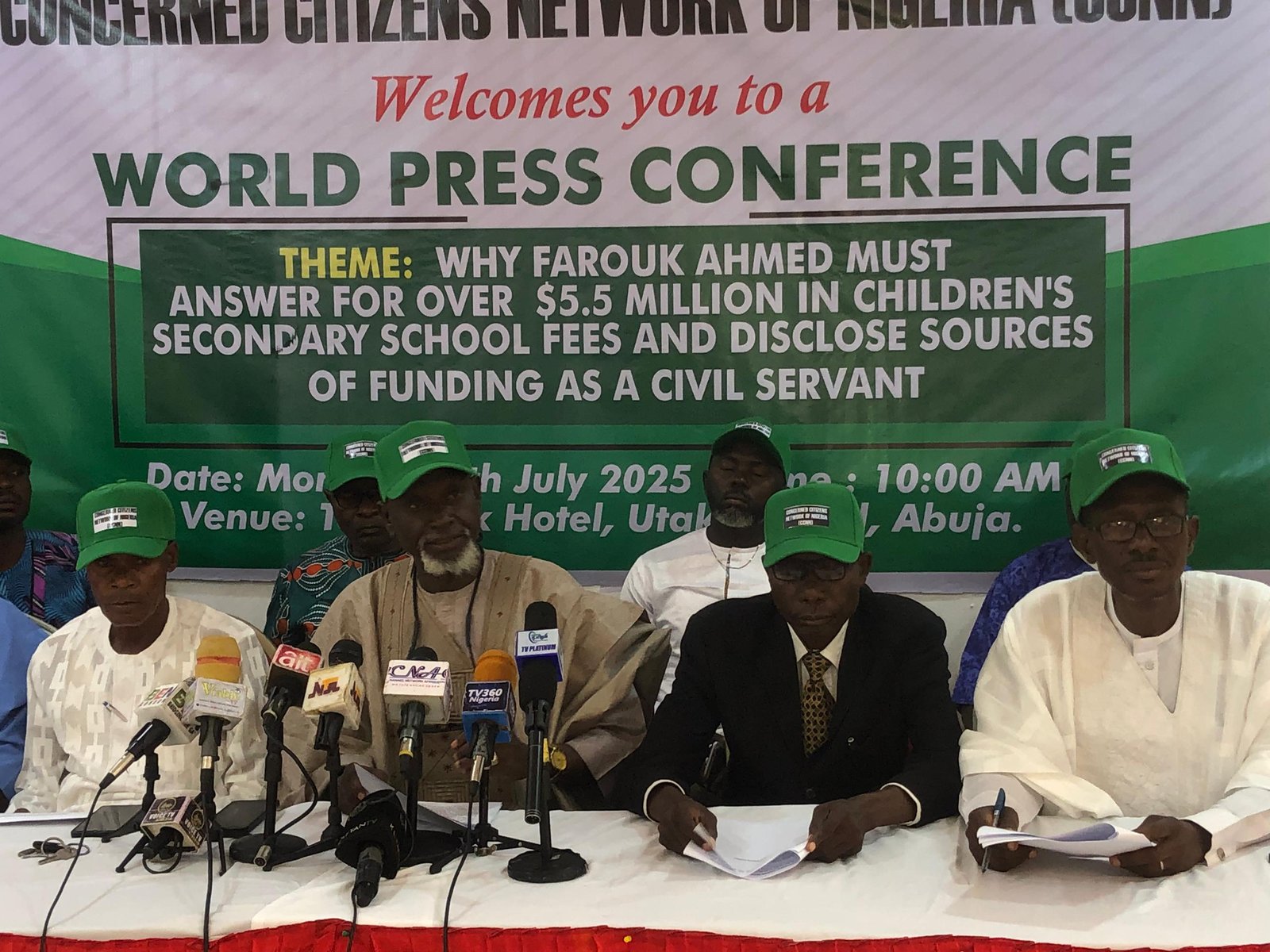
Group slams NMDPRA Boss Farouk’s Diversionary Newspapers Ads On $5.5 Million In Children’s Tuition Fees

Published

on

*charges relevant agencies to open immediate investigation.

The Concerned Citizens Network of Nigeria (CCNN) has slammed Engineer Farouk Ahmed, Chief Executive of the Nigerian Midstream and Downstream Petroleum Regulatory Authority (NMDPRA), for his full-page newspaper advertisements published on July 11, 2025, as a “disgraceful charade” and “diversionary” designed to dodge accountability.

The group said the ads, appearing on page 12 of Thisday, page 17 of The Guardian, page 15 of Vanguard, page 3 of BusinessDay, and page 19 of Daily Trust, were unsigned and devoid of substance, failing to address explosive allegations that Ahmed spent over $5.5 million (approximately N8.25 billion) on his children’s secondary education abroad.

In a fiery press conference on Monday in Abuja, the CCNN, led by Dr. Emmanuel Agibi, demanded an immediate investigation, accusing Ahmed of insulting Nigerians’ intelligence with his evasive tactics.

The CCNN highlighted that Ahmed’s children—Faisal Farouk attended the Montreux school, Farouk Jr attended the Aiglon college, Ashraf Farouk attended the Institut Le Rosey while Farhana Farouk attended the La Garenne International School for six years each.

With annual tuition and upkeep exceeding $200,000 per school, the total cost for the four children is estimated at $5 million, or roughly $1.2 million per child over six years.

“The cost per child included annual tuition fees of approximately $130,000–$150,000 and an additional $50,000 for upkeep, flights, and other expenses. For each child, this amounts to roughly $180,000–$200,000 annually, or $1,080,000–$1,200,000 over six years,” the statement said.

“For four children, the total expenditure ranges from $4,320,000–$4,800,000. Even now, questions remain unanswered about the tertiary education of Ahmed’s children. Having completed their secondary education, Faisal, Farouk Jr., Ashraf, and Farhana are enrolled in prestigious universities abroad, where annual costs often exceed $70,000–$100,000 per student.

“Further compounding public outrage, Engr. Farouk Ahmed’s son recently graduated from Harvard University, where tuition and associated costs exceeded $152,000, with additional expenses in the range of $100,000. This extravagant expenditure, far beyond the gross earnings of a civil servant of his calibre, places an immense burden on Nigeria’s poor taxpayers, many of whom struggle to afford three meals a day or school uniforms for their children, particularly in the northern regions.

“Notably, Ahmed has never held employment outside his role with the Federal Government since leaving school, raising further questions about the source of his wealth. The opulence displayed in funding such elite education underscores a stark disconnect between Ahmed’s lifestyle and the economic realities faced by ordinary Nigerians.”

The group urged the Code of Conduct Bureau (CCB), Independent Corrupt Practices Commission (ICPC), and Economic and Financial Crimes Commission (EFCC) to investigate how a civil servant’s salary could fund such lavish expenditure.

“In a nation where over 10 million children, particularly in the north, lack access to basic education, this lavish spending by a public servant is not merely a matter of personal choice—it is a moral outrage,” the statement added.

“While countless Nigerian families struggle to afford primary schooling, Ahmed’s children attended secondary institutions costing more per term than the annual budgets of some federal colleges. This stark inequality represents an injustice that cannot be ignored.

“The absence of transparency regarding how these ongoing expenses are funded further fuels public suspicion. If Ahmed’s wealth can support such elite secondary and tertiary education, the public deserves to know the legitimate sources of these funds, especially given his role as a public servant accountable to Nigerian taxpayers.

“The CCNN’s allegations are grounded in rigorous evidence, stemming from a petition to the Attorney-General of the Federation after weeks of verification, fact-finding, and public record reviews.We question how a public official, whose salary is known and whose assets must be constitutionally declared, could finance such an extraordinary level of overseas education without a visible commercial empire or disclosed inheritance.

“The petition raises serious concerns about potential abuse of office, asset concealment, or diversion of public funds under Ahmed’s leadership at NMDPRA. Public response has been resolute, with peaceful protests by lawyers, students, and civic groups targeting the Attorney-General’s office, ICPC, EFCC, National Assembly, and NMDPRA headquarters. These demonstrations, supported by formal letters and placards, demanded a transparent investigation.

“The NMDPRA’s attempt to dismiss these voices as ‘faceless’ is a cynical effort to undermine lawful civic engagement, further eroding public trust. The NMDPRA’s statement conspicuously avoided addressing key issues: it did not deny the children’s attendance at the listed secondary schools, nor did it provide any breakdown of how tuition was funded.

“It offered no details on asset declarations, loans, business income, family inheritance, or blind trusts, relying instead on vague appeals to Ahmed’s ‘reputation’ and ‘integrity.’ In a democracy, such claims are insufficient when a public servant’s lifestyle appears misaligned with their declared income. The burden of proof rests with Ahmed, not the public.

“The CCB, ICPC, and EFCC have constitutional mandates to investigate cases of unexplained wealth, ensuring that public officials are held accountable. This case tests the credibility of President Bola Tinubu’s anti-corruption and transparency agenda. The CCNN is not calling for Ahmed’s immediate removal but for an open, independent investigation. If he is innocent, a transparent process will vindicate him.

“However, continued silence risks tarnishing both his reputation and the government’s reform efforts. Ignoring these allegations would be a grave miscalculation. The CCNN is submitting additional letters, pursuing legal action, and mobilising further protests to ensure accountability. Civic vigilance is not a nuisance—it is the cornerstone of a functioning democracy.

“Engr. Farouk Ahmed must step forward, disclose his funding sources, and submit to a full inquiry. This is not persecution—it is the price of public trust. The CCB, ICPC, and EFCC must act swiftly to investigate these allegations, ensuring that justice and transparency prevail.”

Continue Reading
Click to comment

Leave a Reply

Your email address will not be published. Required fields are marked *

Cover

Brazil Beat Haiti 3-0, Boost Knockout Hopes

Published

on

Brazil strengthened their chances of advancing to the knockout stage of the World Cup with a commanding 3-0 victory over Haiti today. The South Americans delivered a disciplined performance, combining attacking flair with defensive solidity to secure three crucial points.

From the opening whistle, Brazil imposed themselves on the match. Their midfield trio dictated tempo, recycling possession and stretching Haiti’s defensive lines. Within the first 15 minutes, Brazil’s pressure paid off when striker Gabriel Silva converted a low cross from the right flank, giving his side an early lead.

Despite conceding early, Haiti showed resilience. They tightened their defensive shape and attempted to hit Brazil on the counterattack. Winger Jean-Pierre Louis tested Brazil’s goalkeeper with a sharp effort from distance, but the shot was comfortably saved. Haiti’s determination kept the scoreline respectable through much of the first half.

Brazil doubled their advantage just before halftime. Midfielder Lucas Andrade unleashed a curling shot from outside the box, leaving Haiti’s goalkeeper rooted to the spot. The strike highlighted Brazil’s technical superiority and gave them a cushion heading into the break.

In the second half, Brazil maintained control. Their passing sequences frustrated Haiti, who struggled to regain possession. Brazil’s third goal came in the 70th minute when substitute forward Rafael Costa capitalized on a defensive lapse, slotting the ball calmly into the net. The goal sealed the contest and allowed Brazil to manage the closing stages with confidence.

Brazil’s coach emphasized balance, ensuring the team did not overcommit forward. The defensive line remained compact, neutralizing Haiti’s attempts to break through. This tactical discipline prevented Haiti from creating clear chances and underscored Brazil’s maturity in tournament play.

Although Haiti failed to score, their effort was commendable. The team fought hard, pressing when possible and showing flashes of creativity. However, the gulf in quality was evident, particularly in midfield battles where Brazil consistently regained control.

The victory places Brazil in a strong position in their group. With six points from two matches, they are now favorites to progress to the knockout stage. The team’s blend of youth and experience appears to be clicking at the right time, raising hopes among supporters for a deep run in the tournament.

Brazil will face a tougher test in their next fixture against a European opponent. The team must maintain focus and continue refining their attacking transitions. For Haiti, the defeat complicates their path forward, but they remain mathematically alive. Their next match will be decisive in determining whether they can keep their World Cup dream aliv


Continue Reading

Cover

Bosnia Crushed By A Merciless Switzerland Machine

Published

on

Switzerland were in imperious form today as they blew Bosnia away in the group stage game of the World Cup in what was a dominant and uncompromising offensive masterclass from the Swiss. Switzerland played at a frightening speed, executed a crisp passing game and proved ruthlessly efficient in front of goal.

Switzerland began in the ascendancy and looked eager to press and control the game from the start, and after only two minutes had Bosnia backed into a corner of their own half.

They kept the ball well and at speed, and the Swiss looked eager to push the Bosnia defence wider as the game started. Within the first 15 minutes, Switzerland had already tested the Bosnian goalkeeper with two powerful shots.

The breakthrough came after halftime. With an attack moving quickly, the Bosnian back line is open, leaving the Swiss attacker in a clear scoring position.

The ball slides calmly to the net to give the Swiss a much-deserved lead. It was a game where Bosnia was struggling deep in their own territory as they were being pushed to the limit.

A counterattack was their goal, but it fell flat as they tried to do something but couldn’t get it right. They’ve isolated their forwards, and the midfield has failed to connect up the game. A long-range shot was their closest call, but the Swiss goalie wasn’t going to do it then and there.

Their inability to generate consistent pressure against Switzerland made them play from a defensive mindset. The double-goal advantage came just before the half as Switzerland was in top-notch form with another incisive approach that will make all opponents fear them.

With a pass from the left, their winger managed to score an ideal goal and also showing that any of their forwards are available to find the open space and punish you against defensive error.

The Swiss reached the break, well deserved of it, and mentally depleted from the opponent as Bosnia’s score reached 0 goals for their team. The Swiss were ready to continue this show.

They played like nothing was about to change and continued with their forward aggression. Switzerland’s offense began to work relentlessly, generating forced errors and, consequently, chances to create another goal for them.

Three goal came via another header, which smashed Bosnia’s defence to send the ball home. After Bosnia had their fourth goal scored against them, the game became so one sided as the Swiss were simply walking through the Bosnian team’s defence without issue. Bosnia seemed unable to match their opponents for any level of performance.

After the game reached its conclusion and Switzerland was victorious, the Swiss have many good performers to recognize. The team’s captain was influential as he seemed to control the whole pitch from his central midfield role. He was vocal, directed plays, and seemed to pump his teammates up with great performance throughout. For the Bosnia team, the keeper may be recognized. Although there may have been many goals scored against his team he seemed to be playing very well to be stopping every other chance by a Swiss attacking team.

They played from a back foot throughout the game as if all their play was being played as if it were defense but when a chance to attack came, they failed. The Swiss may well deserve the win as they showed a complete game.

The Swiss coach was at his best on the sidelines as he made the appropriate personnel changes and substitutions throughout the game that help Switzerland find success and continue their winning ways in the tournament. The group implications seem fairly obvious. Switzerland have improved their standings and appear to be in a strong position to qualify from their group.

Bosnia’s hopes look a lot less favorable and they really have to pick it up. Overall it seems Switzerland dominated Bosnia and a 4–0 defeat was entirely deserved from the Bosnian team.

Switzerland came ready for this game and put it on display through skillful passing, a powerful forward attack, and some incredible play on both ends of the pitch and as their Coach did in the press conference, this was a statement.

Continue Reading

Cover

Judicial Battle Reboots Kwara ADC’s 2027 Election Machinery

Published

on

The Kwara State chapter of the African Democratic Congress (ADC) has converted a recent legal threat into a political launchpad. Following an appellate court victory that halted an attempt to deregister the party, the Kwara ADC has declared its full readiness to contest the 2027 general elections.

A Federal High Court judgment by Justice Peter Lifu originally ordered the Independent National Electoral Commission (INEC) to deregister the ADC along with four other opposition parties.

The decision was met with an outcry by opposition coalition who alleged the judicial action was another manipulative scheme to cripple opposition politics in the nation and give an unearned leap to ruling parties for the 2027 election cycle.

The “threat however, disappeared into thin air as the Court of Appeal in Abuja swung into action and delivered a strong rebuff on the lower court. A stay of execution of the deregistration order was issued by the Court of Appeal.

Experts and political leaders in opposition said the lower court’s ruling had contravened judicial hierarchy as courts above had already issued a stay of proceedings. It has returned to status quo, following the successful legal defence as the Kwara State chapter of the ADC has called an emergency State Executive Committee meeting at its State Secretariat, Ilorin.

Party stakeholders have already turned the page from the legal battle to an intensive grassroots mobilisation as party structures have been instructed to get set for the next election cycle.

“This issue, while appearing like a setback, has only united us more than before,” said the Kwara State Chairman of ADC, Babatunde Muhammed, who assured that “

The Court of Appeal intervention in our case has revived my confidence in the country’s judicial system, and that you cannot simply rubbish an existing political movement because you have access to some judges.

We remain unruffled” he added. Consequently, all ADC Candidates and ward executives in Kwara State have been tasked to commence voter outreach immediately with a unit-by-unit grassroots mobilisation plan that aims to put the current ruling party on the defensive by articulating how the ADC platform and agenda contrast with the performance of the incumbent administration.

The new approach of Kwara ADC will focus primarily on local security issues, fiscal and economic management and ensuring a free and fair electoral system in 2027 election.

Continue Reading

Trending

Copyright © 2023 - 2025 DailyMirror Nigeria. Design by AspireWeb.ng, powered by WordPress.