Connect with us

Cover

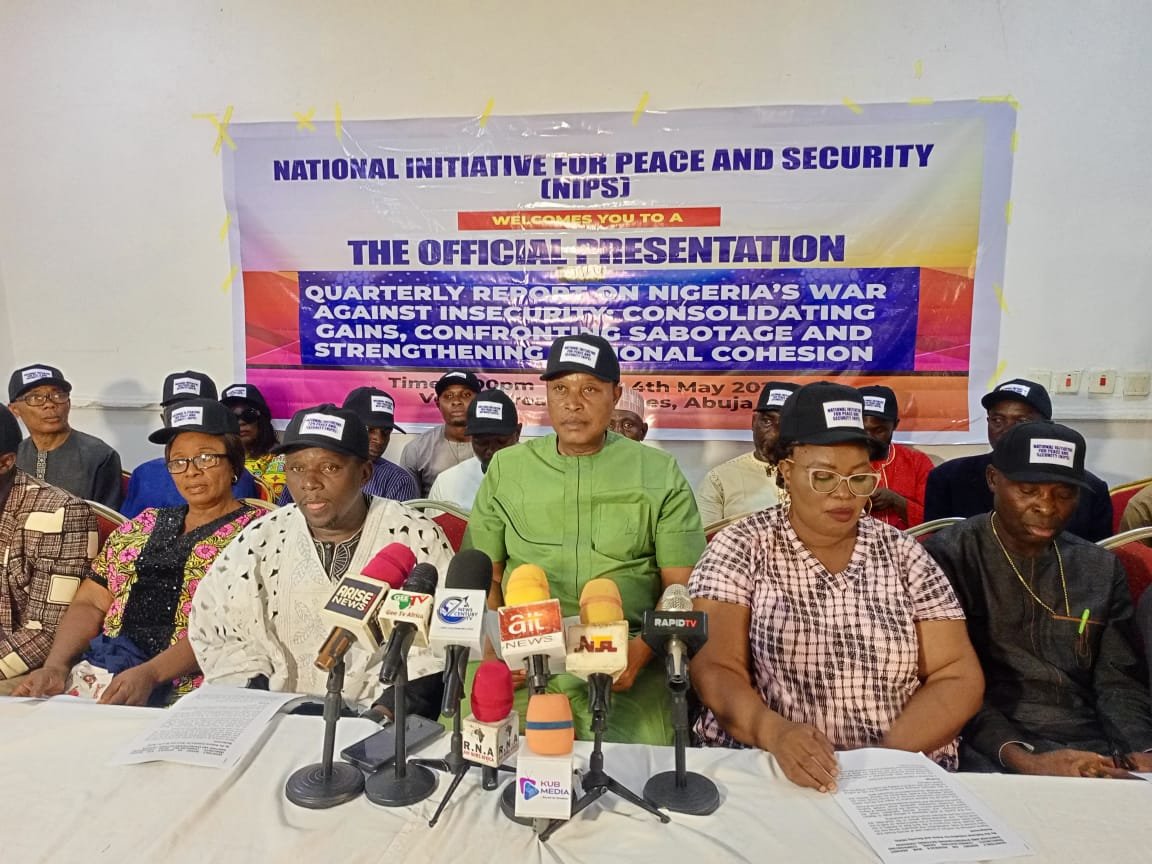
NIPS Lauds regional gains in armed forces operations against insecurity

Published

on

*decries politicisation of military efforts for selfish reasons

The National Initiative for Peace and Security (NIPS) has commended the Armed Forces of Nigeria for significant operational successes recorded across multiple theatres in the first quarter of 2026.

Under the leadership of General Olufemi Oluyede, the group led by Dr Adams Kings, its Executive Director said the military intensified coordinated operations, resulting in the neutralisation of over 200 terrorists, the arrest of nearly 300 suspects, and the rescue of approximately 188 kidnapped civilians in April alone.

In its quarterly report on the war against insecurity, the NIPS noted that these gains were spread across the North-East, North-West, North-Central, South-South, and South-East regions, reflecting improved logistical capacity, better inter-service coordination, and a strategic shift from mere firefights to dismantling the support ecosystems of criminal networks.

NIPS described the period as a defining phase in Nigeria’s counter-insurgency and internal security efforts.

“The Armed Forces have demonstrated a significant increase in operational tempo across the country. These outcomes reflect a more aggressive and coordinated approach that targets both the combat and support structures of criminal networks,” the NIPS report stated.

NIPS further noted that operations were not limited to one region but executed nationwide, indicating enhanced strategic planning.

“In the North-East, sustained offensives have continued to degrade insurgent strongholds with the killing of over 130 terrorists. Similar disruptions were recorded in the North-West through bandit neutralisation and victim rescues,” it added.

The report highlighted a deeper strategic focus on systemic disruption, including the destruction of camps, illegal arms production facilities, and logistics networks.

This approach, the group said, aims at long-term degradation of criminal groups’ regeneration capacity in asymmetric warfare.

“Rescues of women, children, farmers, and other civilians have restored dignity to affected communities and reinforced public trust in state institutions,” the report added.

“Operations also adhered to rules of engagement and international humanitarian standards, helping to maintain legitimacy.

“While democratic systems thrive on debate and dissent, NIPS notes with concern that certain political actors have adopted narratives that undermine the morale of security forces and distort public perception of ongoing efforts,” the organisation said.

“Some elements within the political space have engaged in conduct that inadvertently strengthens the propaganda of terrorist and criminal groups.

“This includes dismissing verifiable military gains, amplifying fear without context, and framing national security challenges solely as tools for political contestation,” NIPS added.

Such politicisation of security efforts poses serious risks, as intelligence assessments sometimes link these narratives to boosted confidence among criminal elements.

NIPS stressed that when national security becomes a casualty of political rivalry, ordinary citizens and frontline personnel bear the brunt.

Despite the gains, the NIPS said challenges persist as criminal groups adapt to difficult terrains and exploit local grievances.

The group, therefore, recommended sustained offensive operations to maintain momentum, deeper investment in intelligence networks, and stronger civil-military relations.

It also called for prioritised funding and timely release of resources to the Armed Forces to ensure operational continuity.

“National security should not be trivialised or weaponised for political gain. All actors must recognise that their words carry consequences beyond political advantage,” the report emphasised.

NIPS urged political leaders to exercise restraint and responsibility in public statements while calling for enhanced socio-economic interventions to address root causes of instability.

Abel Kings further advocated for a unified national narrative that promotes collective responsibility and resilience against extremist propaganda.

The organisation concluded that the first quarter of 2026 shows Nigeria’s security forces growing more effective under General Olufemi Oluyede’s leadership.

However, it warned that military successes must be supported by national cohesion rather than undermined by internal sabotage.

Continue Reading
Click to comment

Leave a Reply

Your email address will not be published. Required fields are marked *

Branded Content

Senator George Akume and the Test of Party Democracy in Benue

Published

on

Senator George Akume, CON, represents a rare breed of Nigerian politician. In a political culture often characterised by impatience, self-interest, and inconsistency, he has distinguished himself through patience, loyalty, and an enduring commitment to teamwork.

I have worked closely with him and witnessed his steady rise since 1999, when he became Governor of Benue State. From there, he went on to serve as Senator, Minister of the Federal Republic, and now Secretary to the Government of the Federation (SGF). His trajectory has been defined not by haste, but by discipline and a remarkable ability to work within the system.

These qualities have been severely tested in recent times, particularly in his relationship with Governor Hyacinth Alia. Governor Alia entered the political arena with significant backing despite having limited political experience, modest resources, and no established structure to contend with seasoned figures such as Barnabas Gemade and Steven Lawani. Against these odds, he emerged victorious.

However, from the moment he assumed office, his relationship with Senator Akume deteriorated without any clear provocation. What began as a strained engagement has since evolved into a persistent political rift.

When discussions later emerged about a potential second term for the governor, many of us close to Senator Akume were understandably concerned by what appeared to be the position of the party’s national leadership. Yet, true to his nature, Akume remained calm and aligned himself with the party, even where the circumstances were personally unfavourable.

This included accepting the controversial dissolution of the duly elected state party leadership and the installation of a caretaker committee—decisions he embraced in the interest of party unity. More notably, when he conveyed the directive that political office holders, including the governor, should be returned unopposed, he did so with restraint, placing party cohesion above personal considerations.

At a gathering in Makurdi, he stated:

“All those elected on the platform of the APC, from the State Assembly to the National Assembly, are expected to return automatically… and of course, the Governor is also expected to be returned.

That position, however, was publicly rejected by Governor Alia, who insisted there would be no automatic tickets, citing the stance of the President and the party’s national leadership. In effect, this signalled a willingness to proceed without regard for the political structure that facilitated his emergence.

For many of us, that moment was decisive.

Senator Akume, despite what can only be described as sustained political provocation, has remained composed—much like the biblical Job—accepting both favourable and difficult circumstances within the party framework.

But this is no longer about personalities.

It is about the survival of political order and internal democracy within the All Progressives Congress (APC) in Benue State.

There is a dangerous assumption at play—that power can be consolidated through imposition, that party structures can be ignored, and that those who built the system can be sidelined without consequence. That assumption is fundamentally flawed.

Those of us who have stood with Senator Akume have exercised restraint out of respect for his disposition. But restraint must not be mistaken for weakness.

The time has come for a necessary shift.

Our leader, Senator George Akume, must now allow his supporters—and indeed all party members—to fully exercise their political rights. Let there be open contest. Let aspirants emerge freely, without intimidation or artificial barriers. Let the people of Benue State decide.

Anything short of this will not only fracture the party; it will erode its credibility beyond repair.

And let no one be under any illusion: if the process is manipulated, if candidates are imposed, if the will of the people is subverted, it will mark the beginning of the end for the APC in Benue State.

As one who has followed Nigerian politics since the 1970s, I say this without hesitation: no political party survives sustained injustice against its own members.

The warning signs are already clear. What happens next will determine whether the party corrects itself—or collapses under the weight of its own contradictions.

A Benue APC chosen by the people, not imposed from above, will not only survive—it will endure and dominate.

Continue Reading

Business

CRMI Urges Strategic Repositioning After UAE’s OPEC Exit

Published

on

The Chartered Risk Management Institute of Nigeria (CRMI) has issued a Policy Advisory in response to the United Arab Emirates’ (UAE) decision to exit the Organization of the Petroleum Exporting Countries (OPEC), effective May 1, 2026.

This is contained in a statement signed by the Registrar /CEO
Chartered Risk Management Institute of Nigeria (CRMI), Mr Victor Olannye.

According to him “ This landmark development signals a significant shift in global oil governance, potentially leading to increased market volatility, geopolitical tensions, and energy supply chain disruptions. CRMI advises corporate members, public sector institutions, financial institutions, and individual risk professionals to reassess their risk management strategies and strengthen institutional resilience.”

Mr Olannye, Ph.D., highlighted Key Risks to include
Structural breakdown of OPEC’s cohesion Oil price volatility
Geopolitical instability
Energy supply chain disruptions Macroeconomic uncertainty
Contagion risk of other member states exiting OPEC

Implications for Nigeria according to the Registrar include Increased production flexibility, potential market share expansion, and enhanced revenue prospects.

On Risks: Exposure to price volatility, reduced supply management protection, heightened competition, and fiscal instability.
He highlighted Policy Directives to Corporate Organizations to ensure they Implement robust risk management frameworks, adopt dynamic hedging strategies, and diversify business portfolios while calling on Financial Institutions and Investors to Reassess energy-related risks, strengthen portfolio diversification, and enhance risk disclosure

He called on Public Sector and Policymakers to Strengthen fiscal buffers, accelerate economic diversification, and promote renewable energy transition

For Individual Risk Professionals, the CRMI is advocating Upskill in geopolitical risk analysis and energy economics, develop expertise in scenario planning and predictive analytics.

CRMI urged stakeholders to proactively reposition their strategies to navigate this evolving geo- economic environment.

“ The Institute anticipates possible scenarios, including fragmentation of global oil governance structures, increased market-driven oil pricing mechanisms, and acceleration of global energy transition initiatives” he added

Continue Reading

Cover

From Newsroom to Policy Circle: NUJ FCT Applauds Ikharo Attah’s Appointment

Published

on

The Nigeria Union of Journalists (NUJ), FCT Council, has congratulated Ikharo Attah on his appointment as Special Adviser on Media and Communication to the Minister of Education, Dr. Morufu Olatunji Alausa.

In a statement signed by its Chairman, Grace Ike, the council described the appointment as well-deserved, noting Attah’s track record of professionalism and excellence in journalism.

Before his appointment, Attah served as Head of News at Independent Television, where he was recognised for his leadership, commitment to ethical journalism, and contributions to the media industry.

The council said his extensive experience in newsroom management and public communication positions him to effectively enhance the Ministry’s media engagement and public communication of its policies.

According to the NUJ, the appointment reflects Attah’s dedication, competence, and impact within the media space.

The council expressed confidence that he would promote transparent communication, support ongoing educational reforms, and contribute to national development in his new role.

It also urged him to uphold the core values of journalism while strengthening the role of the media in nation-building.
The NUJ FCT Council wished him success in his new assignment.

Continue Reading

Trending

Copyright © 2023 - 2025 DailyMirror Nigeria. Design by AspireWeb.ng, powered by WordPress.